Hibiscus Extraction Plant
Hibiscus Extraction Plant
Mechotech designs and manufactures turnkey hibiscus extraction plants, engineered and built at our Hyderabad, India works. The catalogue covers three distinct hibiscus targets: a red natural colour extract (anthocyanins) from flowers, a standardised hibiscus liquid extract listed with an HCA figure, and a mucilage and anthocyanin extract from calyces by subcritical water or enzyme-assisted routes. This page is for ingredient makers who hold, or plan to source, hibiscus raw material and want the extraction, concentration and drying plant engineered around it.
Scope of supply is the extraction plant itself: a raw-material cleaning and size-reduction system, closed jacketed SS 316L extraction vessels, plate-and-frame and cartridge filtration, a falling-film / vacuum evaporator with solvent recovery, a standardisation vessel, a spray or vacuum dryer where a powder is required, CIP and PLC-based automation. Hibiscus anthocyanins respond strongly to pH, heat, light and oxygen, so the extraction medium, acidity and temperature are set to protect the colour. The plant uses GMP-oriented hygienic design with documentation to support the customer's own qualification. A stand-alone hibiscus flower drying, sorting or powder-milling line is not listed in our catalog. Final configuration depends on raw material, process requirement, capacity and engineering review.
Technical Specifications
| Plant Type | Hibiscus extraction plant, turnkey, solvent or aqueous route |
|---|---|
| Raw Material | Hibiscus flowers or calyces; species, plant part and fresh or dried form confirmed with the client |
| Catalogued Targets | Red colour (anthocyanins); standardised hibiscus liquid extract (HCA as listed); calyx mucilage and anthocyanins |
| Extraction Routes | Food-grade alcohol / aqueous extraction in closed jacketed SS 316L extractors; subcritical water and enzyme-assisted routes screened for calyx mucilage and anthocyanins |
| Filtration | Plate-and-frame filter press with cartridge polish filters on the solvent route; filtration or centrifugation on the water-based routes |
| Concentration | Falling-film / vacuum evaporator with closed-loop solvent recovery |
| Drying | Spray dryer or vacuum dryer where a powder is required |
| Product-contact Material | SS 316L, electropolished, CIP-cleanable |
| Automation | PLC-based; PLC-SCADA configurable to the project |
| Utilities | Steam, chilled/cooling water, compressed air and power (project-specific) |
| Plant Capacity | Configured to requirement |
| Not Listed in Catalog | Stand-alone hibiscus flower drying, sorting and powder-milling lines |
Manufacturing Process
Raw Material Check & Preparation
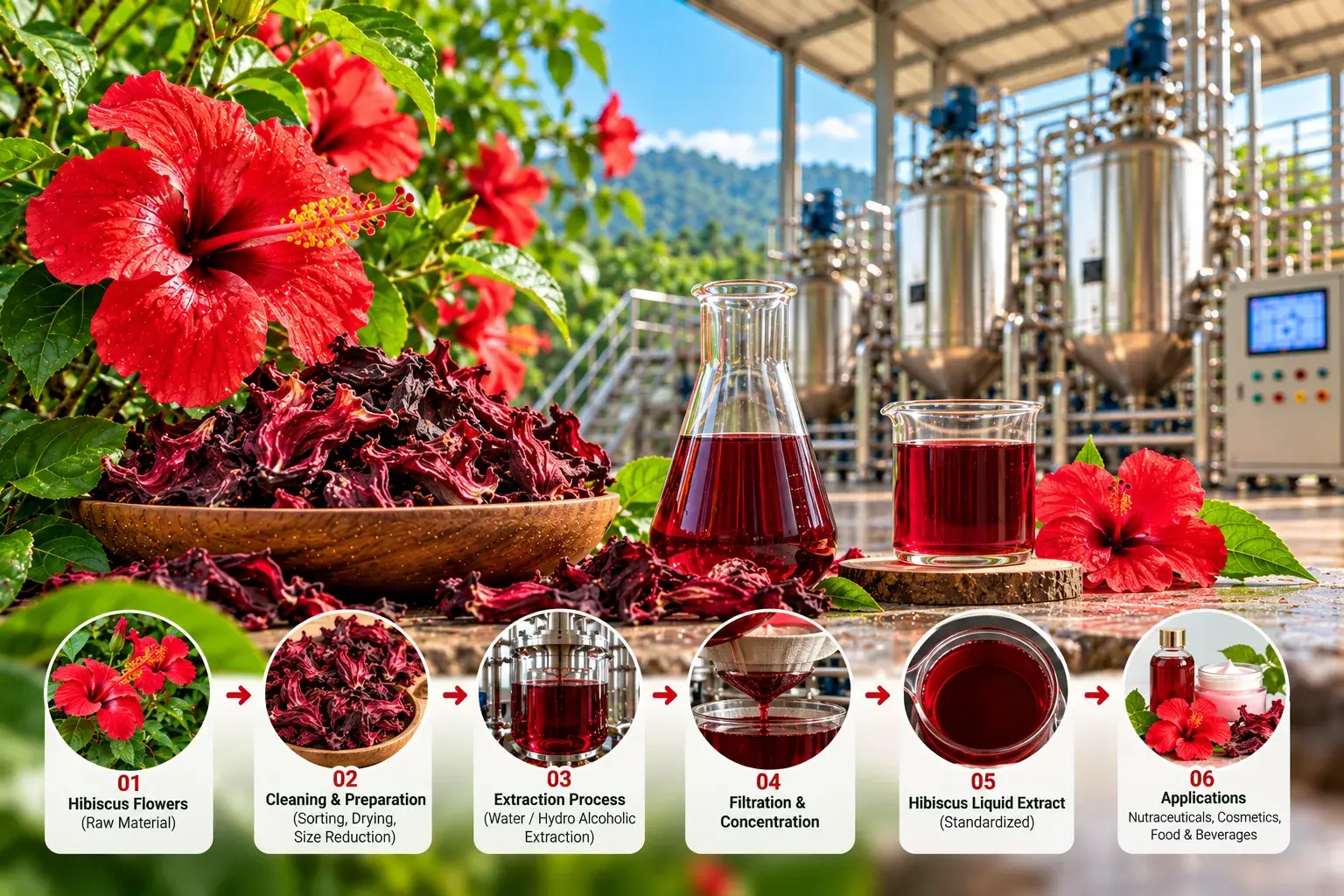
Hibiscus flowers or calyces are sorted, cleaned of dust and foreign matter and, where required, crushed or milled so the pigment or mucilage is released evenly into the extraction medium. Species, form and moisture are confirmed with the client.
Extraction
The prepared material is extracted with a food-grade alcohol / aqueous solvent in closed jacketed SS 316L extractors at controlled temperature over multiple cycles. For calyx mucilage and anthocyanins, subcritical water and enzyme-assisted routes are the screened alternatives.
Filtration & Clarification
The extract is clarified through a plate-and-frame filter press followed by cartridge polish filters, or by filtration or centrifugation on the water-based routes.
Concentration & Solvent Recovery
The clarified extract is concentrated in a falling-film / vacuum evaporator so heat exposure of the pigment stays low, with solvent recovered through the condenser return system.
Standardisation
The concentrate is assayed against the customer-declared target, such as colour strength for the colour extract, and adjusted before the finishing step.
Drying
Where a powder is required, the standardised extract is spray- or vacuum-dried; otherwise it is supplied as a liquid concentrate.
Quality Control & Release
Batches are released after the agreed assay, residual-solvent, heavy-metal, microbial and moisture tests, with test methods defined during process development.
Major Plant Equipment
- Raw material cleaning and size-reduction system
- Closed jacketed SS 316L extraction vessels
- Solvent storage tanks
- Plate-and-frame filter press
- Cartridge polish filtration
- Falling-film / vacuum evaporator
- Solvent recovery unit and condensers
- Standardisation / blending vessel
- Spray dryer or vacuum dryer (where a powder is required)
- Jacketed enzyme reaction vessel with pH and temperature control (enzyme-assisted route)
- CIP (clean-in-place) system
- PLC-based automation and instrumentation
Plant Output
Applications
- Natural colour and dye ingredient supply
- Food and beverage colour applications (subject to approval of the specific colour in each market)
- Cosmetic and personal-care colour applications
- Nutraceutical and Ayurvedic / herbal formulations
- Weight-management and metabolic-health formulations (hibiscus liquid extract)
- Pharmaceutical standardised ingredient supply
Key Features
Three Catalogued Hibiscus Routes
Colour extraction, standardised liquid extract and calyx mucilage with anthocyanins each have their own catalogue page, so the route is matched to the ingredient you want to sell.
pH-Aware Extraction
Anthocyanins are water-soluble and strongly pH-responsive. Extraction medium, acidity and temperature are set during process development to hold the red to reddish-purple shade.
Gentle Vacuum Concentration
A falling-film / vacuum evaporator limits heat exposure of temperature-sensitive colour compounds, with closed-loop solvent recovery returning solvent for reuse.
SS 316L Hygienic Construction
Electropolished SS 316L product-contact surfaces with CIP operation between batches, designed for hygienic operation with documentation to support the customer's qualification.
Pilot Before Commitment
Raw-material feasibility and pilot trials can be run through the Botanical Process Development Centre with Sureka Life Sciences before the plant is configured.
Frequently Asked Questions
What does a hibiscus extraction plant produce?
Which hibiscus route should I choose?
What do you need to know about my hibiscus raw material?
Does Mechotech supply hibiscus drying, sorting or powder-milling lines?
Can the hibiscus extract be spray dried to a powder?
Can we trial our hibiscus before committing to a plant?
What is included in a turnkey hibiscus plant?
What should I send to get a hibiscus plant quote?
Project Enquiry Pages
Country pages that include this equipment among their project areas:
Ready to discuss your project?
Get a free quote and technical consultation from our engineering team.