Solvent Recovery System
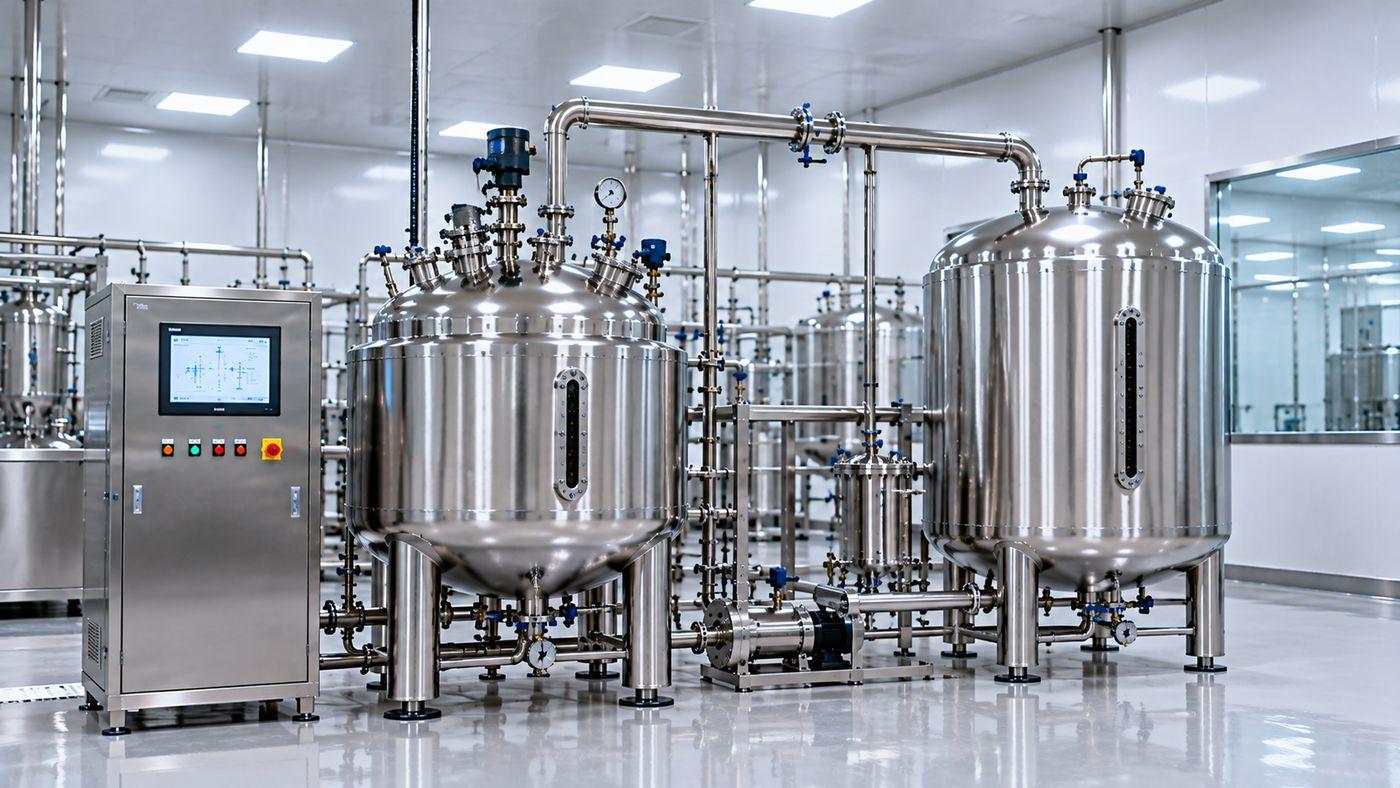
Solvent Recovery System
Mechotech designs and manufactures the Solvent Recovery Distillation Plant as turnkey process equipment that reclaims process solvent — from extraction, washing, or reaction operations — and returns it to a reusable grade instead of it being discharged as waste. Built around a straightforward still or multi-stage column paired with a condenser and receiver, the plant is engineered as a closed-loop system with explosion-proof electricals, inert-gas blanketing, and vapour-containment measures suited to flammable solvents, so recovered solvent can be routed straight back into the process with minimal fresh-solvent make-up.
Spent solvent — typically carrying dissolved solids, moisture, colour bodies, or residual product — is charged to the still and heated so the clean solvent fraction vaporises away from the non-volatile residue, then condenses back to a purified liquid in the condenser for collection. Where the process handles a single solvent, a simple single-stage still is sufficient; where two or more solvents must be split and each recovered to its own specification, a multi-stage column with reflux is added. Because the recovered solvents are frequently flammable (ethanol, hexane, acetone, and similar), the plant is engineered as a sealed, closed-loop system with nitrogen blanketing, flame-proof instrumentation, and vent/vapour-recovery provisions built in from the design stage rather than added afterward. Mechotech fabricates the still, column (where fitted), condenser, and receiver train in SS 316L (or a process-appropriate grade) with electropolished product-contact surfaces, and controls heating, vacuum, and cut collection under PLC-based automation, with capacity and configuration engineered to the customer's solvent system and recovery target.
Process Flow
Technical Specifications
| Technology | Solvent recovery distillation — closed-loop reclamation of process solvent |
|---|---|
| Working Principle | Spent solvent is vaporised away from non-volatile residue, then condensed and returned to storage for reuse |
| Configuration | Single-stage still (single solvent) or multi-stage column with reflux (multi-solvent split) |
| Operating Temperature | Configured to the solvent's boiling range and heat sensitivity |
| Operating Vacuum | Configurable for heat-sensitive solvents and energy efficiency |
| Product-contact Material | SS 316L (or process-appropriate grade), electropolished |
| Safety Design | Flame-proof electricals, nitrogen/inert-gas blanketing, sealed vapour-containment circuit |
| Solvent Recovery | Depends on solvent stream, feed quality and cut specification; established during process development |
| Automation | PLC-based control of heating, vacuum, and cut collection with batch data logging |
| Capacity | Configured to requirement — pilot to commercial |
| Utilities | Steam/thermic fluid or electric heating, cooling water, nitrogen, power, compressed air |
| Compliance | GMP hygienic design; full documentation for qualification |
| Final Output | Purified, reusable process solvent with concentrated residue for disposal |
Plant Capacities
| Scale | Typical Duty | Still/Column Configuration | Operating Mode |
|---|---|---|---|
| Pilot | Solvent-recovery process validation | Single-stage still | Atmospheric or vacuum (configurable) |
| Small commercial | Single-solvent recovery for reuse | Single-stage still with condenser | Atmospheric or vacuum (configurable) |
| Commercial multi-solvent | Recovery train splitting two or more solvents | Multi-stage column with reflux | Vacuum-capable for heat-sensitive solvents |
Still/column size, condenser duty, and vacuum rating are engineered to the specified solvent system, feed volume, and recovery target; exact capacity is confirmed during process design.
Manufacturing Process
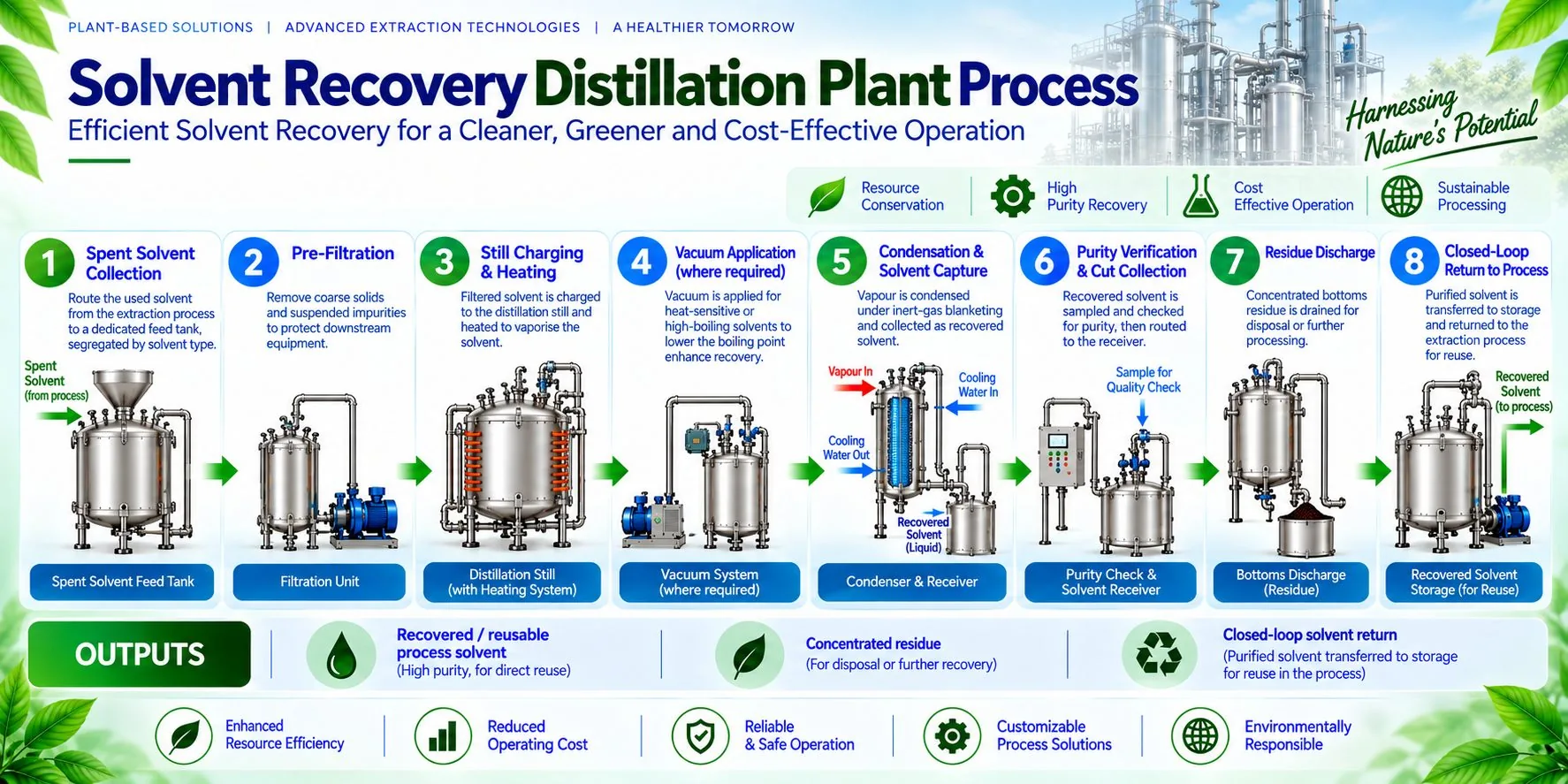
Spent Solvent Collection
Solvent recovered from extraction, washing, or reaction stages is routed to a dedicated feed tank, with streams segregated by solvent type to protect recovery quality.
Pre-Filtration
Coarse solids, marc, or sludge are removed ahead of the still to protect heating surfaces and reduce fouling during distillation.
Still Charging & Heating
The filtered feed is charged to the recovery still and heated so the clean solvent fraction vaporises while non-volatile residue and dissolved solids remain behind.
Vacuum Application (where required)
For heat-sensitive or high-boiling solvents, vacuum is drawn to lower the operating temperature and reduce thermal stress on the solvent and any residual product.
Condensation & Solvent Capture
Solvent vapour is condensed in a closed shell-and-tube condenser under inert-gas blanketing, capturing the recovered solvent while minimising vapour loss to atmosphere.
Purity Verification & Cut Collection
Recovered solvent is checked against its reuse specification and routed to the appropriate receiver, with off-spec cuts diverted for reprocessing.
Residue Discharge
Concentrated bottoms residue is drained from the still base for disposal or further recovery, and the vessel is prepared for the next batch.
Closed-Loop Return to Process
Purified solvent is transferred to storage for direct reuse in the originating extraction, washing, or reaction step, closing the solvent loop.
Major Plant Equipment
- Spent-solvent feed tank
- Pre-filtration system
- Recovery still / reboiler
- Multi-stage rectification column (where fitted)
- Reflux divider and control (multi-stage configuration)
- Shell-and-tube condenser
- Nitrogen/inert-gas blanketing system
- Recovered-solvent receiver vessels
- Vacuum system (for vacuum-mode operation)
- Residue collection and discharge system
- Flame-proof electricals and instrumentation
- PLC/HMI control panel
Plant Output
Applications
- Recovery of extraction solvent for reuse in botanical and herbal extraction plants
- Reclamation of washing and rinsing solvents from pharmaceutical process lines
- Recovery of reaction-stage solvents in API and fine-chemical manufacturing
- Closed-loop solvent management for flammable solvents such as ethanol, hexane, and acetone
- Reduction of fresh-solvent purchase and hazardous-waste disposal volumes
- Solvent recovery in nutraceutical concentrate and standardised-extract production
- Recovery trains supporting the customer's emission and solvent-management practice
- Pilot-scale solvent-recovery validation ahead of commercial plant sizing
Key Features
Closed-Loop Recovery Design
The still, condenser, and receiver form a sealed circuit engineered to return recovered solvent directly to the process, minimising vapour loss and fresh-solvent make-up.
Explosion-Proof, Flammable-Solvent-Ready Construction
Flame-proof electricals, nitrogen blanketing, and vapour-containment provisions are built into the design for safe handling of flammable process solvents.
Single or Multi-Stage Recovery
A simple single-stage still handles single-solvent recovery, while a multi-stage column with reflux is added where two or more solvents must be split and recovered separately.
Vacuum Operation for Sensitive Solvents
Configurable vacuum lowers operating temperature to protect heat-sensitive solvents and any entrained product residue from thermal degradation.
Hygienic SS 316L Construction
Electropolished SS 316L product-contact surfaces designed for hygienic operation, with the vessel cleaned in place (CIP) between batches; documentation supports the customer's GMP qualification.
PLC-Based Recovery Control
Heating, vacuum, and cut collection are managed under automated control with batch data logging for repeatable recovery quality and traceability.
Frequently Asked Questions
What does a Solvent Recovery Distillation Plant do?
Is this a single still or a multi-stage column?
How is flammable-solvent safety handled?
What recovery rate can be expected?
Where does this plant fit relative to Mechotech's other distillation equipment?
What capacity can Mechotech supply?
Does Mechotech provide turnkey design, installation, and commissioning?
Ready to discuss your project?
Get a free quote and technical consultation from our engineering team.