Industrial Peptide Synthesiser
Industrial Peptide Synthesiser
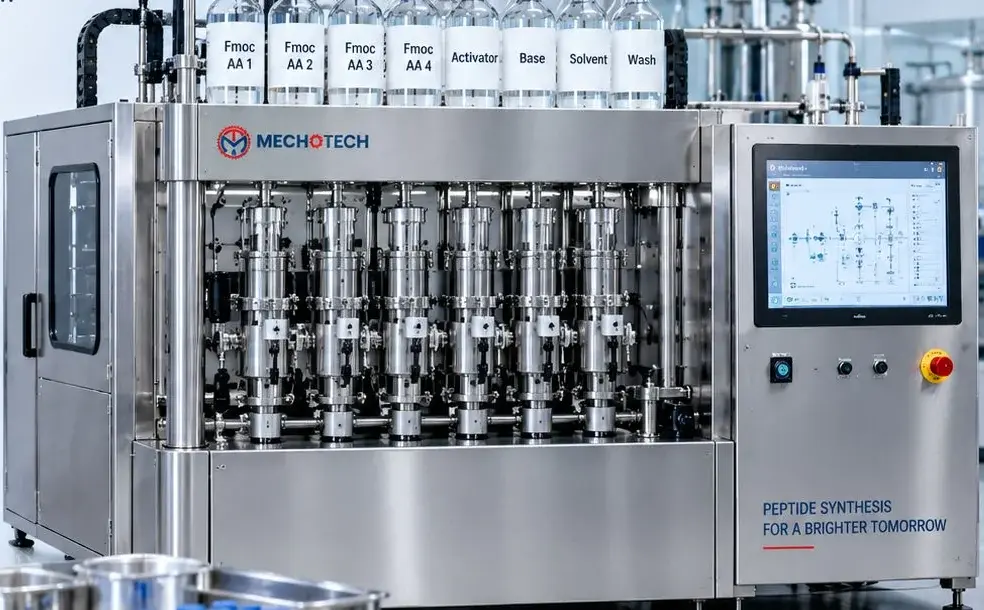
Mechotech designs and manufactures industrial peptide synthesisers for production-scale solid-phase peptide synthesis (SPPS). Mechotech lists peptide synthesisers in laboratory and industrial versions; this page covers the industrial version, built around an agitated reaction vessel in which the resin-bound peptide is assembled through automated coupling, deprotection and wash cycles. Vessel volume, materials of construction, hazardous-area construction and automation level are configured to the customer’s peptide, batch size and facility. The synthesiser sits at the front of Mechotech’s peptide synthesis and purification line, ahead of preparative HPLC, concentration, lyophilisation and solvent recovery.
A Mechotech industrial peptide synthesiser is configured around an agitated reaction vessel served by metered liquid dispensing, so that each coupling, deprotection and wash addition is delivered in sequence under recipe control. Options that are specified per project include jacketed temperature control, inert-gas (nitrogen) pressure transfer of reagents, online flow metering on solvent and reagent lines, a clean-in-place (CIP) system, an optional cleavage module and EX-proof or standard construction, with local and remote control. The SPPS chemistry strategy (Fmoc or t-Boc), the reactor volume and the control and documentation scope are confirmed with the client during project definition.
Technical Specifications
| Product | Industrial Peptide Synthesiser |
|---|---|
| Technology | Industrial solid-phase peptide synthesis (SPPS) |
| Synthesis Strategy | Fmoc or t-Boc SPPS chemistry, selected for the peptide and confirmed with the client |
| Reaction Vessel | Agitated reaction vessel; volume configured to batch size and product |
| Temperature Control | Jacketed heating / cooling, where specified |
| Reagent Feed | Metered liquid dispensing; inert-gas (nitrogen) pressure transfer where specified |
| Flow Measurement | Online flow metering on solvent / reagent lines, where specified |
| Cleaning | Clean-in-place (CIP) system, where specified |
| Cleavage Unit | Optional module |
| Hazardous-Area Construction | EX-proof or standard construction; rating and certification specified and confirmed per project and facility classification |
| Control | Local and remote control; audit-trail / electronic-record scope confirmed with the client |
| Product-contact Material | Stainless steel 316L or chemically resistant lining, per product and solvent system |
| Plant Capacity | Configured to requirement |
| Compliance | GMP hygienic design; full documentation for qualification |
| Output | Resin-bound crude peptide; crude peptide after the optional cleavage module, for downstream purification |
Plant Capacities
| Plant Scale | Reactor Volume | Typical Use |
|---|---|---|
| Pilot | Configured to your peptide and trial plan | Process development, parameter validation |
| Semi-Commercial | Configured between pilot and commercial scale | Scale-up trials, contract manufacturing |
| Commercial | Configured to confirmed batch size and product volume | Production-scale peptide manufacturing |
Reactor volume is configured to the peptide, batch size and facility. The metering, flow measurement, CIP, temperature control, hazardous-area construction and optional cleavage unit are scaled to the confirmed reactor.
Manufacturing Process
Resin Charging & Swelling
Resin is loaded into the reaction vessel and swelled in solvent under agitation, forming the support on which the peptide chain is assembled.
Reagent Transfer
Amino-acid, activator, deprotection and wash solutions are transferred to the vessel through metered lines, by inert-gas pressure where specified, with online flow metering where fitted.
Coupling
The activated amino acid is dosed into the vessel and mixed under temperature control where specified, forming the amide bond to the resin-bound chain.
Solvent Washing
Programmed solvent washes flush excess reagents and by-products from the resin bed between steps.
Deprotection
The temporary N-terminal protecting group is removed under controlled time and temperature so the amine is ready for the next coupling cycle.
Cycle Repetition
Coupling, washing and deprotection repeat for every residue in the sequence under recipe control, with step data recorded by the control system.
Clean-in-Place
Where a CIP system is specified, it cleans the vessel and internals between batches to help prevent carry-over; cleaning-validation requirements are defined with the client.
Cleavage (Optional Module)
The optional cleavage module releases the peptide from the resin and removes side-chain protection, delivering crude peptide for downstream purification.
Major Plant Equipment
- Agitated reaction vessel (jacketed where specified)
- Metered liquid dispensing system
- Inert-gas (nitrogen) pressure-transfer system, where specified
- Online flow meters on solvent and reagent lines, where specified
- Reagent, solvent and wash vessels
- Clean-in-place (CIP) system, where specified
- Optional cleavage module
- Local and remote control system
Plant Output
Applications
- Peptide active pharmaceutical ingredient (API) manufacturing
- Clinical-batch and production-scale peptide manufacturing
- Contract development and manufacturing (CDMO) of peptides
- Scale-up of validated research sequences
Key Features
Configurable Reactor Volume
The reaction vessel is sized to the peptide, batch size and facility rather than to a fixed catalogue volume.
Metered Reagent Delivery
Metered liquid dispensing, with inert-gas pressure transfer and online flow metering where specified, delivers each addition in sequence under recipe control.
Temperature-Controlled Steps
A jacketed vessel, where specified, holds coupling and deprotection steps at their set temperature.
Clean-in-Place Option
A CIP system, where specified, cleans the vessel and internals between batches to help prevent carry-over.
EX-Proof or Standard Construction
Hazardous-area (EX-proof) or standard construction is specified per project and facility classification, with local and remote control.
Optional Cleavage Module
An optional module releases the peptide from the resin and removes side-chain protection, so crude peptide can pass to purification.
Frequently Asked Questions
What is an industrial peptide synthesiser?
What reactor sizes are available?
What compliance and documentation support is available?
Can it be used in a hazardous area?
Does it include cleavage of the peptide from the resin?
How is the vessel cleaned between batches?
Which SPPS chemistry does the synthesiser use?
How does this industrial synthesiser differ from the laboratory peptide synthesiser?
What equipment follows the peptide synthesiser?
Does Mechotech supply it turnkey?
Ready to discuss your project?
Get a free quote and technical consultation from our engineering team.