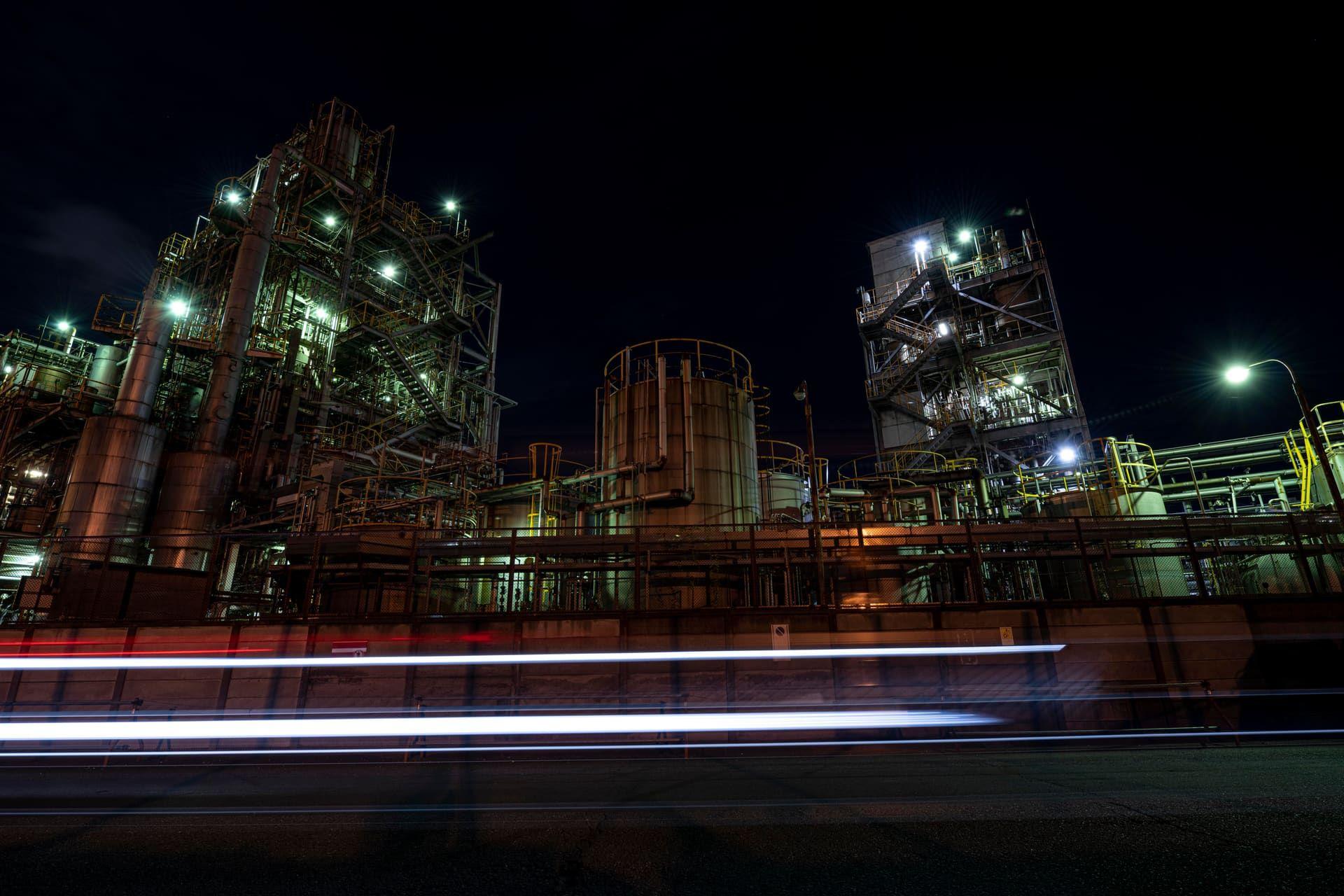
Counter-Current Extraction (CCE) Plant
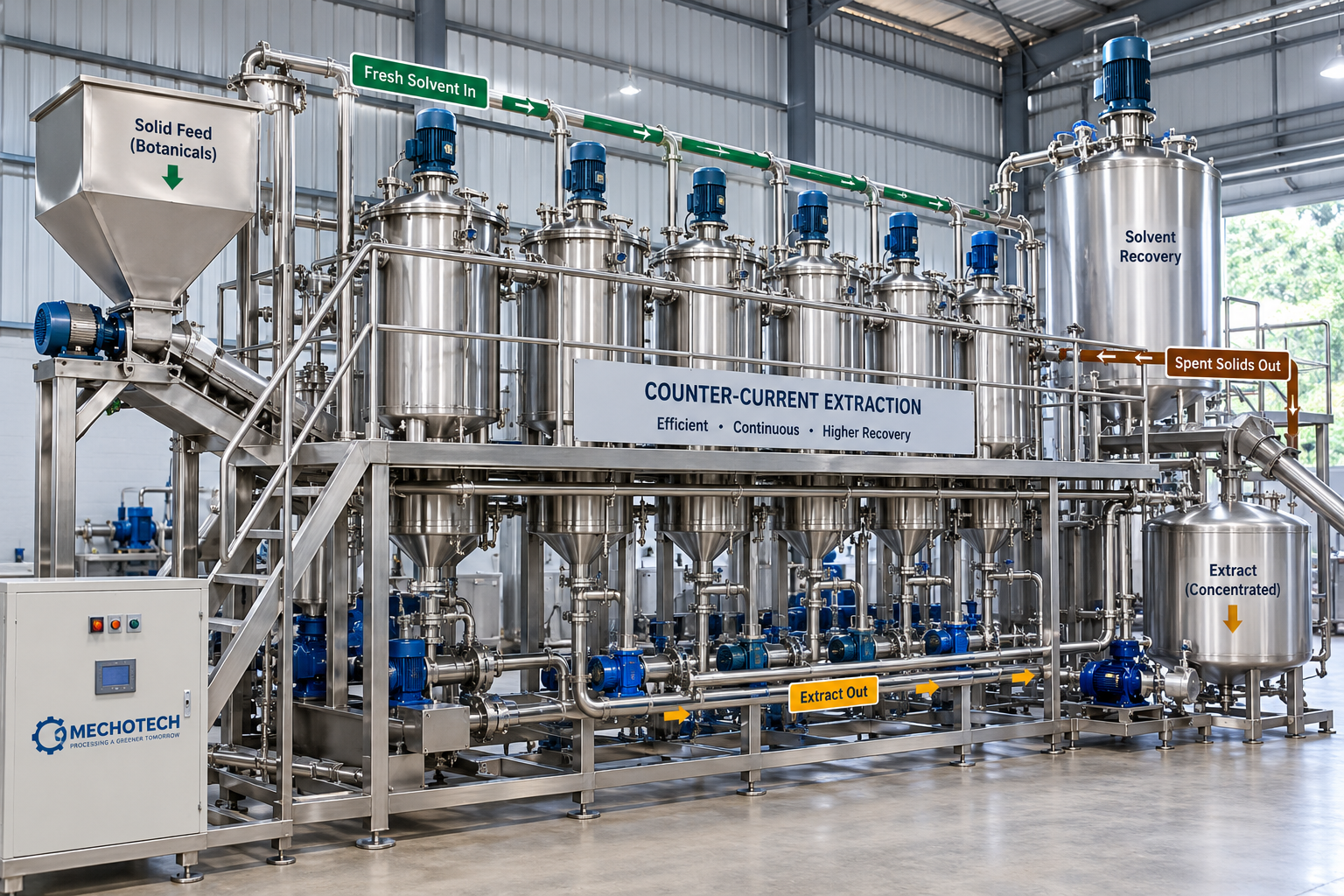
Counter-Current Extraction (CCE) Plant
Counter-Current Extraction (CCE) moves feed material and solvent through a series of connected extraction stages in opposing directions, so the freshest, most concentrated solvent gradient always meets the material at the stage where it will do the most good. This staged, opposing-flow arrangement sustains a higher concentration gradient across the whole extraction train than a single-vessel soak can achieve, giving solvent-efficient, consistent recovery at commercial throughput. Mechotech engineers turnkey counter-current extraction systems configured to each feedstock, solvent and target compound.
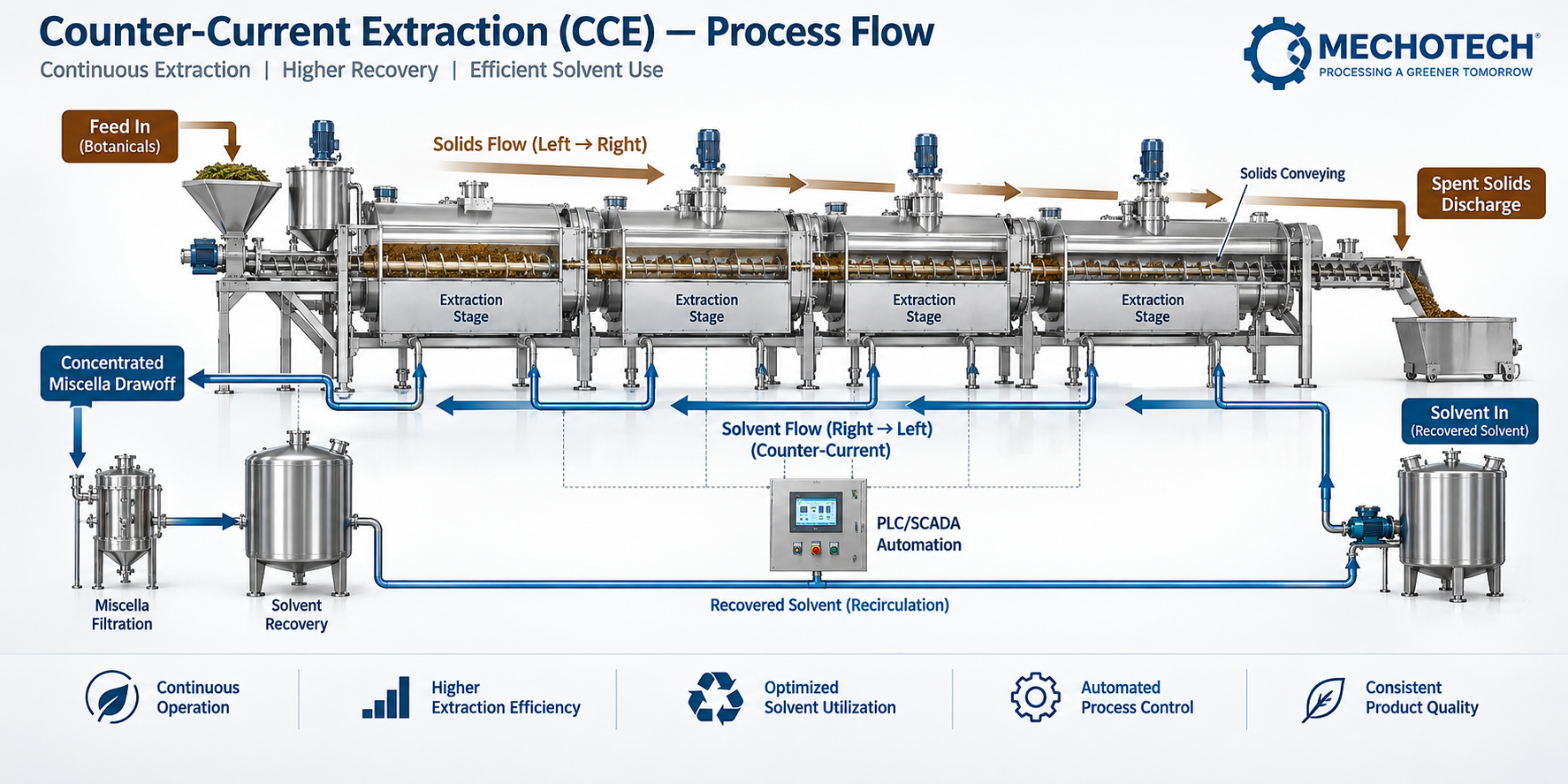
In a counter-current extraction plant, prepared feed advances progressively through multiple linked extraction stages while solvent is introduced at the discharge end and flows in the opposite direction. At each stage the solids contact a solvent stream that is progressively fresher than the miscella it displaces, so the leanest solvent finishes off the most-exhausted material and the richest miscella is drawn off where it has contacted the freshest feed. This opposing-flow, multi-stage arrangement is what distinguishes CCE from a single-pass or single-vessel batch soak, and it is the same underlying principle Mechotech applies across its counter-current and continuous extraction equipment. Mechotech fabricates the extraction stages, solids-conveying mechanism, solvent distribution manifold and miscella collection train in SS 304 with product-contact SS 316L to hygienic, GMP-oriented standards, with PLC/SCADA control of feed rate, solvent flow and stage residence time. Capacity and stage configuration are engineered to the customer's feedstock and target throughput.
Process Flow
Technical Specifications
| Technology | Counter-Current Extraction (CCE) — multi-stage, opposing-flow solid-liquid extraction |
|---|---|
| Working Principle | Feed and solvent move through multiple linked stages in opposing directions, maximising the concentration-gradient driving mass transfer at each stage |
| Stage Configuration | Multiple sequential extraction stages, number and residence time configured to feedstock and target yield |
| Solids Conveying | Screen, basket or auger conveying mechanism (configurable to feedstock) |
| Solvent | Water, ethanol, hexane, hydro-alcoholic or other process-grade solvents (as applicable to the target compound) |
| Product-contact Material | SS 304 / SS 316L, electropolished |
| Miscella Handling | In-line filtration and clarification ahead of downstream concentration |
| Solvent Recovery | Integrated recirculation of recovered solvent to the counter-current stage train |
| Automation | PLC/SCADA (configurable) with feed-rate, solvent-flow and stage-residence-time control |
| Capacity | Configured to process requirement — pilot to commercial, pilot validation recommended before scale-up |
| Utilities | Electric power, solvent-handling and recovery utilities, compressed air |
| Compliance | GMP / WHO-GMP hygienic design |
| Final Output | Concentrated miscella; spent solids discharged per the configured stage cycle |
Manufacturing Process
Feed preparation & intake
Prepared feed material is metered into the first extraction stage at a controlled rate, sized to the feedstock's particle size and bed permeability.
Staged solids conveying
A conveying mechanism — screen, basket or auger, selected to the feedstock — advances the solids through successive extraction stages at a controlled residence time per stage.
Counter-current solvent introduction
Solvent is introduced at the discharge end of the stage train and flows opposite to the solids' direction of travel, establishing the opposing-flow concentration gradient that defines counter-current operation.
Stage-wise contact & mass transfer
At each stage, solvent percolates through or contacts the solid bed, progressively dissolving target compounds as the material advances toward discharge and the solvent advances toward the richest end.
Miscella drawoff
Concentrated solvent-and-extract solution (miscella) is drawn off at the feed-entry end, where it has contacted the freshest material and reached its highest concentration for that stage configuration.
Spent-solids discharge
Extracted, solvent-wet solids are discharged from the far end of the stage train for downstream desolventising or disposal, as configured to the process.
Miscella filtration & clarification
Drawn-off miscella passes through filtration to remove fines before being routed to downstream concentration and solvent-recovery stages.
Solvent recovery & recirculation
Recovered solvent from downstream evaporation is returned to the extraction train's solvent-in stage, sustaining the counter-current loop and reducing fresh-solvent consumption.
Major Plant Equipment
- Feed intake and metering system
- Multi-stage extraction body
- Solids-conveying mechanism (screen, basket or auger, configurable)
- Counter-current solvent distribution manifold
- Miscella drawoff and collection manifold
- In-line miscella filtration
- Spent-solids discharge system
- Solvent recovery and recirculation interface
- PLC/SCADA automation
Plant Output
Turnkey Line
Counter-Current Extractor
See the complete end-to-end plant and the equipment at each stage.
Applications
- Multi-stage botanical and herbal extraction requiring solvent-efficient recovery
- Oilseed and vegetable-oil extraction at commercial throughput
- Oleoresin and spice-extract production with staged solvent contact
- Nutraceutical actives extraction where consistent, gradient-driven recovery is required
- Protein-meal and de-oiled cake processing
- Scale-up production lines moving from single-vessel batch soak to staged counter-current operation
- Applications evaluated case-by-case for feedstock permeability and stage count
Key Features
Opposing-flow concentration gradient
Solvent and feed travel in opposite directions across the stage train, maximising the concentration gradient driving mass transfer at every stage compared with a single-vessel soak.
Multi-stage, configurable train
The number of extraction stages, conveying mechanism and per-stage residence time are configured to the feedstock, target yield and required throughput.
Solvent-efficient recovery
Because the leanest solvent meets the most-exhausted material, less fresh solvent is typically needed per unit of extract recovered than in repeated single-vessel soaks.
Integrated solvent recovery loop
Recovered solvent is recirculated to the counter-current stage train, reducing fresh-solvent consumption and supporting closed-loop operation.
Hygienic, GMP-oriented build
Product-contact parts in SS 316L with smooth, CIP-friendly finishes support pharmaceutical, nutraceutical and food-grade production.
Full automation & stage control
PLC/SCADA control of feed rate, solvent flow and per-stage residence time with batch/run logging supports repeatable, traceable operation.
Frequently Asked Questions
What is Counter-Current Extraction (CCE)?
How does counter-current extraction work?
How is this different from Mechotech's Counter-Current Extractor and Continuous Extractor?
What are the advantages of counter-current extraction compared with a single-vessel batch soak?
What feedstocks and solvents suit counter-current extraction?
What capacity and stage configuration can Mechotech supply?
What material of construction and compliance does Mechotech use?
Does Mechotech provide turnkey design, manufacture, installation and commissioning?
Ready to discuss your project?
Get a free quote and technical consultation from our engineering team.