Resin Adsorption / Desorption
Resin Adsorption / Desorption
Resin adsorption and desorption is a purification technology in which a liquid extract is passed through a bed of adsorbent or ion-exchange resin that binds target compounds or impurities, which are then released in a controlled desorption step. In an extraction line it typically sits after clarification, to enrich a target fraction, remove pigments and unwanted solutes, or concentrate a dilute stream into a refined eluate at low thermal load. Mechotech designs and manufactures resin adsorption and desorption systems, supplying engineered columns, tanks and a control panel for pharmaceutical, nutraceutical, food and botanical extraction lines. The resin, the binding mechanism and the cycle are selected on the client’s feed in pilot trials.
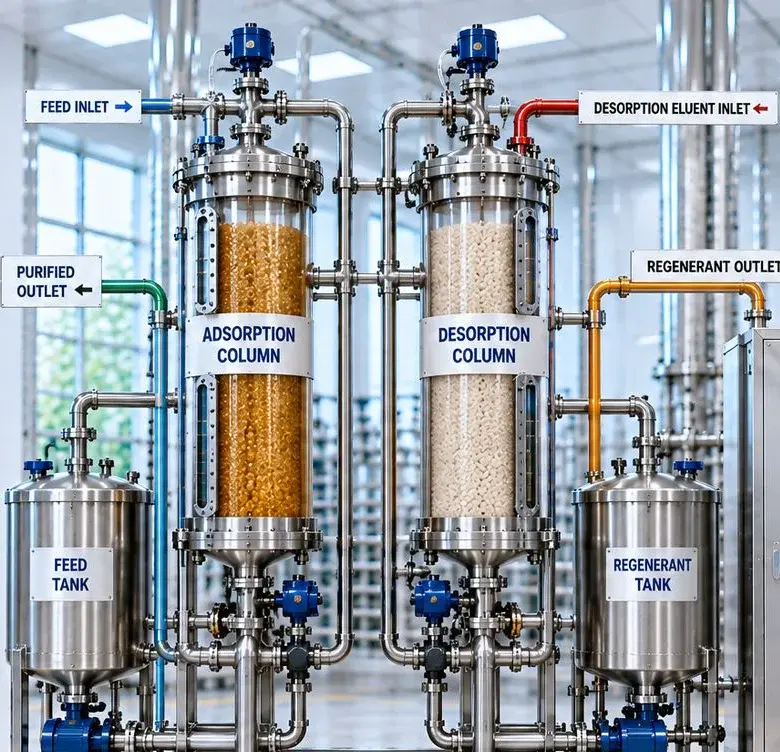
A resin adsorption and desorption system loads clarified feed onto a packed resin column where target molecules or impurities bind to the resin, for example by hydrophobic interaction, ion exchange or size selectivity, after which a change in solvent, pH or ionic strength releases the bound species as a more concentrated eluate. As labelled on the page’s original illustration, a typical skid has a feed tank, an adsorption column, a desorption column, a regenerant tank and a control panel, with PLC-based sequencing of loading, washing, elution and regeneration. Product-contact parts are SS 316L with sanitary, cleanable flow paths. Column volume, resin type and capacity are configured to the client’s feed and requirement rather than a fixed model, and no purity, recovery or concentration figures are quoted on this page.
Technical Specifications
| Technology | Resin adsorption and desorption (sorption-based purification) |
|---|---|
| Working Principle | Target species or impurities bind to a packed resin bed, then are released under a changed solvent, pH or ionic strength as an eluate |
| Resin Types | Macroporous adsorbent and cation- or anion-exchange resins, selected on trials with the client’s feed |
| Binding Mechanisms | Hydrophobic interaction, ion exchange and size selectivity, depending on the resin |
| Separation Function | Purification, decolourisation, desalting and concentration, as the application requires |
| Typical Configuration | Feed tank, adsorption column, desorption column, regenerant tank, pumps and a control panel; the configuration is selected to the duty |
| Product-contact Material | SS 316L; column construction and any sight sections confirmed per project |
| Automation | PLC-based sequencing of load, wash, elute and regenerate (configurable) |
| Capacity | Configured to requirement — column volume and resin type set on the client’s feed |
| Utilities | Electrical power, eluent and regenerant supply, CIP and rinse media as applicable |
| Compliance | GMP hygienic design; full documentation for qualification |
| Output | Purified, decolourised or concentrated eluate, depending on the application |
Plant Capacities
| Scale | Typical Duty | Configuration |
|---|---|---|
| Pilot | Resin screening, binding-capacity and elution trials on the actual feed | Small column with feed and eluent tanks and a control panel |
| Production | Plant-scale purification or decolourisation of a confirmed feed | Column volume, resin type and cycle configured to the confirmed throughput |
| Large commercial | Larger throughput | Larger columns and tanks, or several columns in sequence, sized to the duty |
Column volume, resin type and throughput are configured to the feed and purity requirement; a pilot trial is recommended to confirm binding capacity, elution and regeneration parameters before scaling.
Manufacturing Process
Resin Conditioning
The packed resin bed is pretreated and equilibrated to the pH and ionic state the method needs, so it can bind selectively.
Feed Loading and Adsorption
Clarified extract is passed through the column and the target species or impurities bind to the resin.
Washing
A wash step displaces loosely held impurities and non-target solutes while the bound species remain on the resin.
Desorption / Elution
A change in solvent, pH or ionic strength releases the bound species as an eluate collected for downstream processing.
Fraction Collection
Eluate is collected in cuts so the target fraction can be separated from the leading and trailing portions.
Resin Regeneration
The bed is cleaned and regenerated to restore its adsorption capacity for the next cycle.
Major Plant Equipment
- Feed tank
- Adsorption column with resin bed
- Desorption column
- Eluent and regenerant tanks
- Feed, eluent and regenerant pumps
- Valves, piping and flow instrumentation
- CIP and rinse connections
- PLC-based control panel
Plant Output
Applications
- Purification and enrichment of polyphenols, flavonoids and glycosides from botanical extracts
- Decolourisation and removal of pigments from crude extracts
- Concentration of dilute actives into a refined eluate
- Desalting and removal of ionic impurities by ion-exchange resin
- Selective capture of alkaloids and other target compounds from botanical feeds
- Fractionation of marker compounds for nutraceutical extracts
Key Features
Selective Capture
Adsorbent and ion-exchange resins are chosen to bind specific target compounds or impurities; the selection is made on trials with the client’s feed.
Decolourisation
Resins can remove pigments and coloured bodies from extracts, improving appearance and downstream handling.
Concentration and Enrichment
Controlled desorption releases captured compounds in a smaller eluate volume than the feed.
Automated Cycle Control
PLC-based sequencing of loading, washing, elution and regeneration.
Hygienic SS 316L Design
SS 316L wetted parts with cleanable flow paths support GMP hygienic design and CIP.
Frequently Asked Questions
What is resin adsorption / desorption?
How does resin adsorption / desorption work?
Where does resin adsorption / desorption fit in an extraction or purification line?
How is the resin chosen?
What capacity of resin system can Mechotech supply?
What materials and compliance standards apply?
How does resin adsorption differ from membrane filtration and chromatography?
Does Mechotech supply the resin adsorption / desorption plant as a turnkey system?
Ready to discuss your project?
Get a free quote and technical consultation from our engineering team.