Crystallization System
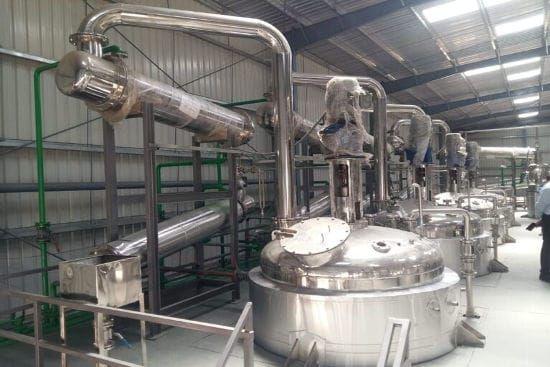
Crystallization System
Crystallization is a solid-liquid separation and purification technique in which a dissolved product is brought out of solution as an ordered crystalline solid, rejecting impurities that remain in the mother liquor. By generating and controlling supersaturation, the process delivers a high-purity crystal with a defined size, shape and moisture content, making it one of the most effective purification steps in fine-chemical, pharmaceutical, food and specialty processing. Because impurities are excluded during crystal growth, a single crystallization stage often achieves purities that would otherwise need several purification operations. Mechotech engineers turnkey crystallization systems designed around each product's solubility behaviour and target crystal specification.
A crystallization system works by driving the solution into a supersaturated state through controlled cooling, solvent evaporation, vacuum flash cooling, or anti-solvent addition, so that nucleation and crystal growth proceed in a regulated manner. Precise control of temperature, agitation, residence time and seeding governs crystal size distribution, purity and yield, while the rejected impurities stay in the mother liquor for downstream recovery. The result is a consistent, free-filtering product with high chemical purity, strong yield and reduced downstream drying load. Mechotech fabricates the crystallizer bodies, jackets, heat-transfer surfaces and agitation systems in SS 304 with product-contact SS 316L to hygienic, GMP-oriented standards, with PLC/SCADA control of cooling profiles, vacuum and agitation. Capacity, crystallization mode and construction are configured to the specific product and process requirement.
Technical Specifications
| Technology | Crystallization / controlled solid-liquid separation and purification |
|---|---|
| Working Principle | Controlled supersaturation drives nucleation and crystal growth that rejects impurities into the mother liquor |
| Crystallization Modes | Cooling, evaporative, vacuum and anti-solvent (configurable) |
| Operating Temperature | Configured to the product solubility curve and heat sensitivity |
| Operating Vacuum | Configurable for vacuum / evaporative crystallization duty |
| Product-contact Material | SS 304 / SS 316L |
| Agitation | Controlled low-shear agitation matched to crystal habit and size target |
| Automation | PLC/SCADA (configurable) with recipe management and batch data logging |
| Capacity | Configured to requirement - pilot to commercial |
| Utilities | Steam / thermic fluid or electric heating, chilled water, cooling water, vacuum, power, compressed air |
| Compliance | GMP / cGMP hygienic design |
| Final Output | High-purity crystalline solid at target size and moisture, with recyclable mother liquor |
Manufacturing Process
Feed preparation & clarification
The hot concentrated solution or melt is prepared and, where required, clarified to remove suspended solids. A clean feed prevents unwanted nucleation sites and protects final crystal purity.
Supersaturation generation
Supersaturation is created by controlled cooling, evaporation, vacuum flash cooling or anti-solvent addition. The chosen method is matched to the product's solubility curve and heat sensitivity.
Seeding & nucleation control
Seed crystals are introduced or nucleation is triggered within the metastable zone. Regulating this step sets the number of crystals and steers the final size distribution.
Controlled crystal growth
Gentle agitation and a programmed temperature or evaporation profile promote steady growth on existing crystals. Slow, uniform growth rejects impurities and produces well-formed crystals.
Slurry maturation
The crystal slurry is held under controlled conditions to complete growth and stabilise the crystal habit. Maturation improves filterability and narrows the size spread.
Solid-liquid separation
The slurry is separated from the mother liquor by centrifuge, nutsche or pressure filter. A wash step displaces residual mother liquor to lift final purity.
Washing & drying
The wet cake is washed and transferred to drying to reach target moisture. Efficient washing removes surface-adhering impurities before the product is dried.
Mother liquor recovery & cleanup
Mother liquor is recycled or concentrated to recover residual product and improve overall yield. CIP flushing then prepares the system for the next batch.
Applications
- Active pharmaceutical ingredients and intermediates
- Fine and specialty chemicals requiring high purity
- Food-grade acids, salts and sweeteners
- Amino acids, vitamins and nutraceutical solids
- Agrochemical and dyestuff intermediates
- Inorganic salts and mineral products
- Purification and de-coloring of crystalline products
- R&D, pilot studies and process scale-up
Key Features
High-purity crystal recovery
Controlled crystal growth rejects impurities into the mother liquor, so a single crystallization stage delivers high chemical purity from an impure solution.
Controlled crystal size distribution
Seeding, agitation and programmed supersaturation govern nucleation and growth, producing a consistent, free-filtering crystal with the target size and habit.
Multiple crystallization modes
Cooling, evaporative, vacuum and anti-solvent crystallization are configured to suit the product's solubility curve and thermal sensitivity.
Strong yield and mother-liquor recovery
Optimised operating profiles maximise recovery per batch, and mother-liquor recycling captures residual product to improve overall plant yield.
Hygienic, GMP-oriented build
Product-contact parts in SS 316L with smooth finishes and CIP-friendly design support pharmaceutical, nutraceutical and food-grade production.
Full automation & data logging
PLC/SCADA control of cooling rate, vacuum, agitation and seeding with recipe management and batch records ensures repeatable, traceable crystallization.
Frequently Asked Questions
What is a crystallization system?
How does crystallization work?
Where does crystallization fit in a process line?
What are the benefits of crystallization for purity and yield?
What capacity is available?
What material of construction and compliance does Mechotech use?
Does Mechotech provide turnkey design, manufacture, installation and commissioning?
Ready to discuss your project?
Get a free quote and technical consultation from our engineering team.