MVR Evaporator
MVR Evaporator
An MVR (mechanical vapour recompression) evaporator concentrates a liquid by boiling it and then reusing its own vapour. The vapour generated in the evaporator is drawn to a compressor or blower, recompressed to a higher pressure and temperature and returned as the heating medium for the same evaporator. The heat in the vapour is reused instead of being sent to a condenser, so the demand for externally supplied steam is lower than in a single-pass evaporator. Mechotech designs and manufactures turnkey MVR evaporators for pharmaceutical, nutraceutical, food and botanical process lines that need continuous concentration with reduced steam consumption. Each unit is configured to the client's feed, duty and utilities.
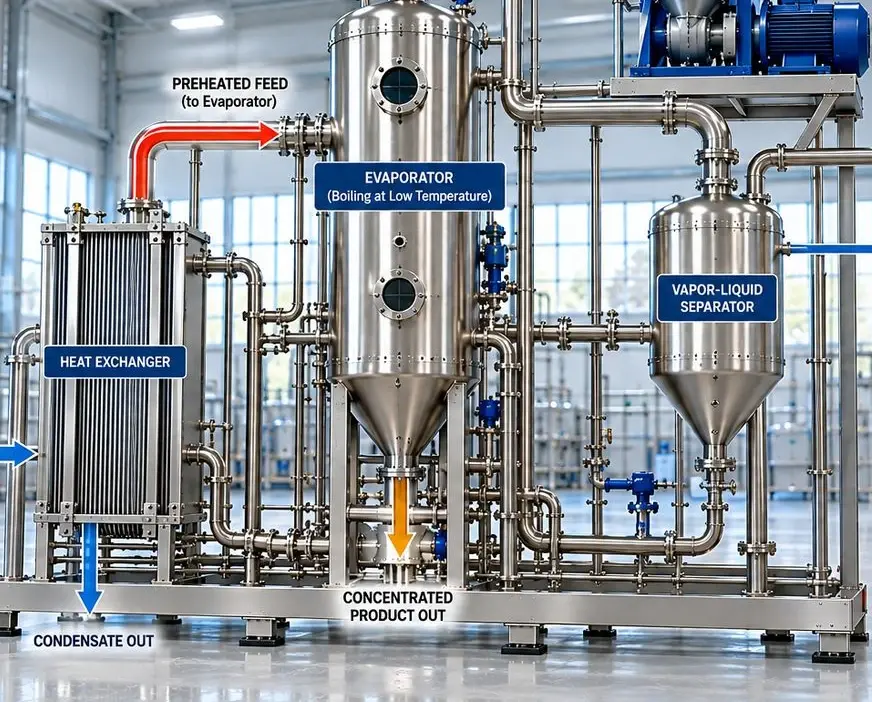
The MVR evaporator is built in SS 316L (or a process-appropriate grade) around an evaporator vessel, a vapour-liquid separator, a heat exchanger and a vapour compressor or blower, with electropolished product-contact surfaces. Feed is preheated and boiled at reduced pressure; the vapour is separated from the concentrate, recompressed and returned to the heating side, where it condenses and leaves as condensate, while non-condensable gases are vented to the vacuum system. Because the compressor is electrically driven, part of the energy duty moves from steam to electric power; whether that is the better choice depends on the feed, the duty and the local steam and power supply, and no saving figure is quoted on this page. Instrumentation and PLC-based control are integrated at assembly, the product-contact circuit can be cleaned in place, and the unit is delivered with documentation to support qualification. Capacity, compressor type and utilities are configured to the client's requirement and confirmed during process design and pilot validation.
Technical Specifications
| Product | MVR Evaporator |
|---|---|
| Technology | Mechanical vapour recompression (MVR) evaporation |
| Working Principle | Vapour generated in the evaporator is recompressed by a compressor or blower and returned as the heating medium, so its heat is reused |
| Vapour Compressor | Compressor or blower; type and duty configured to the evaporation load |
| Evaporator Arrangement | Evaporator vessel with vapour-liquid separator and heat exchanger; evaporator type (for example falling-film or forced-circulation) selected from the feed |
| Heating | Recompressed vapour; start-up and make-up heating arrangements configured to the duty |
| Operating Mode | Continuous operation, boiling at reduced pressure; pressure and temperature set during process design |
| Non-condensable Gases | Vented to the vacuum system |
| Product-contact Material | SS 316L (or process-appropriate grade), electropolished |
| Cleaning | CIP-capable product-contact circuit |
| Automation | PLC-based control with integrated instrumentation (SCADA configurable) |
| Capacity | Configured to requirement — pilot to commercial, with modular expansion |
| Utilities | Electric power for the compressor and drives, cooling water and vacuum utilities as configured; steam requirement depends on the configuration (project-specific) |
| Compliance | GMP hygienic design; full documentation for qualification |
| Output | Concentrated product and condensate |
Plant Capacities
| Scale | Typical Duty | Configuration |
|---|---|---|
| Pilot | Process validation and trial concentration duties | Small evaporator with a compressor or blower sized to the trial duty |
| Production | Plant-scale continuous concentration | Evaporator, separator and compressor configured to the evaporation load |
| Large commercial | High evaporation loads | Larger evaporator and compressor duty, with modular expansion |
Evaporation rate, heat-transfer area, compressor type and utilities are configured to the feed and the confirmed duty; a pilot trial on the actual feed is recommended before scaling.
Manufacturing Process
Feed Preheating
The cold feed passes through a heat exchanger and is preheated before it enters the evaporator.
Evaporation at Reduced Pressure
The feed boils in the evaporator under reduced pressure, so it concentrates at a lower temperature than at atmospheric pressure.
Vapour-Liquid Separation
The vapour is separated from the concentrate in a vapour-liquid separator; non-condensable gases are vented to the vacuum system.
Vapour Recompression
The compressor or blower raises the pressure and temperature of the vapour so that it can be used as the heating medium.
Heat Reuse
The recompressed vapour is returned to the heating side of the evaporator, where it condenses and releases its heat to the feed.
Concentrate & Condensate Discharge
The concentrated product is discharged for further processing and the condensate leaves the unit.
Clean-in-Place
The product-contact circuit is cleaned in place between runs.
Major Plant Equipment
- Evaporator vessel
- Vapour-liquid separator
- Heat exchanger for feed preheating and heating
- Vapour compressor or blower with drive
- Feed, circulation and concentrate discharge pumps
- Condensate receiver and pump-out
- Vacuum system for non-condensable gases
- CIP connections
- Instrumentation for temperature, pressure / vacuum, level and flow
- PLC-based control panel
Plant Output
Applications
- Pharmaceutical and nutraceutical process manufacturing
- Botanical and herbal extraction industries
- Food and flavour processing
Key Features
Vapour Heat Reuse
The evaporator's own vapour is recompressed and returned as the heating medium, which lowers the external steam demand; the extent depends on the feed and the duty.
Continuous Operation
The unit is configured for continuous concentration, with feed preheating and condensate discharge integrated.
Evaporator Matched to the Feed
The evaporator type is selected from the viscosity, heat sensitivity and fouling tendency of the feed.
Hygienic Construction
SS 316L (or process-appropriate grade) with electropolished product-contact surfaces and a CIP-capable circuit, with documentation to support GMP qualification.
Instrumented Control
PLC-based control with integrated instrumentation for temperature, pressure or vacuum and level.
Turnkey Engineering
Design, fabrication, installation and commissioning are delivered as one accountable scope.
Frequently Asked Questions
Does Mechotech supply the complete MVR Evaporator?
What is an MVR evaporator and how does it work?
Does an MVR evaporator use less steam?
How does an MVR evaporator differ from an MEE?
Which evaporator types can be used in an MVR system?
What utilities does an MVR evaporator need?
What capacities are available for the MVR Evaporator?
What information is needed to specify an MVR evaporator?
Which related evaporators does Mechotech list?
Ready to discuss your project?
Get a free quote and technical consultation from our engineering team.