
Freeze Dryer / Lyophiliser
Freeze Dryer / Lyophiliser
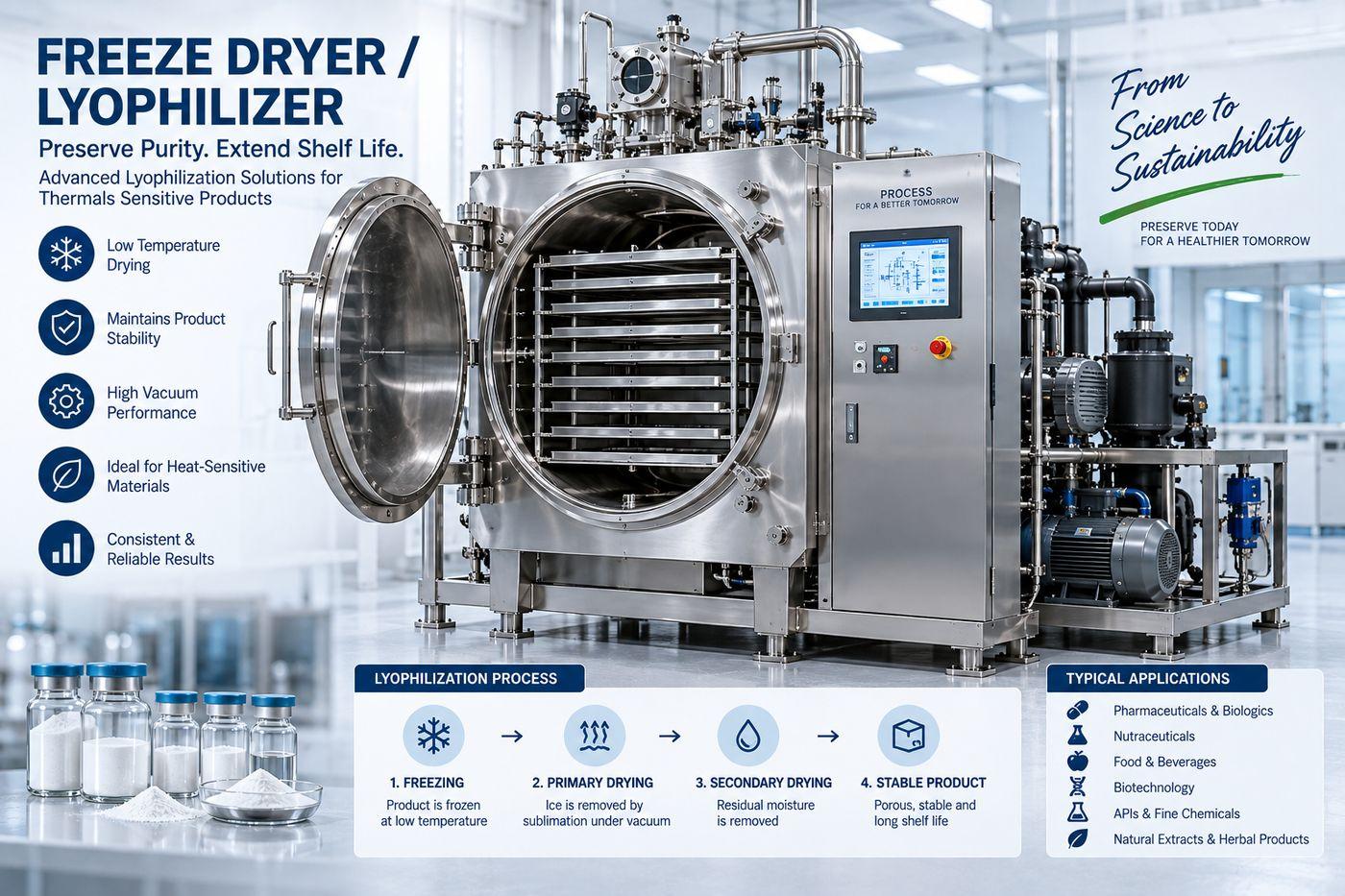
A freeze dryer (lyophiliser) dries heat-sensitive materials by freezing them and then removing the ice by sublimation under vacuum, so the product is never exposed to elevated temperature. This preserves structure, potency and aroma that conventional heat drying can damage. Mechotech designs and manufactures turnkey freeze dryers for pharmaceutical, nutraceutical, food and botanical lines, configured to the client’s product and target moisture specification.
The pre-frozen product is dried in a refrigerated chamber under deep vacuum. In primary drying, heat is supplied to the shelves at a rate that lets ice sublime to vapour, which is captured on a cold condenser; in secondary drying, bound moisture is desorbed at higher shelf temperature. Mechotech builds the chamber, shelves and condenser in SS 316L (or a process-appropriate grade) with electropolished product-contact surfaces, a refrigeration and vacuum system, CIP connections and PLC-based control of the freeze-drying cycle. Shelf area, condenser capacity and cycle parameters are configured to the product and are established during process development and pilot validation.
Process Flow
Technical Specifications
| Technology | Freeze drying (lyophilisation) by sublimation under vacuum |
|---|---|
| Working Principle | Frozen product is dried by sublimation of ice to vapour under vacuum, with the vapour captured on a cold condenser |
| Cycle Stages | Freezing, primary drying (sublimation), secondary drying (desorption), vacuum break |
| Drying Chamber | Insulated chamber with temperature-controlled shelves |
| Condenser | Refrigerated condenser sized to the vapour load |
| Vacuum & Refrigeration | Vacuum pump set and refrigeration system, configured to the cycle |
| Product-contact Material | SS 316L (or process-appropriate grade), electropolished |
| Cleaning | CIP connections for cleaning between batches |
| Automation | PLC-based cycle control with recipe management (configurable) |
| Capacity | Configured to requirement — laboratory and pilot to commercial scale |
| Compliance | GMP hygienic design; full documentation for qualification |
| Output | Dried, porous product in tray, vial or bulk form, per configuration |
Plant Capacities
| Scale | Typical Duty | Shelf Configuration |
|---|---|---|
| Laboratory / Pilot | Cycle development and product validation | Small shelf area; laboratory-to-pilot condenser |
| Production | Plant-scale batch drying | Medium shelf area and condenser sized to the vapour load |
| Large commercial | High-throughput batch drying | Large shelf area, condenser and vacuum set sized to the duty |
Shelf area, condenser capacity and cycle time are configured to the product’s freezing behaviour and moisture load; a pilot cycle-development trial is recommended before scaling.
Manufacturing Process
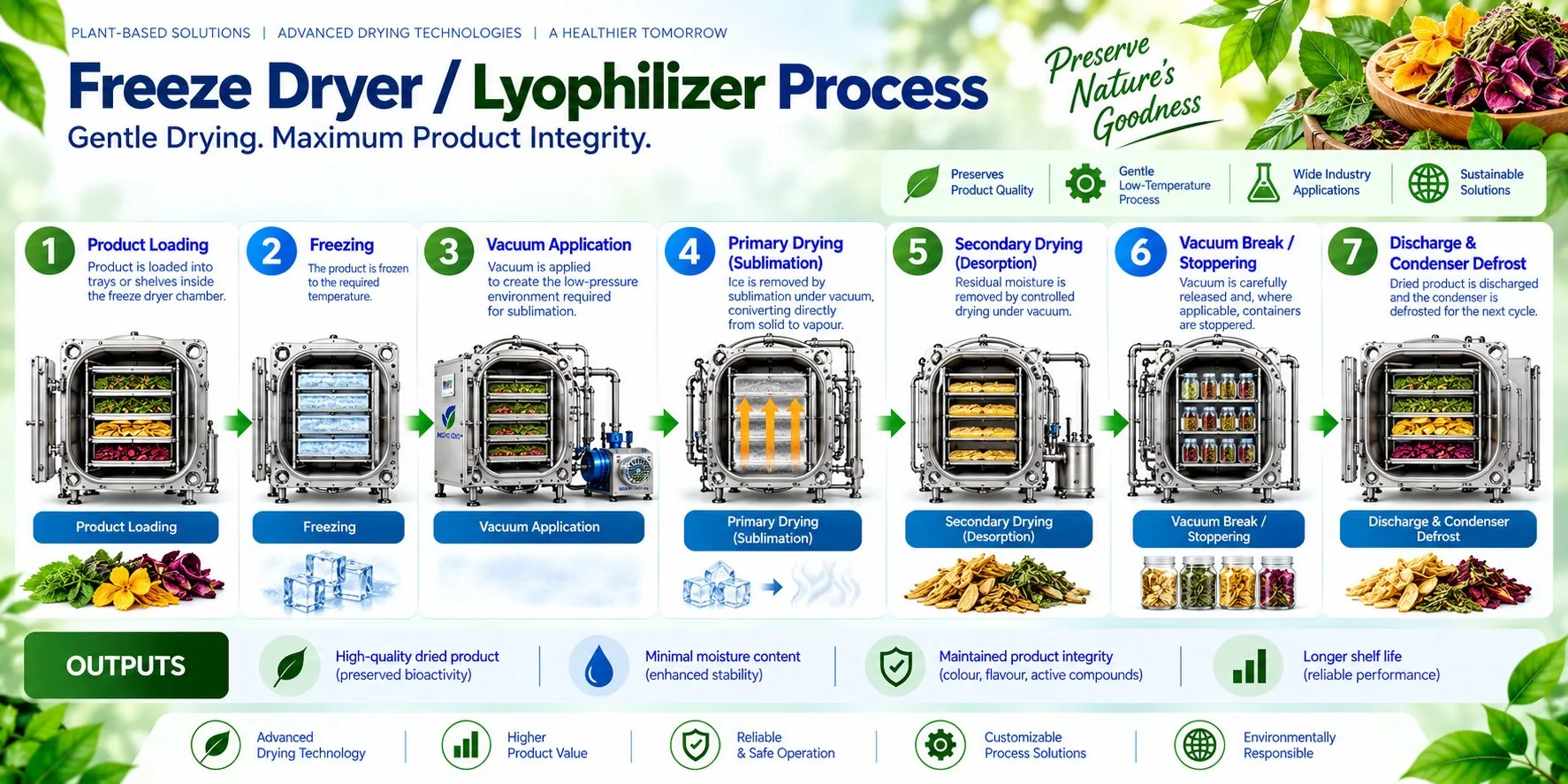
Product Loading
The product is loaded onto the shelves in trays or vials.
Freezing
The product is frozen to the temperature set during cycle development.
Vacuum Application
The chamber is evacuated and the condenser is brought to its operating temperature.
Primary Drying (Sublimation)
Shelf heat is applied at a controlled rate so ice sublimes directly to vapour, which is captured on the condenser.
Secondary Drying (Desorption)
Shelf temperature is raised under vacuum to desorb the remaining bound moisture to the target level.
Vacuum Break & Discharge
The vacuum is broken, vials are stoppered where required, and the dried product is discharged.
Condenser Defrost & Cleaning
The condenser is defrosted and the chamber cleaned in place before the next batch.
Major Plant Equipment
- Drying chamber with temperature-controlled shelves
- Refrigerated condenser
- Vacuum pump set
- Refrigeration system and shelf heating / cooling fluid circuit
- Vial stoppering mechanism (where required)
- CIP connections
- Instrumentation — temperature, pressure and vacuum sensors
- PLC-based control panel with MCC
Plant Output
Applications
- Pharmaceutical and biologic products that cannot tolerate heat
- Heat-sensitive nutraceutical and botanical extracts
- Probiotic and culture preparations
- Food and flavour ingredients where structure and aroma must be preserved
- Pilot freeze-drying cycle development
Key Features
Low-Temperature Drying
Moisture is removed by sublimation, so the product is not exposed to elevated temperature.
Structure & Potency Preservation
The dried product keeps a porous structure that rehydrates readily and retains heat-sensitive components.
Hygienic SS 316L Construction
Electropolished product-contact surfaces with CIP connections support cleaning between batches.
PLC-Based Cycle Control
Freezing, vacuum, shelf temperature and drying stages are controlled and recorded for repeatable cycles.
Scalable Capacity
The dryer is configured to requirement from laboratory and pilot scale upward.
Frequently Asked Questions
Does Mechotech supply the complete Freeze Dryer / Lyophiliser?
What is a freeze dryer (lyophiliser) and how does it work?
When is freeze drying preferred over spray or tray drying?
Which related drying equipment does Mechotech list?
What determines the freeze-drying cycle time?
How is the freeze dryer cleaned between batches?
What capacities are available for the Freeze Dryer / Lyophiliser?
Ready to discuss your project?
Get a free quote and technical consultation from our engineering team.