Spray Dryer
Spray Dryer
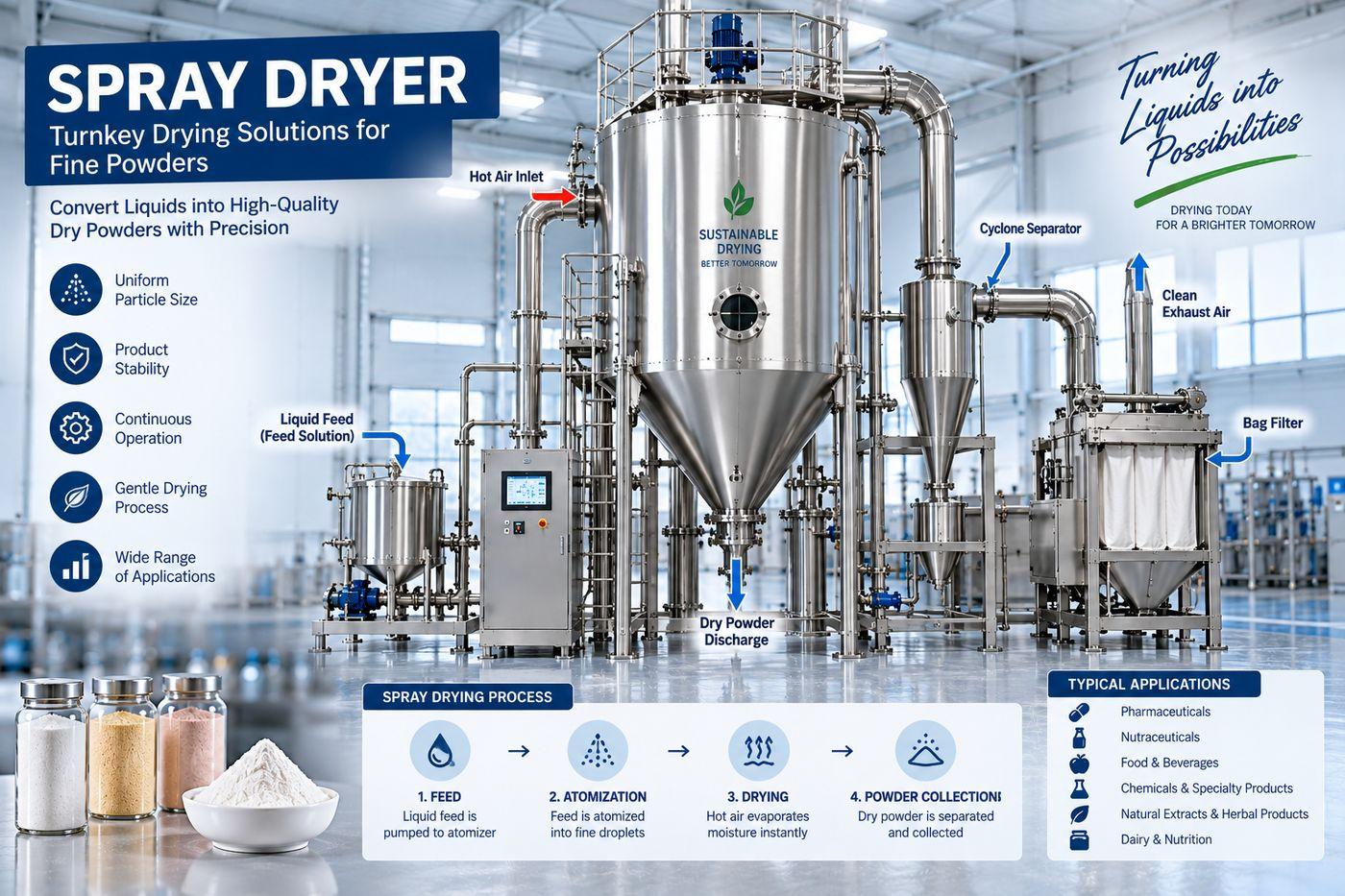
Mechotech engineers and manufactures the Spray Dryer as turnkey process equipment for pharmaceutical, nutraceutical, food, and botanical processing lines that convert a liquid, slurry or concentrate feed directly into a dry powder in a single continuous pass. Atomizing the feed into a fine mist and contacting it with a large volume of hot air gives an enormous surface area for near-instantaneous moisture evaporation, so the actual product exposure to heat lasts only seconds — making spray drying a practical route to powder even for many heat-sensitive extracts.
The Spray Dryer is built in SS 316L (or a process-appropriate grade) around a drying chamber fed by an atomizer — a high-speed rotary disc or a pressure/two-fluid nozzle, selected to match the feed's viscosity and the target particle size — that breaks the liquid feed into a fine spray of droplets. Hot air, generated by a direct or indirect air heater and introduced through a disperser at the chamber top, contacts the droplets in either co-current or counter-current flow; moisture flashes off almost instantly as the droplets travel through the chamber, leaving behind fine, free-flowing powder particles that fall to the base while the moist exhaust air, carrying the finest particles, is drawn to a cyclone and/or bag filter for powder recovery before the air is exhausted or partially recycled. Carrier or drying aids can be added to the feed where a sticky, low-glass-transition product needs help forming a free-flowing powder. Electropolished product-contact surfaces, CIP-capable chamber and cyclone, and PLC-based control of feed rate, atomization, and inlet/outlet air temperature support consistent particle size and moisture content, and capacity is configured to the customer's requirement from pilot-scale spray dryers for formulation trials to larger commercial units.
Process Flow
Technical Specifications
| Equipment Type | Spray Dryer — atomization drying of liquid/slurry feed in a hot air stream |
|---|---|
| Chamber Construction | SS 316L (or process-appropriate alloy), electropolished product-contact surfaces |
| Atomizer Type | High-speed rotary disc, or pressure / two-fluid nozzle (configurable to feed and target particle size) |
| Airflow Pattern | Co-current or counter-current (configurable) |
| Air Heating | Steam, thermic fluid, electric or gas-fired heater (configurable) |
| Powder Separation | Cyclone and/or bag filter for fines recovery |
| Chamber Geometry | Cylindrical-conical drying chamber with base powder discharge |
| Feed Type | Liquid, slurry or concentrate, with optional carrier/drying aid |
| Particle-Size Control | Adjustable via atomizer type, speed/pressure and air temperature |
| Product Handling | Base powder collection, cyclone/bag-filter fines, sieving/sifting |
| Automation | PLC-based control of feed rate, atomization, and inlet/outlet air temperature |
| Cleaning | CIP-capable chamber and cyclone |
| Capacity | Configured to requirement — pilot-scale spray dryers to larger commercial units |
| Utilities | Steam / thermic fluid / electric / gas-fired heating for air heater, compressed air, electric power |
| Compliance | GMP / WHO-GMP / Schedule M hygienic design |
Plant Capacities
| Dryer Scale | Typical Use | Atomizer Type | Evaporation Duty |
|---|---|---|---|
| Pilot-scale | Formulation & particle-characteristic trials | Rotary disc or nozzle | Low, configurable |
| Production-scale | Commercial powder manufacturing | Rotary disc or nozzle | Medium-to-high, configurable |
| Large production-scale | High-throughput continuous powder lines | Rotary disc or nozzle | High, configurable |
Chamber diameter, air-heater duty and atomizer selection are sized to the feed's moisture content and target evaporation rate; exact throughput is configured to your feed and finished-powder specification.
Manufacturing Process
Feed Preparation
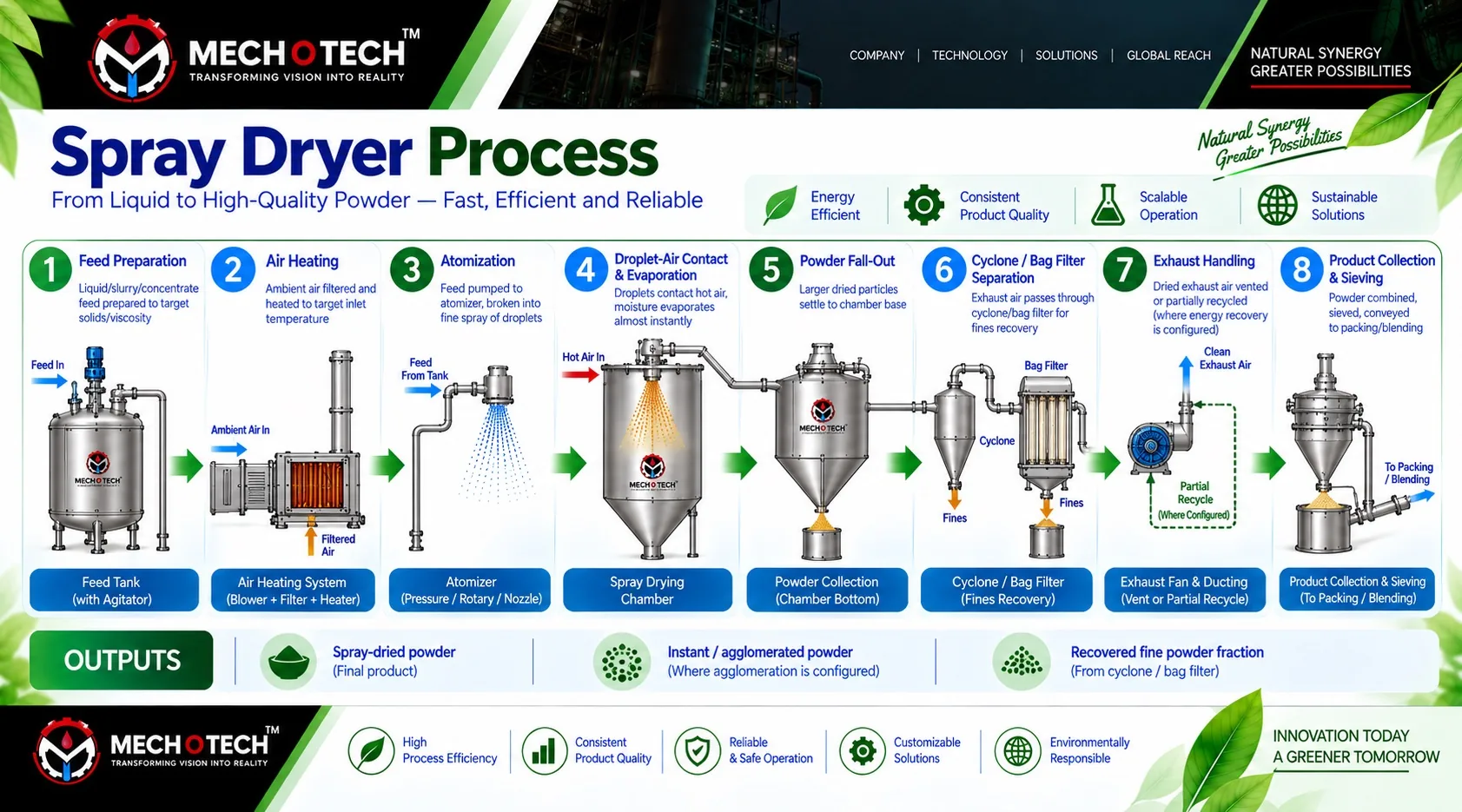
The liquid, slurry or concentrate feed is prepared to the target solids content and viscosity, with carrier or drying aids added where the product is inherently sticky or heat-sensitive, then held in a feed tank under agitation.
Air Heating
Ambient air is filtered and heated by a direct or indirect heater (steam, thermic fluid, electric or gas-fired, as configured) to the target inlet drying-air temperature before entering the chamber's air disperser.
Atomization
The feed is pumped to the atomizer — a high-speed rotary disc or a pressure/two-fluid nozzle — which breaks it into a fine spray of droplets, with atomizer type and settings chosen to hit the target particle-size distribution.
Droplet-Air Contact & Evaporation
Atomized droplets contact the hot air stream in co-current or counter-current flow inside the drying chamber; the large combined droplet surface area evaporates moisture almost instantly, converting each droplet into a dry particle within seconds.
Powder Fall-Out
Larger dried particles settle and fall to the base of the conical chamber, where they are collected and conveyed to product handling, while finer particles remain entrained in the exhaust air stream.
Cyclone / Bag Filter Separation
Exhaust air carrying fine powder passes through a cyclone and/or bag filter, recovering the entrained fine powder fraction and yielding a cleaned exhaust air stream.
Exhaust Handling
The dried, powder-depleted exhaust air is vented or, where energy recovery is configured, partially recycled, after passing through final filtration to meet emission requirements.
Product Collection & Sieving
Powder from the chamber base and the cyclone/bag filter is combined, passed through a sieve or sifter to remove oversize agglomerates, and conveyed to packing or downstream blending.
Major Plant Equipment
- Cylindrical-conical drying chamber (SS 316L, electropolished)
- Atomizer (high-speed rotary disc, or pressure/two-fluid nozzle)
- Air heater (steam / thermic fluid / electric / gas-fired)
- Hot-air disperser
- Feed tank with agitator and feed pump
- Cyclone separator
- Bag filter / fines recovery system
- Exhaust air blower and ductwork
- Base powder discharge and conveying system
- Sieve / sifter for oversize removal
- Instrumentation (inlet/outlet air temperature, feed rate, atomizer speed/pressure)
- PLC-based control panel with recipe management
Plant Output
Applications
- Spray drying of botanical and herbal extract concentrates to powder
- Nutraceutical and dietary-supplement powder production
- Instant food, beverage and dairy powder manufacturing
- Pharmaceutical excipient and API micronized-powder production
- Flavour and fragrance encapsulation and powder conversion
- Enzyme, probiotic and microbial-culture powder drying
- Pigment, dye and specialty-chemical powder production
- Protein and functional-ingredient powder manufacturing
Key Features
Instant Liquid-to-Powder Conversion
Atomization into fine droplets and contact with hot air evaporates moisture in seconds, converting a liquid or slurry feed directly to powder in one continuous pass.
Short Thermal Exposure
Because each droplet dries almost instantly, actual product exposure to elevated temperature is very brief, allowing many heat-sensitive extracts and actives to be spray-dried without significant degradation.
Controllable Particle Size and Morphology
Atomizer type, speed or pressure, and air conditions can all be tuned to hit target particle-size distribution, bulk density and flow characteristics for the finished powder.
Continuous, High-Throughput Operation
Feed is continuously atomized and dried powder continuously discharged, suiting production lines that need steady, scalable throughput rather than discrete batch cycles.
Integrated Fines Recovery
Cyclone and/or bag-filter separation recovers the fine powder fraction entrained in the exhaust air, maximising yield and controlling emissions.
GMP-Compliant, CIP-Capable Construction
Electropolished SS 316L surfaces and a CIP-capable chamber and cyclone meet WHO-GMP and Schedule M hygienic-design expectations for regulated powder manufacturing.
Frequently Asked Questions
What is a Spray Dryer used for?
How does spray drying protect heat-sensitive products?
What atomizer types are available and how do they affect the product?
How are fine powder particles recovered from the exhaust air?
Can spray drying be used for sticky or low-melting-point products?
What capacity range is available?
How does spray drying compare with freeze drying for extract powders?
Ready to discuss your project?
Get a free quote and technical consultation from our engineering team.