
Microwave-Assisted Extraction Plant
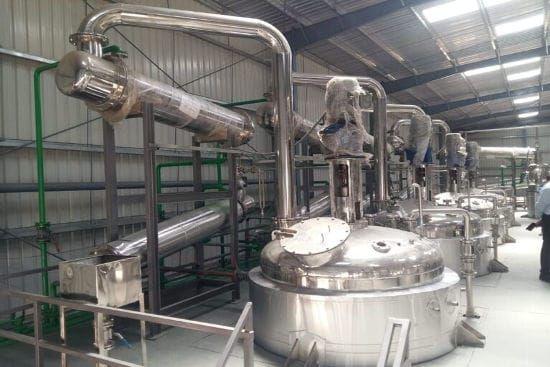
Microwave-Assisted Extraction Plant
Microwave-Assisted Extraction (MAE) uses microwave energy to heat a solvent-and-solids mixture volumetrically, directly exciting polar molecules and the moisture held inside plant cells. The rapid internal heating builds pressure within the cells until their walls rupture, releasing target compounds quickly into the surrounding solvent. Because heating is fast and targeted, MAE delivers high yields in short cycles with reduced solvent use, and it can even be run solvent-free using the matrix's own moisture. Mechotech engineers turnkey microwave extraction systems configured to each feedstock, solvent and target compound.
Microwave-Assisted Extraction works by volumetric, in-situ heating: microwave energy, typically at the industrial 2.45 GHz frequency, couples with polar solvent molecules and intracellular water so heat is generated inside the material rather than conducted from outside. The moisture inside plant cells heats and expands rapidly, raising internal pressure until cell walls burst and expose the contents to the solvent, sharply accelerating mass transfer. This gives faster extraction, higher yields, lower solvent consumption and better energy efficiency than conventional heating, and solvent-free microwave modes such as hydrodiffusion are possible for aromatic plants. Mechotech builds the microwave applicator, extraction vessels, condensers and circulation circuit in SS 304 with product-contact SS 316L to hygienic, GMP-oriented standards, with PLC/SCADA control of microwave power, temperature and pressure. Capacity is configured from pilot to commercial scale.
Technical Specifications
| Technology | Microwave-Assisted Extraction (MAE), including solvent-free / hydrodiffusion modes |
|---|---|
| Working Principle | Volumetric microwave heating of polar solvent and intracellular water ruptures cell walls and intensifies mass transfer |
| Microwave Frequency | Industrial band, typically 2.45 GHz (configurable) |
| Operating Temperature | Configurable, controlled by microwave power modulation |
| Operating Pressure | Configurable - atmospheric (open) or pressurised (closed) mode |
| Solvent | Water, ethanol, hydro-alcoholic and other microwave-absorbing solvents, or solvent-free (as applicable) |
| Product-contact Material | SS 304 / SS 316L |
| Automation | PLC/SCADA (configurable) with power, temperature, pressure and batch logging |
| Capacity | Configured to process requirement - pilot to commercial |
| Utilities | Electric power for microwave generators, cooling water, chilled water, compressed air |
| Compliance | GMP / cGMP hygienic design |
| Final Output | Liquid extract or aromatic distillate; optional concentrate or dried powder via downstream recovery and drying |
Manufacturing Process
Feed & solvent charging
Milled botanical material and a microwave-absorbing solvent are charged to the extraction vessel, or moisture-rich material is loaded for solvent-free operation. Correct loading supports uniform heating.
Microwave irradiation
Microwave energy is applied so polar solvent molecules and intracellular water heat volumetrically. Heat is generated inside the matrix rather than conducted from the vessel wall.
Cell rupture
Rapid internal heating vaporises and expands moisture inside the cells, raising pressure until the cell walls rupture. The released compounds pass into the surrounding solvent.
Temperature & pressure control
Power is modulated to hold target temperature, in open atmospheric or closed pressurised mode. Controlled conditions protect actives and ensure repeatability.
Extraction hold
Irradiation continues for a short, defined period until the target release is achieved. Volumetric heating completes recovery far faster than surface heating.
Cooling & separation
The mixture is cooled and the extract is separated from spent solids by filtration or centrifugation. Fines are removed to yield a clean liquid extract.
Solvent recovery & concentration
Solvent is recovered by evaporation and returned for reuse while the extract is concentrated. This lowers operating cost and solvent waste.
Finishing & cleanup
The concentrate can be dried to powder downstream and the system is flushed for the next batch. CIP-friendly design simplifies turnaround.
Applications
- Nutraceutical and dietary-supplement actives
- Phytochemicals including polyphenols, flavonoids and alkaloids
- Essential oils and aromatic compounds via solvent-free microwave modes
- Oleoresins and natural colours
- Pharmaceutical botanical actives and standardised extracts
- Food, beverage and natural flavour ingredients
- Cosmetic and personal-care botanical extracts
- R&D, pilot studies and process scale-up
Key Features
Volumetric in-situ heating
Microwaves heat the material from within, so extraction is far faster and more energy-efficient than wall-conducted heating.
Rapid cell rupture, high yield
Internal pressure build-up bursts cell walls and exposes compounds directly to solvent, driving high recovery in short cycles.
Low solvent, green operation
Reduced solvent consumption, integrated recovery and solvent-free microwave modes support clean-label and green-extraction goals.
Open or pressurised operation
Atmospheric or closed-vessel modes let the process match volatile targets, higher temperatures or delicate actives as needed.
Hygienic, GMP-oriented build
Product-contact parts in SS 316L with smooth, CIP-friendly finishes support pharmaceutical, nutraceutical and food-grade production.
Full automation & power control
PLC/SCADA control of microwave power, temperature and pressure with batch logging ensures repeatable, traceable operation.
Frequently Asked Questions
What is Microwave-Assisted Extraction?
How does microwave-assisted extraction work?
What are the advantages of MAE compared with conventional extraction?
What can a microwave-assisted extraction plant process?
What capacity is available?
What material of construction and compliance does Mechotech use?
Does Mechotech provide turnkey design, manufacture, installation and commissioning?
Ready to discuss your project?
Get a free quote and technical consultation from our engineering team.