Molecular Distillation Unit
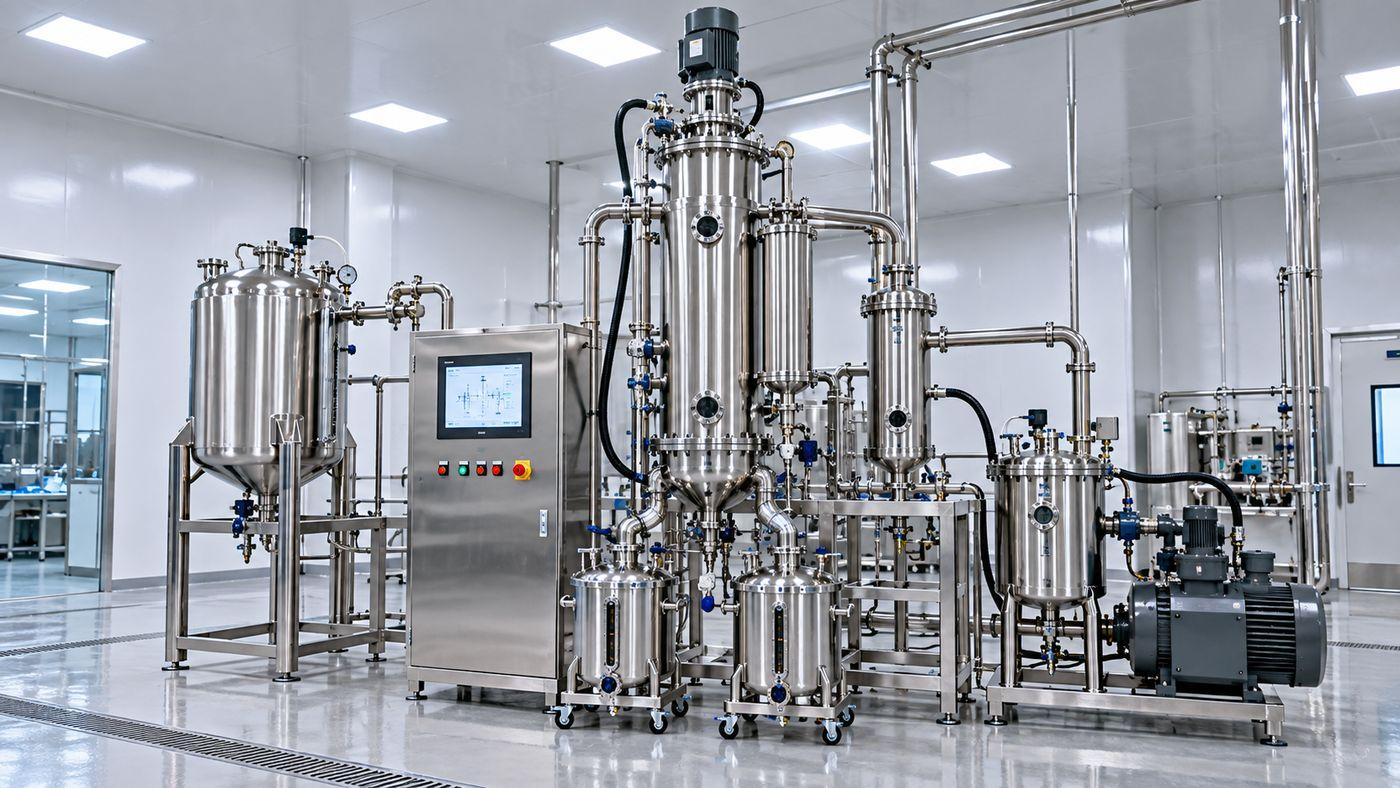
Molecular Distillation Unit
A molecular distillation unit separates and purifies heat-sensitive or high-boiling compounds under high vacuum. The heated evaporating surface and the condenser sit only a short distance apart, so the vapour travels a short path from one to the other and the feed spends little time at temperature. This allows compounds that would degrade in conventional distillation to be separated at a lower temperature. Mechotech designs and manufactures turnkey molecular distillation units for pharmaceutical, nutraceutical, food and botanical process lines. Each unit is configured to the client's feed material, target compound and output specification.
The unit is built in SS 316L (or a process-appropriate grade) with electropolished product-contact surfaces and integrated instrumentation. A feed vessel supplies the distillation section, where the more volatile fraction evaporates under high vacuum and condenses as distillate while the less volatile fraction leaves as residue; a high-vacuum pumping system, heating and cooling circuits and a PLC-based control panel complete the unit. The product-contact circuit can be cleaned between batches and the unit is delivered with documentation to support qualification. Vacuum level, operating temperature, evaporating area and the number of stages are configured to the application and established during process development and pilot validation; no fixed values are quoted on this page. Mechotech's catalogue also lists a Short Path Distillation Unit, which describes short-path distillation as also called molecular distillation.
Technical Specifications
| Product | Molecular Distillation Unit |
|---|---|
| Technology | Molecular (short-path) distillation under high vacuum |
| Working Principle | The heated evaporating surface and the condenser are a short distance apart; the more volatile fraction evaporates, crosses the short path and condenses as distillate, with minimal residence time at temperature |
| Typical Duty | Separation and purification of heat-sensitive or high-boiling compounds |
| System Vacuum | High vacuum; level configured to the target compound and confirmed during process development |
| Operating Temperature | Configured to the target compound; set during process development and pilot validation |
| Evaporating Area and Stages | Configured to the throughput and the separation duty |
| Product-contact Material | SS 316L (or process-appropriate grade), electropolished |
| Feed System | Feed vessel with feed delivery to the distillation section (arrangement configured) |
| Product Streams | Distillate and residue collected in separate receivers |
| Cleaning | Product-contact circuit cleaned between batches; CIP connections as configured |
| Automation | PLC-based control with integrated instrumentation (configurable) |
| Capacity | Configured to requirement — pilot to commercial, with modular expansion |
| Utilities | Electric power for the vacuum system and drives, heating and cooling services (project-specific) |
| Compliance | GMP hygienic design; full documentation for qualification |
| Output | Purified distillate and residue fractions |
Plant Capacities
| Scale | Typical Duty | Configuration |
|---|---|---|
| Pilot | Process development and trial separations | Small unit with feed vessel, distillation section and receivers |
| Production | Plant-scale batch or continuous separation | Distillation section and high-vacuum system configured to the throughput |
| Large commercial | Higher throughput | Larger evaporating area or additional stages, with modular expansion |
Evaporating area, number of stages, vacuum system and utilities are configured to the feed and the target separation; a pilot trial on the actual feed is recommended before scaling.
Manufacturing Process
Feed Charging
The feed material is charged to the feed vessel and delivered to the distillation section at a controlled rate.
Evaporation under High Vacuum
The feed is heated on the evaporating surface under high vacuum, so the more volatile fraction evaporates at a lower temperature than at atmospheric pressure.
Short-Path Condensation
The vapour crosses the short distance to the condenser and condenses as distillate, with little time spent at temperature.
Fraction Collection
Distillate and the less volatile residue are collected in separate receivers.
Further Stages
Where the unit is configured with more than one stage, the fractions pass on to the next stage for further separation.
Cleaning
The unit is cleaned between batches.
Major Plant Equipment
- Feed vessel and feed delivery
- Distillation section with heated evaporating surface and condenser
- Distillate and residue receivers
- High-vacuum pumping system
- Cold trap or condensation stage for the vacuum line (as configured)
- Heating and cooling circuits
- Instrumentation for temperature, vacuum and flow
- PLC-based control panel
Plant Output
Applications
- Pharmaceutical and nutraceutical process manufacturing
- Botanical and herbal extraction industries
- Food and flavour processing
- Refining of essential oils and aroma materials, including terpene removal
- Purification of heat-sensitive or high-boiling botanical actives
Key Features
Gentle Separation
High vacuum and a short vapour path let heat-sensitive or high-boiling compounds be separated at a lower temperature and with little time at heat.
Configured to the Feed
Vacuum level, temperature, evaporating area and number of stages are set to the feed and the target compound.
Hygienic Construction
SS 316L (or process-appropriate grade) with electropolished product-contact surfaces, with documentation to support GMP qualification.
Instrumented Control
PLC-based control with integrated instrumentation for temperature and vacuum.
Turnkey Engineering
Design, fabrication, installation and commissioning are delivered as one accountable scope.
Scalable Capacity
Configured from pilot scale to commercial duty, with modular expansion.
Frequently Asked Questions
Does Mechotech supply the complete Molecular Distillation Unit?
What is molecular distillation and how does it work?
How is molecular distillation different from conventional distillation?
How does this page differ from the Short Path Distillation Unit page?
What can a molecular distillation unit separate?
What vacuum and temperature does the unit run at?
What capacities are available for the Molecular Distillation Unit?
What information is needed to specify a Molecular Distillation Unit?
Which related distillation pages does Mechotech list?
Ready to discuss your project?
Get a free quote and technical consultation from our engineering team.