Hybrid Extraction (UAE + EAE)
Hybrid Extraction (UAE + EAE)
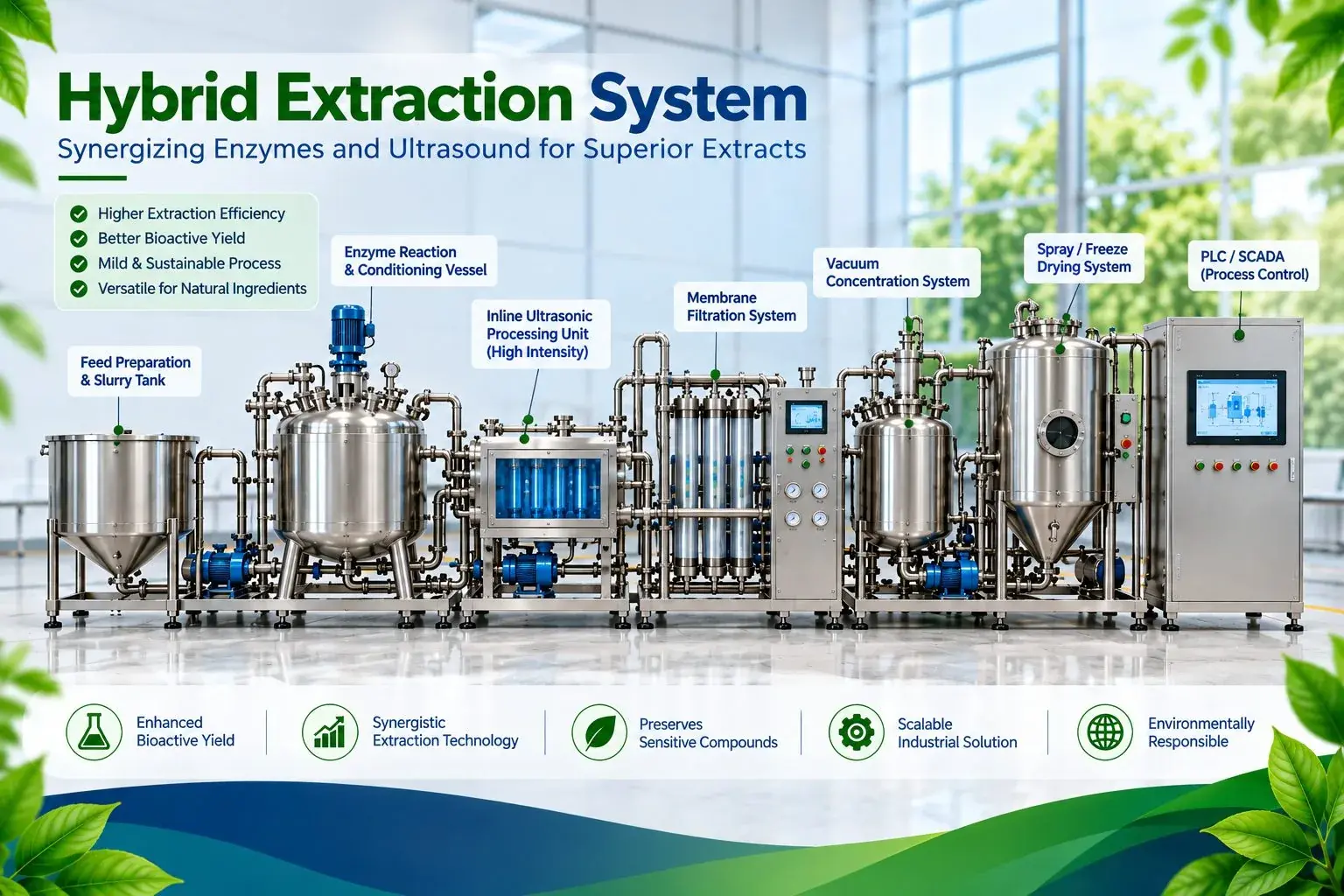
Hybrid Extraction (UAE + EAE) combines two proven intensification technologies — enzyme-assisted extraction and ultrasound-assisted extraction — into a single modular platform. Targeted enzymes such as cellulase, pectinase, hemicellulase and protease selectively break down cell-wall and membrane structures, while controlled ultrasonic cavitation further disrupts the loosened matrix and drives solvent penetration. Together, the two mechanisms address feedstocks that resist either technology alone, particularly protein-, pectin- and polyphenol-rich botanical materials and difficult fibrous matrices. Mechotech engineers turnkey Hybrid Extraction systems configured to each feedstock, enzyme system and target compound.
A Hybrid Extraction system is built around a sequential process by default: a substrate slurry is first conditioned and treated with a selected enzyme blend, allowing controlled enzymatic hydrolysis to loosen the cell-wall structure, before the slurry is circulated through an inline ultrasonic reactor to complete disruption and intensify mass transfer under controlled temperature. This sequential configuration is Mechotech's recommended first commercial design, since it gives easier process control, a lower risk of ultrasonic enzyme deactivation, and is easier to validate across different enzyme combinations and contract-processing scenarios. A simultaneous configuration, where enzymatic action and ultrasonic treatment run concurrently, is available as a configurable option for validated processes — it can offer shorter processing time, better mass transfer and potentially lower enzyme consumption, but requires pulsed ultrasound and tight temperature control to avoid excessive ultrasonic intensity deactivating the enzyme or local heat generation damaging sensitive actives, and each enzyme–material combination requires its own validation before scale-up. Mechotech builds the enzyme reaction/conditioning vessel, inline ultrasonic recirculation system, membrane purification stage, vacuum concentration and drying equipment in SS 316L to hygienic, GMP-oriented standards, with PLC/SCADA recipe management across the full process train. Capacity is developed from a 500-litre pilot/demonstration system through to standardised 2,000, 5,000 and 10,000-litre commercial modules.
Process Flow
Technical Specifications
| Technology | Hybrid Extraction (UAE + EAE) |
|---|---|
| Working Principle | Targeted enzymatic hydrolysis of cell-wall structures combined with acoustic cavitation from inline ultrasonic treatment |
| Process Configuration | Sequential (enzyme treatment followed by ultrasound) as the recommended first commercial design, or simultaneous operation as a configurable option for validated processes |
| Process Parameters | Solids loading, enzyme dosage, temperature, pH, enzyme reaction time and ultrasound settings are configured to the selected enzyme system and raw material and established in pilot trials |
| Product-contact Material | SS 316L |
| Automation | PLC/SCADA with recipe management |
| Compliance | GMP hygienic design; full documentation for qualification |
| Final Output | Liquid extract; optional concentrate or dried powder via downstream recovery and drying |
Plant Capacities
| Plant Scale | Scale / Usage | Configuration Note |
|---|---|---|
| Pilot / Demonstration | Enzyme selection, process sequence and parameter validation on the actual raw material | Jacketed enzyme reactor with agitation, enzyme-dosing skid, inline ultrasonic recirculation, heat exchanger, separation and CIP, with sampling points before and after ultrasound. |
| Commercial module | Plant-scale production | Standardised commercial-scale module, sized and configured to the validated pilot parameters. |
The recommended development route is a pilot / demonstration system first, used to validate enzyme selection, process sequence and operating parameters for the specific raw material, followed by commercial modules sized to the validated parameters. All sizes are configured to the customer’s feedstock and throughput requirement.
Manufacturing Process
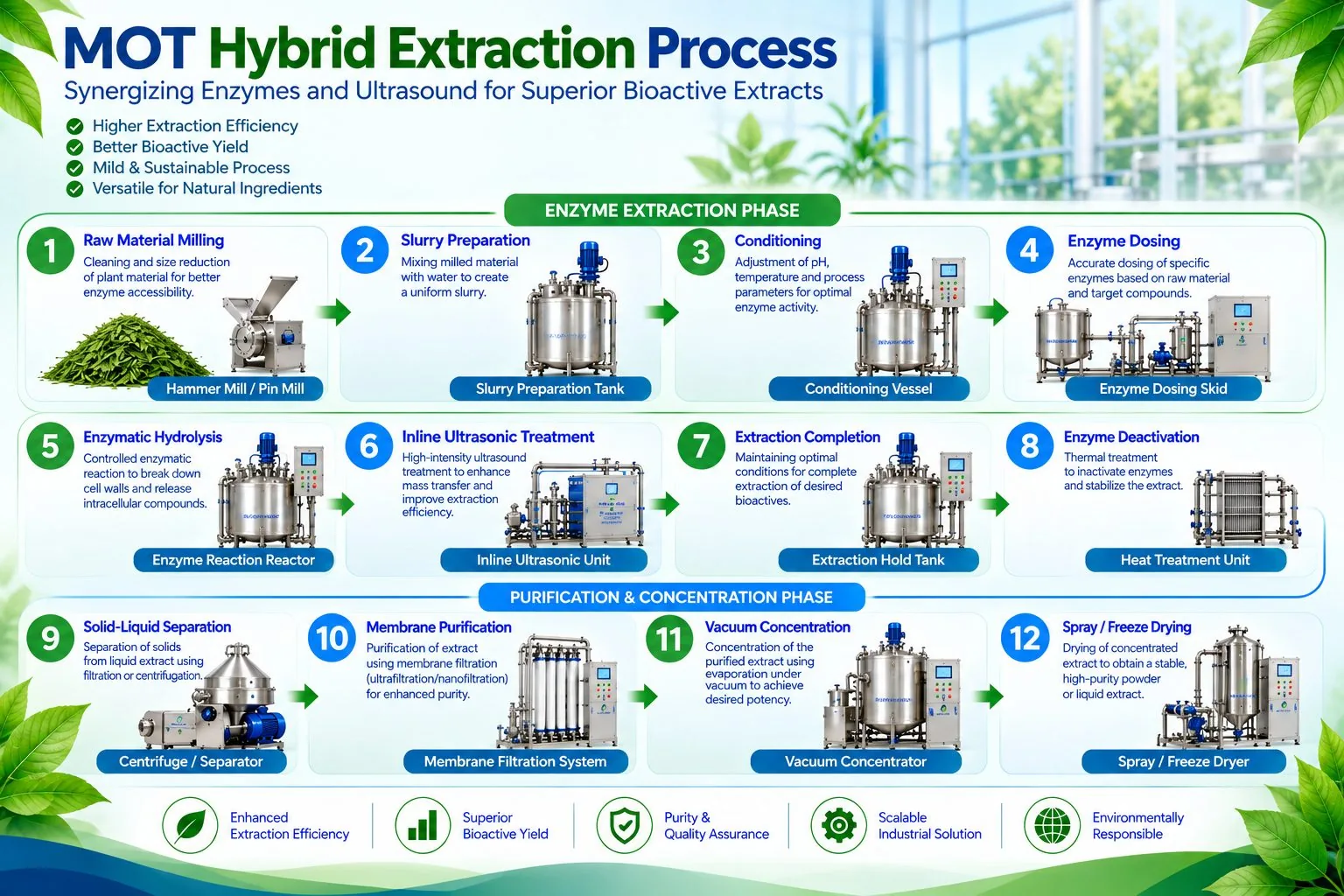
Raw material milling
Botanical feedstock is milled to the validated particle size, giving the enzyme system good access to the cell-wall surface.
Slurry preparation
The milled material is dispersed in water or a buffer solution to form a substrate slurry at the configured solids loading.
pH & temperature conditioning
The slurry is adjusted to the pH and temperature range that suits the selected enzyme system, before dosing begins.
Enzyme dosing
A selected enzyme or enzyme blend — cellulase, pectinase, hemicellulase, protease or a customised combination — is metered into the slurry.
Controlled enzymatic hydrolysis
The dosed slurry is held to allow controlled hydrolysis of the cell-wall and structural components, loosening the matrix ahead of ultrasonic treatment.
Inline ultrasonic treatment
The enzyme-treated slurry is circulated through an inline ultrasonic reactor, where acoustic cavitation further disrupts the loosened matrix and intensifies solvent penetration.
Extraction completion under controlled temperature
The treated slurry is held under controlled temperature to complete extraction and allow target compounds to fully diffuse into the surrounding medium.
Enzyme deactivation (where required)
Where the final product specification requires it, the enzyme is deactivated — typically by a controlled heat step or pH shift — to halt further hydrolysis before separation.
Solid–liquid separation
Spent solids are separated from the liquid extract using a decanter, centrifuge or filter press, selected to the feedstock and slurry characteristics.
Membrane purification
The clarified extract is further purified by membrane filtration, removing fines and refining the extract ahead of concentration.
Vacuum concentration
The purified extract is concentrated under vacuum, reducing volume while protecting temperature-sensitive compounds.
Spray or freeze drying
The concentrate is finished to a stable powder by spray drying or freeze drying, depending on the product's thermal sensitivity and target form.
Major Plant Equipment
- Jacketed enzyme reaction / conditioning vessel
- Variable-speed agitation system
- Enzyme dosing skid
- pH and temperature monitoring & control loop
- Inline ultrasonic recirculation system with adjustable amplitude and pulsed operation
- Plate heat exchanger for temperature control
- Extraction holding tank
- Solid–liquid separation stage (decanter, centrifuge or filter press)
- Membrane purification stage
- Vacuum concentration system
- Spray dryer or freeze dryer (configured to product form)
- CIP skid
- PLC/SCADA recipe management system
Plant Output
Applications
- DORB / rice-bran protein recovery using protease and cellulase enzyme systems
- Pectin extraction with controlled pectinase/cellulase enzyme systems
- Fruit pomace polyphenol recovery using pectinase and cellulase combinations
- Turmeric and curcuminoid extraction using cellulase in combination with ultrasound
- Ashwagandha active-compound extraction using cellulase/pectinase enzyme systems
- Gingerol extraction using cellulase in combination with ultrasound
- Natural colour extraction using pectinase/cellulase enzyme systems
- Plant protein extraction using protease and carbohydrase enzyme systems
- Mucilaginous herb processing, evaluated case-by-case for the specific matrix
- Delicate native enzyme or protein recovery, where mild, closely controlled conditions are required
Key Features
Sequential hybrid design as standard
Enzyme treatment followed by inline ultrasound is Mechotech's recommended first commercial configuration, giving easier process control, lower risk of ultrasonic enzyme deactivation, and easier validation across enzyme combinations.
Two intensification mechanisms in one platform
Selective enzymatic cell-wall disruption is combined with controlled ultrasonic cavitation, addressing fibrous, protein-, pectin- and polyphenol-rich feedstocks that resist either method alone.
Configurable simultaneous mode for validated processes
Where a specific enzyme–material combination has been validated, enzymatic action and ultrasonic treatment can run concurrently using pulsed ultrasound and tight temperature control, subject to process-specific validation.
Reduced solvent and energy demand versus conventional extraction
Combining enzymatic and ultrasonic intensification can shorten extraction cycles and reduce solvent and energy consumption compared with conventional extraction, with actual gains established per validated raw material.
Hygienic, GMP-oriented build
Product-contact parts in SS 316L with smooth, CIP-friendly finishes support pharmaceutical, nutraceutical and food-grade production.
Full automation & recipe management
PLC/SCADA control with recipe management governs enzyme dosing, temperature, pH, ultrasonic amplitude and batch sequencing, with energy, flow and batch-data recording for repeatable, traceable operation.
Frequently Asked Questions
What is Hybrid Extraction (UAE + EAE)?
How does the enzyme and ultrasound treatment combine in Hybrid Extraction?
Why is the sequential configuration recommended over simultaneous operation?
What materials and applications suit a hybrid enzyme–ultrasound process?
What benefits does hybrid processing offer compared with conventional extraction?
What is the recommended development route from pilot to commercial scale?
Does Mechotech provide turnkey design, manufacture, installation and commissioning?
Are other hybrid combinations possible?
Ready to discuss your project?
Get a free quote and technical consultation from our engineering team.