VTD – Vacuum Tray Dryer
VTD – Vacuum Tray Dryer
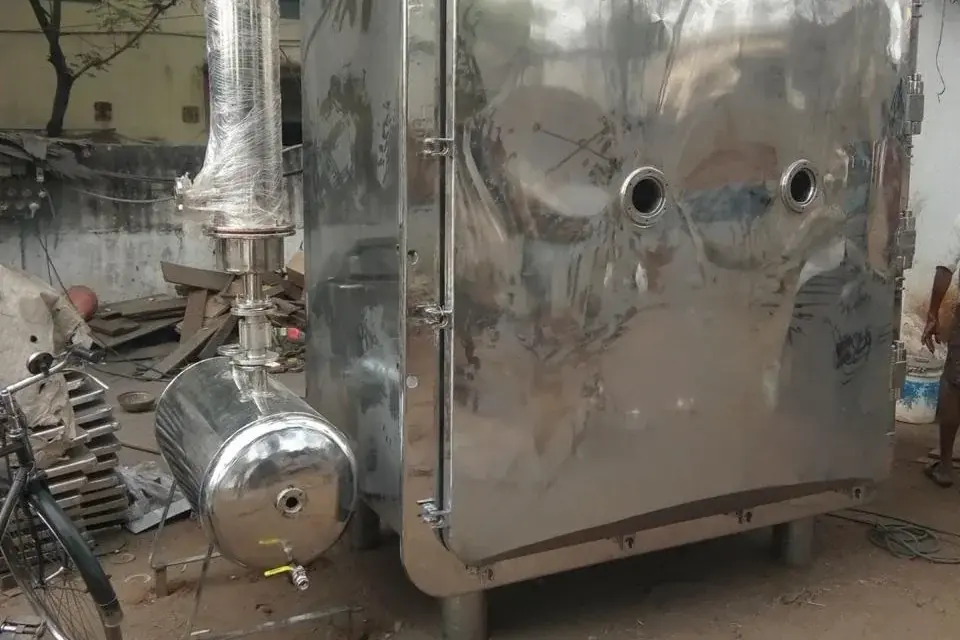
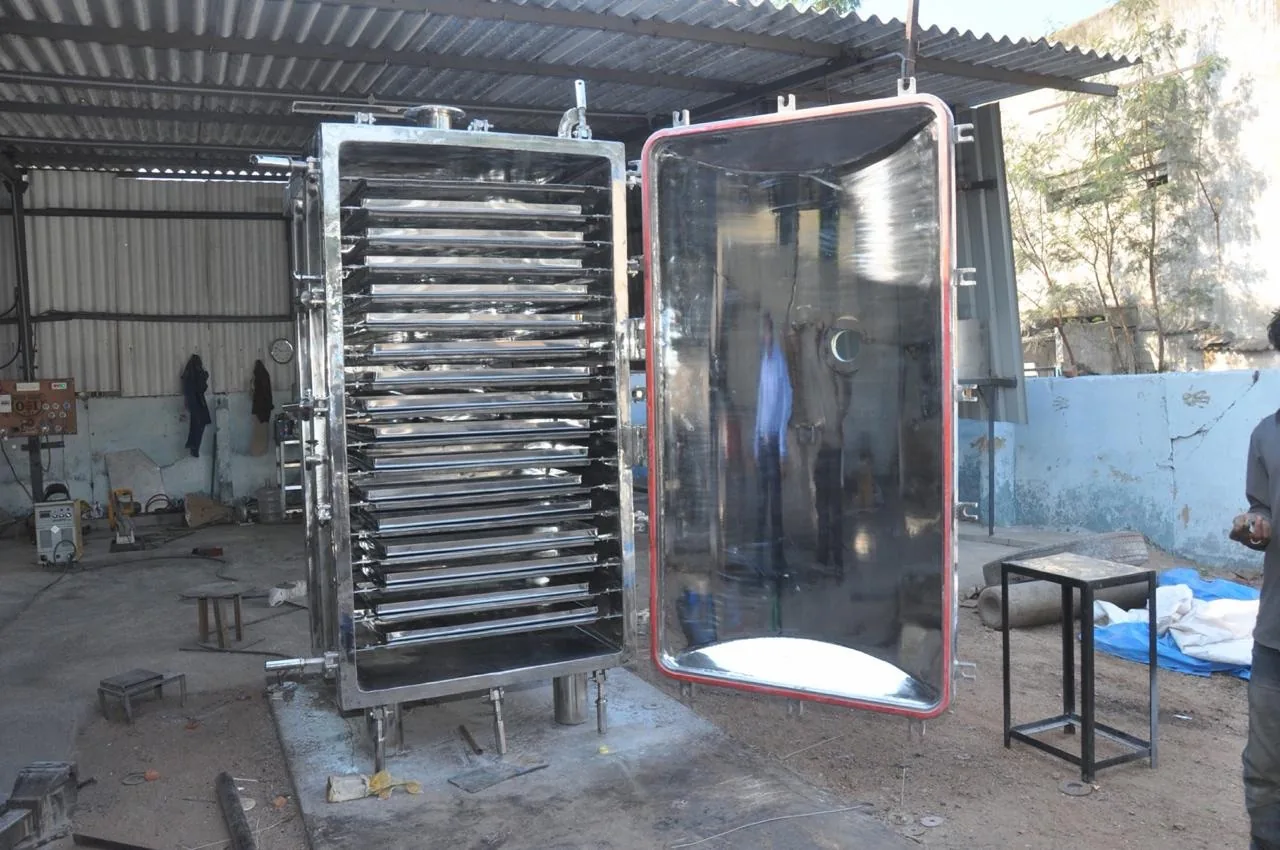
Mechotech designs and manufactures the VTD Vacuum Tray Dryer as turnkey process equipment for the static drying of solids under vacuum. Material is spread on trays and dried by conduction from heated shelves inside a sealed vacuum chamber, with no agitation, so the product is not mechanically disturbed. Mechotech’s photographs show a rectangular chamber with a stack of shelves, a large door with sight glasses and a vapour outlet leading to a condenser vessel. The unit is designed around the client’s product and target dryness, then fabricated, installed and commissioned by Mechotech as a single scope.
The VTD Vacuum Tray Dryer is built in SS 316L (or a process-appropriate grade) as a sealed chamber housing a stack of hollow, jacketed shelves; wet solid, cake or paste is spread in thin layers on trays that are loaded onto the shelves, and hot water, steam or thermic fluid circulated through the shelves conducts heat into the product. With the chamber under vacuum, moisture evaporates at a lower temperature and is drawn through a vapour outlet to a condenser, so drying takes place by static conduction and evaporation without stirring or tumbling the product. Electropolished product-contact surfaces, removable tray trolleys and PLC-based control of shelf temperature and vacuum support repeatable batch drying. Capacity is configured to the customer’s requirement, and the unit is delivered with documentation to support GMP qualification.
Process Flow
Technical Specifications
| Equipment Type | Vacuum Tray Dryer (VTD) — static, tray-based conduction drying under vacuum |
|---|---|
| Chamber Shape | Rectangular or cylindrical sealed chamber (configurable) |
| Construction | SS 316L (or process-appropriate alloy), electropolished product-contact surfaces |
| Shelf System | Hollow, jacketed shelves, fixed or on a removable tray trolley |
| Heating Medium | Hot water / steam / thermic fluid circulated through shelves |
| Agitation | None — static tray drying, no mechanical disturbance of product |
| Vacuum System | Vacuum pump with vapour outlet and external condenser |
| Inert Atmosphere Option | Nitrogen / inert-gas purge, where fitted, confirmed in design for the product |
| Loading Format | Removable trays on trolley or fixed shelf loading |
| Automation | PLC-based control of shelf temperature and vacuum level |
| Monitoring | Shelf / product temperature probes, vacuum gauging |
| Cleaning | CIP-capable chamber, removable trays for external cleaning |
| Capacity | Configured to requirement — small pilot chambers to larger multi-shelf production units |
| Utilities | Hot water / steam / thermic fluid for shelf heating, vacuum system utilities, nitrogen / inert gas (where fitted), electric power |
| Compliance | GMP hygienic design; full documentation for qualification |
Plant Capacities
| Chamber Scale | Typical Use | Loading Format | Shelf Count |
|---|---|---|---|
| Pilot-scale | Formulation and process-parameter trials | Fixed shelf or small trolley | Few shelves |
| Production-scale | Commercial batch drying | Tray trolley | Multi-shelf |
| Large production-scale | High-volume batch drying | Multiple tray trolleys | Multi-shelf, larger tray area |
Shelf area, chamber volume and heating capacity are sized to the tray load and target drying time; no fixed areas or volumes are quoted on this page.
Manufacturing Process
Tray Loading
The wet solid, cake or paste is spread in a thin, even layer across trays, which are loaded onto a trolley or directly onto the chamber's fixed shelf stack.
Chamber Sealing
The loaded trays are wheeled or placed into the rectangular or cylindrical chamber, and the door is sealed to establish an airtight enclosure.
Vacuum Draw
The chamber is evacuated to the target vacuum level, lowering the boiling point of residual moisture so evaporation can proceed at a reduced temperature.
Shelf Heating (Conduction)
Hot water, steam or thermic fluid circulates through the hollow, jacketed shelves; heat conducts from the shelf into the tray and then into the static product layer resting on it.
Static Evaporation
Moisture evaporates from the exposed surface of the undisturbed product bed under vacuum, with no agitation, tumbling or mechanical contact of any kind.
Vapour Removal & Condensation
Evaporated moisture is drawn from the chamber through a vapour outlet to an external condenser, where it is recovered, sustaining the vacuum level through the cycle.
Endpoint Verification
Product or shelf temperature and vacuum-level trends are monitored, and trays can be sampled between cycles to confirm the target residual moisture has been reached.
Unloading & Cleaning
Trays are removed once dry, and the chamber and tray trolley are cleaned between batches, supporting validated changeover between products.
Major Plant Equipment
- Sealed rectangular or cylindrical vacuum chamber (SS 316L, electropolished)
- Hollow jacketed shelf stack
- Removable tray trolley and trays
- Chamber door with vacuum-rated seal
- Heating system (hot water / steam / thermic fluid) with circulation pump
- Vacuum pump and vacuum receiver
- Vapour/solvent recovery condenser
- Nitrogen/inert-gas purge system (where fitted)
- Instrumentation (shelf/product temperature, vacuum level)
- PLC-based control panel
Plant Output
Applications
- Drying of friable granules and crystals where mechanical disturbance is undesirable
- Drying of botanical and herbal extracts at reduced temperature
- Nutraceutical powder and granule batch drying
- Drying of filter cakes where agitation would damage the product form
- Food-grade solid drying requiring undisturbed handling
- Vacuum drying of solvent-wet solids with solvent recovered in a condenser
- Small-batch and multi-product drying with tray-trolley changeover
Key Features
Static, Non-Agitated Drying
The product rests on trays throughout the cycle, so there is no paddle or tumbling action on the material.
Low-Temperature Vacuum Drying
Under vacuum the boiling point of moisture falls, so evaporation proceeds at a lower shelf temperature.
Inert-Gas Purge Option
A nitrogen or inert-gas purge can be fitted and is confirmed in design for products that need it.
Removable Tray Trolleys
Trays on a removable trolley can be loaded and unloaded outside the chamber, which shortens the time the chamber is open.
Solvent Recovery via Condenser
A condenser on the vacuum line recovers solvent evaporated during drying.
SS 316L, CIP-Capable Construction
Electropolished SS 316L surfaces, removable trays and a cleanable chamber support GMP hygienic design.
Frequently Asked Questions
Does Mechotech supply the complete VTD Vacuum Tray Dryer?
What capacities are available for the VTD Vacuum Tray Dryer?
Which industries use the VTD Vacuum Tray Dryer?
What is a Vacuum Tray Dryer (VTD) used for?
Why is a static (non-agitated) dryer preferred for some products?
How does vacuum improve drying compared with atmospheric tray drying?
Can a VTD be purged with inert gas?
How is the VTD loaded and unloaded?
How does the VTD differ from agitated vacuum dryers like the RVPD or Vacuum Paddle Dryer?
What information is needed to specify a VTD Vacuum Tray Dryer?
Which related drying pages does Mechotech list?
Ready to discuss your project?
Get a free quote and technical consultation from our engineering team.