
Solvent Rectification Plant
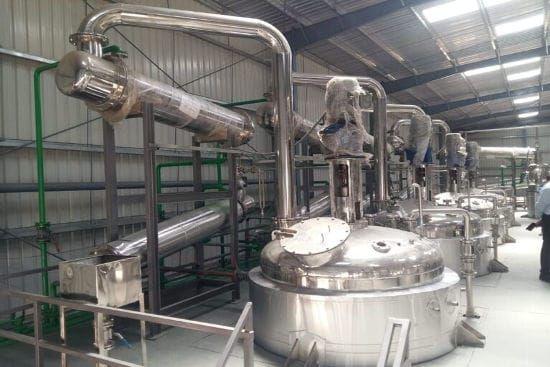
Solvent Rectification Plant
Solvent rectification is a high-efficiency fractional distillation process that refines crude, mixed or recovered solvents into a high-purity product by repeatedly vaporizing and condensing the mixture along a packed or tray column under controlled reflux. Each theoretical stage in the column enriches the vapor in the more volatile component, so rectification can separate close-boiling solvents and strip water or heavy residues that a single distillation cannot. It is central to solvent recovery and reuse, letting manufacturers reclaim expensive solvents to a reusable or resale grade while cutting fresh-solvent purchase and disposal costs. Mechotech engineers turnkey solvent rectification plants designed around each solvent system and target purity specification.
A solvent rectification plant works by feeding the crude solvent to a reboiler and column where rising vapor and descending reflux liquid exchange mass across many stages, so the overhead product is progressively enriched in the desired solvent while impurities and heavies concentrate in the bottoms. Controlling reflux ratio, column pressure or vacuum, and reboiler duty sets the achievable purity and the separation of close-boiling components, and operating under vacuum protects heat-sensitive solvents. The result is high solvent purity, strong recovery with a typical target above 95 percent, excellent solvent economy and lower emissions when paired with efficient condensation, supporting CPCB-aligned solvent management. Mechotech fabricates the columns, reboilers, condensers and reflux circuits in SS 304 with product-contact SS 316L to hygienic, GMP-oriented standards, with PLC/SCADA control of reflux, temperature and vacuum. Capacity, column configuration and construction are configured to the specific process requirement.
Technical Specifications
| Technology | Solvent rectification / fractional distillation with reflux |
|---|---|
| Working Principle | Repeated vaporization and condensation across column stages enriches the overhead in the target solvent while heavies concentrate in the bottoms |
| Column Configuration | Packed or tray column, batch or continuous (configurable) |
| Operating Temperature | Configured to the solvent boiling range and duty |
| Operating Vacuum | Configurable for heat-sensitive solvents and close-boiling separations |
| Product-contact Material | SS 304 / SS 316L |
| Solvent Recovery | Typical target greater than 95 percent, depending on solvent system |
| Automation | PLC/SCADA (configurable) with reflux-ratio and cut control and batch data logging |
| Capacity | Configured to requirement - pilot to commercial |
| Utilities | Steam / thermic fluid or electric heating, cooling water, chilled water, vacuum, power, compressed air |
| Compliance | GMP hygienic design; CPCB-aligned for solvent recovery and emissions |
| Final Output | High-purity recovered solvent for reuse or resale, with concentrated bottoms residue |
Manufacturing Process
Feed collection & pre-treatment
Crude or recovered solvent is collected and, where needed, pre-filtered to remove solids and gross contaminants. Clean feed protects the column internals and improves separation.
Reboiler heating & vaporization
The feed is heated in the reboiler until the solvent vaporizes and rises into the column. Reboiler duty is set to the solvent's volatility and the required boil-up rate.
Fractionation across the column
Rising vapor contacts descending reflux across packing or trays, exchanging mass at each stage. This repeated vaporization and condensation enriches the vapor in the target solvent.
Reflux control
Part of the overhead condensate is returned as reflux to sharpen the separation. Adjusting reflux ratio trades throughput against the purity of the overhead product.
Overhead condensation
The purified overhead vapor is condensed to liquid in the condenser. Efficient condensation captures the solvent and minimises vapor losses to vent.
Product cut collection
The high-purity solvent fraction is drawn off as the product cut, with intermediate cuts routed for reprocessing. Cut points are set to meet the purity specification.
Heavies & residue removal
High-boiling impurities and residues concentrate in the bottoms and are drained from the reboiler. Regular residue removal keeps the column running at steady purity.
Cooling, storage & cleanup
The recovered solvent is cooled and routed to storage for reuse or resale, and the system is flushed for the next campaign. This closes the recovery loop efficiently.
Applications
- Recovery and refining of process solvents for reuse
- Separation of close-boiling solvent mixtures
- Dehydration and purification of alcohols and ketones
- Pharmaceutical and API solvent reclamation
- Agrochemical and specialty-chemical solvent recovery
- Paint, ink and coatings solvent purification
- Purification of recovered solvents to resale grade
- R&D, pilot studies and process scale-up
Key Features
High-purity solvent output
Multi-stage fractionation with controlled reflux separates close-boiling components and strips heavies, delivering a consistently high-purity solvent product.
Strong solvent recovery & economy
Rectification reclaims expensive solvents to a reusable or resale grade with a typical target recovery above 95 percent, cutting fresh-solvent purchase and disposal costs.
Reflux-ratio flexibility
Adjustable reflux lets operators trade throughput against purity, so the same column can meet different specifications across product campaigns.
Vacuum operation for heat-sensitive solvents
Configurable vacuum lowers boiling temperatures to protect thermally sensitive solvents and reduce fouling and degradation in the reboiler.
Low emissions with efficient condensation
Well-sized condensers and reflux capture solvent vapor for CPCB-aligned solvent management and reduced venting to atmosphere.
Full automation & data logging
PLC/SCADA control of reflux, temperature, pressure and vacuum with recipe management and batch records ensures repeatable, traceable rectification.
Frequently Asked Questions
What is solvent rectification?
How does solvent rectification work?
Where does solvent rectification fit in a process line?
What are the benefits for solvent economy and emissions?
What capacity is available?
What material of construction and compliance does Mechotech use?
Does Mechotech provide turnkey design, manufacture, installation and commissioning?
Ready to discuss your project?
Get a free quote and technical consultation from our engineering team.