Forced Circulation Evaporator
Forced Circulation Evaporator
A forced circulation evaporator concentrates viscous, fouling-prone or crystallising liquids by pumping the liquor at high velocity through a heat exchanger and into a vapour–liquid separator. The pumped circulation keeps the heat-transfer surface swept clean, which is why it is the usual choice when a gravity-fed film evaporator would scale or block. Mechotech designs and manufactures turnkey forced circulation evaporators for pharmaceutical, nutraceutical, food and botanical lines, configured to the client’s feed and target concentration.
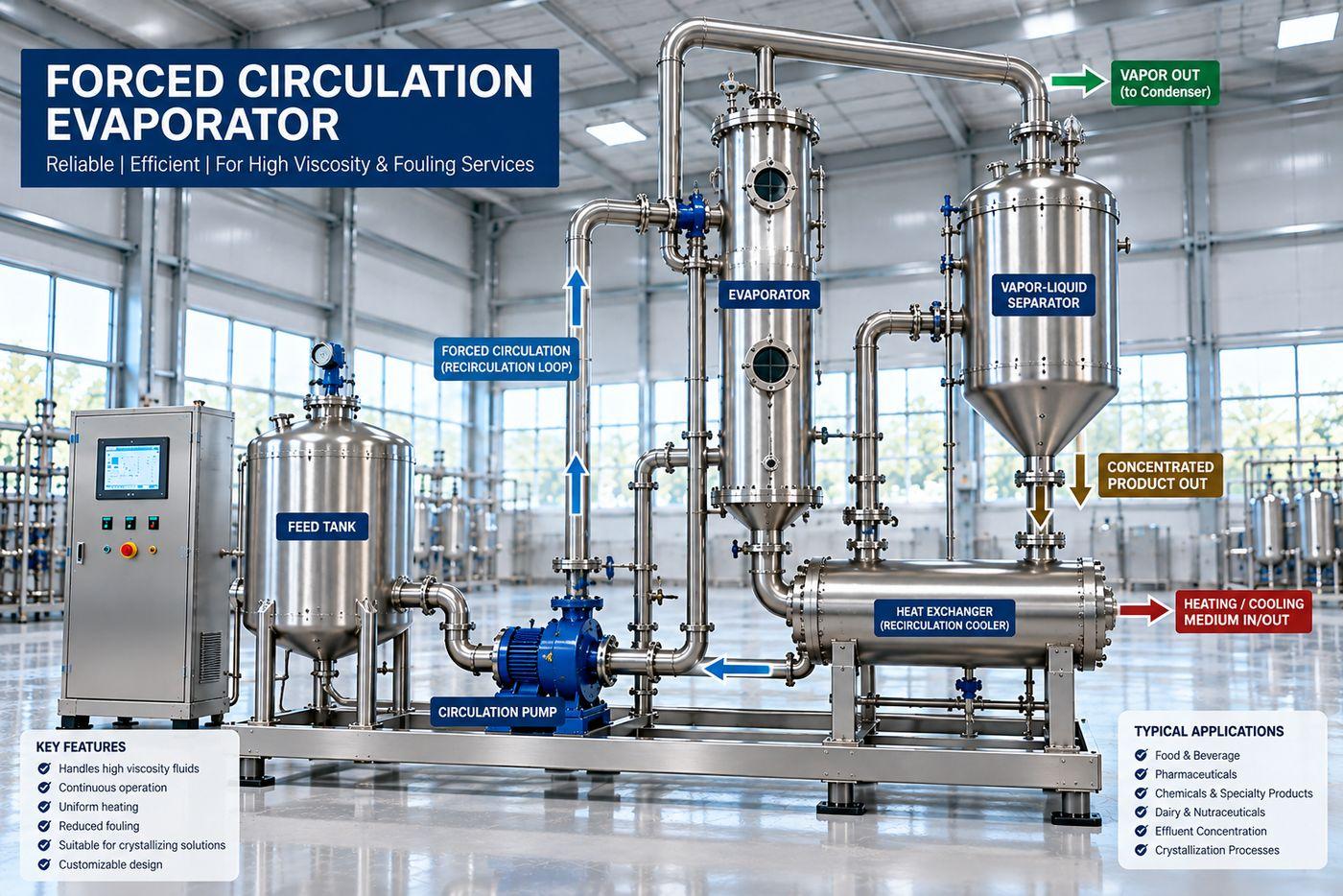
A circulation pump drives the liquor through the heat exchanger at positive velocity. The liquor is heated under enough pressure that it does not boil inside the tubes; it flashes when it enters the vapour–liquid separator, where vapour is released and the concentrated liquor is recirculated. Because boiling happens in the separator rather than on the tube wall, scaling and fouling of the heat-transfer surface are reduced. Mechotech builds the unit in SS 316L (or a process-appropriate grade) with electropolished product-contact surfaces, a condenser and vacuum system, CIP connections and PLC-based control. Capacity and heat-exchanger sizing are configured to the evaporation duty and are established during process development and pilot validation.
Technical Specifications
| Technology | Forced circulation evaporation |
|---|---|
| Working Principle | A circulation pump drives liquor through a heat exchanger; the heated liquor flashes in a vapour–liquid separator, so boiling occurs away from the tube wall |
| Illustrated Configuration | Feed tank, circulation pump, evaporator with a recirculation loop, heat exchanger (recirculation cooler), vapour–liquid separator, vapour out to condenser, concentrated-product outlet and heating / cooling medium in and out, as labelled on the product illustration; the configuration is selected to the duty |
| Suited Feeds | Viscous, fouling-prone, scaling or crystallising liquids |
| Circulation | Circulation pump sized to the liquor and heat-exchanger duty |
| Heat Exchanger | Shell-and-tube or plate-type, per feed; heated by steam or hot process fluid |
| Vapour–Liquid Separation | Separator vessel with demisting; concentrate drawn off by discharge pump |
| Condensing System | Surface or barometric condenser with vacuum system |
| Product-contact Material | SS 316L (or process-appropriate grade), electropolished |
| Cleaning | CIP connections for cleaning between batches |
| Automation | PLC-based control of level, temperature and vacuum (configurable) |
| Capacity | Configured to requirement — pilot to commercial scale |
| Compliance | GMP hygienic design; full documentation for qualification |
| Output | Concentrated liquor or slurry, condensate |
Plant Capacities
| Scale | Typical Duty | Circulation Configuration | Effect Arrangement |
|---|---|---|---|
| Pilot | Process validation on the actual feed | Small circulation pump and heat exchanger | Single effect |
| Mid-size commercial | Plant-scale concentration of difficult feeds | Medium heat exchanger and separator | Single effect or one effect of a multi-effect train |
| Large commercial | High-throughput continuous evaporation | Large circulation loop sized to the duty | Single or multiple effects, per project |
Heat-exchanger area, circulation rate and separator size are configured to the feed viscosity, fouling tendency and evaporation duty; a pilot trial on the actual feed is recommended before scaling.
Manufacturing Process
Feed Intake
The liquid feed enters the circulation loop from the feed tank at a controlled rate.
Pumped Circulation
The circulation pump drives the liquor at high velocity through the heat exchanger, keeping the tube surface swept.
Heating & Flash Evaporation
The heated liquor flashes as it enters the vapour–liquid separator, releasing vapour while the concentrate stays in the loop.
Vapour Separation & Condensation
Vapour leaves the separator through a demister and is condensed in the condenser; the vacuum system sets the operating pressure.
Concentrate Discharge
Concentrated liquor or slurry is drawn off by the discharge pump once the target concentration is reached.
Clean-in-Place
The loop, heat exchanger and separator are cleaned between batches to restore heat-transfer performance.
Major Plant Equipment
- Feed tank and feed pump
- Circulation pump
- Heat exchanger (calandria)
- Vapour–liquid separator with demister
- Surface or barometric condenser
- Vacuum system (steam ejector or liquid-ring pump)
- Condensate receiver and pump-out
- Concentrate discharge pump
- CIP skid and connections
- Instrumentation — level, temperature and pressure/vacuum transmitters
- PLC-based control panel with MCC
Plant Output
Applications
- Concentration of viscous botanical and herbal extracts
- Concentration of crystallising or salting-out solutions
- Evaporation of scaling or fouling-prone process liquors
- Pharmaceutical and nutraceutical intermediate concentration
- Concentration ahead of crystallisation or drying
- Effect within a larger multi-effect evaporation train
Key Features
Low Fouling Tendency
Pumped circulation keeps liquor moving across the heat-transfer surface, reducing scale and deposit build-up.
Handles Viscous & Crystallising Feeds
Suited to liquors that thicken, scale or crystallise as they concentrate.
Hygienic SS 316L Construction
Electropolished product-contact surfaces with CIP connections support cleaning between batches.
PLC-Based Control
Level, temperature and vacuum are controlled for repeatable concentration.
Scalable Capacity
The unit is configured to requirement from pilot scale upward, with modular expansion.
Frequently Asked Questions
Does Mechotech supply the complete Forced Circulation Evaporator?
What is a forced circulation evaporator and how does it work?
Which feeds suit a forced circulation evaporator?
How does it differ from other evaporators Mechotech builds?
Can it be combined with multi-effect or vapour-recompression systems?
What operating temperature and vacuum does it use?
What capacities are available for the Forced Circulation Evaporator?
What information is needed to specify a Forced Circulation Evaporator?
Ready to discuss your project?
Get a free quote and technical consultation from our engineering team.