Rising-Film Evaporator
Rising-Film Evaporator
Mechotech engineers and manufactures the Rising Film Evaporator as turnkey process equipment that concentrates liquids as they rise through heated vertical tubes. The feed is heated at the base of the tube bundle, and the vapour it generates carries the liquid upward as a climbing film; the concentrate and vapour are then separated in a vapour separator above the bundle. Mechotech’s Falling Film Evaporator page notes that rising film units are often used for lower-viscosity feeds in the earlier stages of concentration, and its MEE page lists the rising-film evaporator among the effect types. The unit is designed around the client’s feed, throughput and target concentration, then fabricated, installed and commissioned by Mechotech as a single scope.
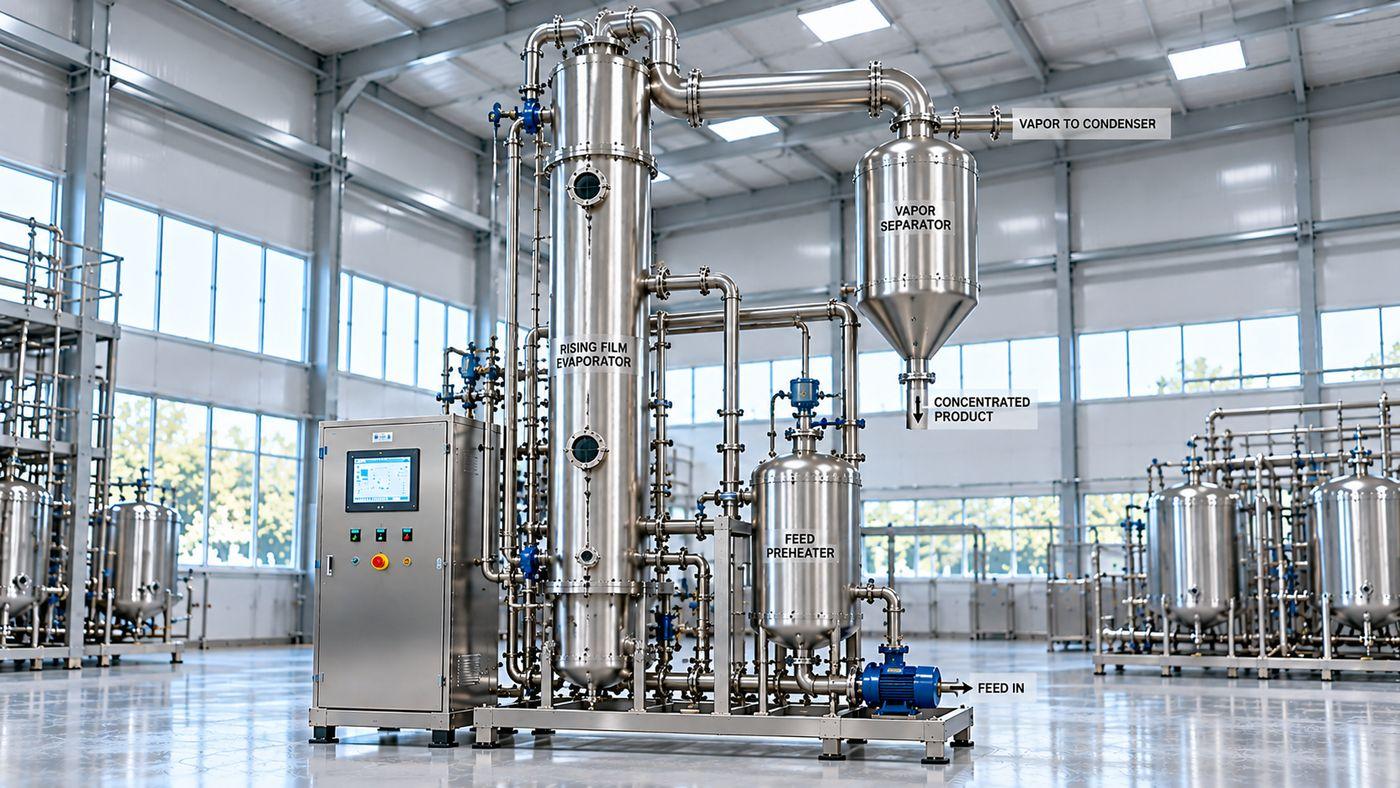
The Rising Film Evaporator is built in SS 316L (or a process-appropriate grade) around a bundle of heated vertical tubes, with a feed preheater, a vapour separator and a connection to the condenser, as Mechotech’s illustration shows. Feed enters at the base, is brought to its boiling point, and rises as a film driven by its own vapour; the vapour and concentrate separate in the vapour separator, the vapour goes to the condenser and the concentrated product is discharged. Electropolished product-contact surfaces, CIP connections and PLC-based control with a touchscreen panel support operation under vacuum or at atmospheric pressure, depending on the heat sensitivity of the product. Tube length, tube count and shell diameter are configured to the specified evaporation duty, and the unit is delivered with full documentation to support GMP qualification.
Technical Specifications
| Evaporator Type | Rising Film Evaporator, vertical tube-bundle geometry (climbing-film evaporator) |
|---|---|
| Working Principle | Feed boils at the base of heated vertical tubes and rises as a film carried by the vapour it generates |
| Tube Orientation | Vertical, bottom-fed |
| Feed System | Feed pump and feed preheater ahead of the tube bundle (as shown in Mechotech’s illustration) |
| Heating Medium | Steam or other process heating medium on the shell side (configurable) |
| Operating Mode | Vacuum operation or atmospheric, depending on product heat sensitivity (configurable) |
| Vapour Separation | Separate vapour separator vessel with the vapour outlet to the condenser |
| Suited Feed Character | Lower-viscosity liquids, often in the earlier stages of concentration (per Mechotech’s Falling Film Evaporator and MEE pages) |
| Product-contact Material | SS 316L (or process-appropriate grade), electropolished |
| Condensing System | Condenser, with vacuum system where vacuum operation is used (configurable) |
| Automation | PLC-based control with touchscreen panel (configurable to SCADA) |
| Cleaning | CIP-capable product-contact circuit |
| Configuration | Single unit, or as one effect within a multiple-effect (MEE) train |
| Capacity | Configured to requirement — pilot to commercial evaporation duty |
| Utilities | Steam or heating medium for the shell, cooling water, vacuum utilities where used, electric power, compressed air |
| Compliance | GMP hygienic design; full documentation for qualification |
Plant Capacities
| Scale | Typical Duty | Tube Configuration | Effect Arrangement |
|---|---|---|---|
| Pilot | Process validation, low evaporation load | Small tube count | Single unit |
| Mid-size commercial | Plant-scale concentration | Medium tube bundle | Single unit or one effect of an MEE train |
| Large commercial | High-throughput concentration | Large tube bundle | Effect within an MEE train |
Tube count, tube length and shell diameter are engineered to the specified evaporation duty and feed properties; exact heat-transfer area and throughput are confirmed during process design.
Manufacturing Process
Feed Charging
The liquid feed is pumped into the system and sent to the feed preheater, as the illustration shows with the feed entering at the pump and the preheater beside the tube bundle.
Feed Preheating
The feed is preheated so it enters the base of the tube bundle close to its boiling point, so evaporation starts early in the tubes rather than the tube length being spent on sensible heating.
Climbing-Film Evaporation
The feed boils at the base of the heated vertical tubes, and the vapour generated lifts the liquid up the tube wall as a film while the shell side supplies heat; the arrangement and the heating medium are configured to the duty.
Vapour–Liquid Separation
Liquid and vapour leaving the top of the tubes enter the vapour separator, which disengages the vapour from the concentrate; the vapour leaves toward the condenser and the concentrate drains downward.
Condensation & Vacuum
Vapour is condensed in the condenser, and where vacuum operation is used a vacuum system holds the pressure that lowers the boiling point and protects heat-sensitive product.
Concentrate Discharge
The concentrated product is discharged from the separator to storage or the next process step; level and concentration instrumentation confirms it meets the target before transfer.
Further Concentration
Where a higher concentration is needed, the concentrate can be routed through a further pass or to another effect; the arrangement is set during process design.
CIP & Changeover
The tube bundle, separator and connecting lines are cleaned in place between batches or product changeovers.
Major Plant Equipment
- Feed pump
- Feed preheater
- Rising-film tube-bundle evaporator (SS 316L, electropolished)
- Vapour separator
- Condenser
- Vacuum system (where vacuum operation is used)
- Concentrate discharge pump and receiver
- CIP connections
- PLC-based control panel with touchscreen
Plant Output
Applications
- Concentration of lower-viscosity extracts and process liquids
- Botanical and herbal extract pre-concentration
- Pharmaceutical and nutraceutical intermediate concentration
- Food and flavour liquid concentration
- Effect within a multiple-effect evaporation train (per Mechotech’s MEE page)
Key Features
Climbing-Film Heat Transfer
The feed is carried up the heated tubes by the vapour it generates, as Mechotech’s Falling Film Evaporator page describes for rising film units.
Feed Preheater and Vapour Separator Included
The illustration shows a feed preheater and a separate vapour separator as part of the unit, so feed conditioning and vapour disengagement are designed in rather than added later.
Vacuum or Atmospheric Operation
Vacuum operation lowers the boiling point for heat-sensitive feeds, while atmospheric operation is available where the process allows.
Fits Lower-Viscosity Duties
Mechotech’s MEE and Falling Film Evaporator pages place rising film units on lower-viscosity feeds in the earlier stages of concentration; the feed is confirmed in design.
SS 316L, CIP-Capable, PLC Control
Electropolished SS 316L product-contact surfaces, CIP connections and a PLC control panel with touchscreen support hygienic, repeatable operation.
Scalable Capacity
The evaporator is sized to the customer’s requirement, from pilot-scale validation through to commercial capacity, with modular expansion as production grows.
Frequently Asked Questions
Does Mechotech supply the complete Rising Film Evaporator?
What capacities are available for the Rising Film Evaporator?
Which industries use the Rising Film Evaporator?
What is a rising film evaporator?
How does a rising film evaporator work?
How is a Rising Film Evaporator different from a Falling Film Evaporator?
What feeds is it suited to, and what is not?
Can it be used as one effect in a multiple-effect train?
Does it run under vacuum?
What information is needed to specify one?
Which related equipment pages does Mechotech list?
Ready to discuss your project?
Get a free quote and technical consultation from our engineering team.