Fermenter / Bioreactor System
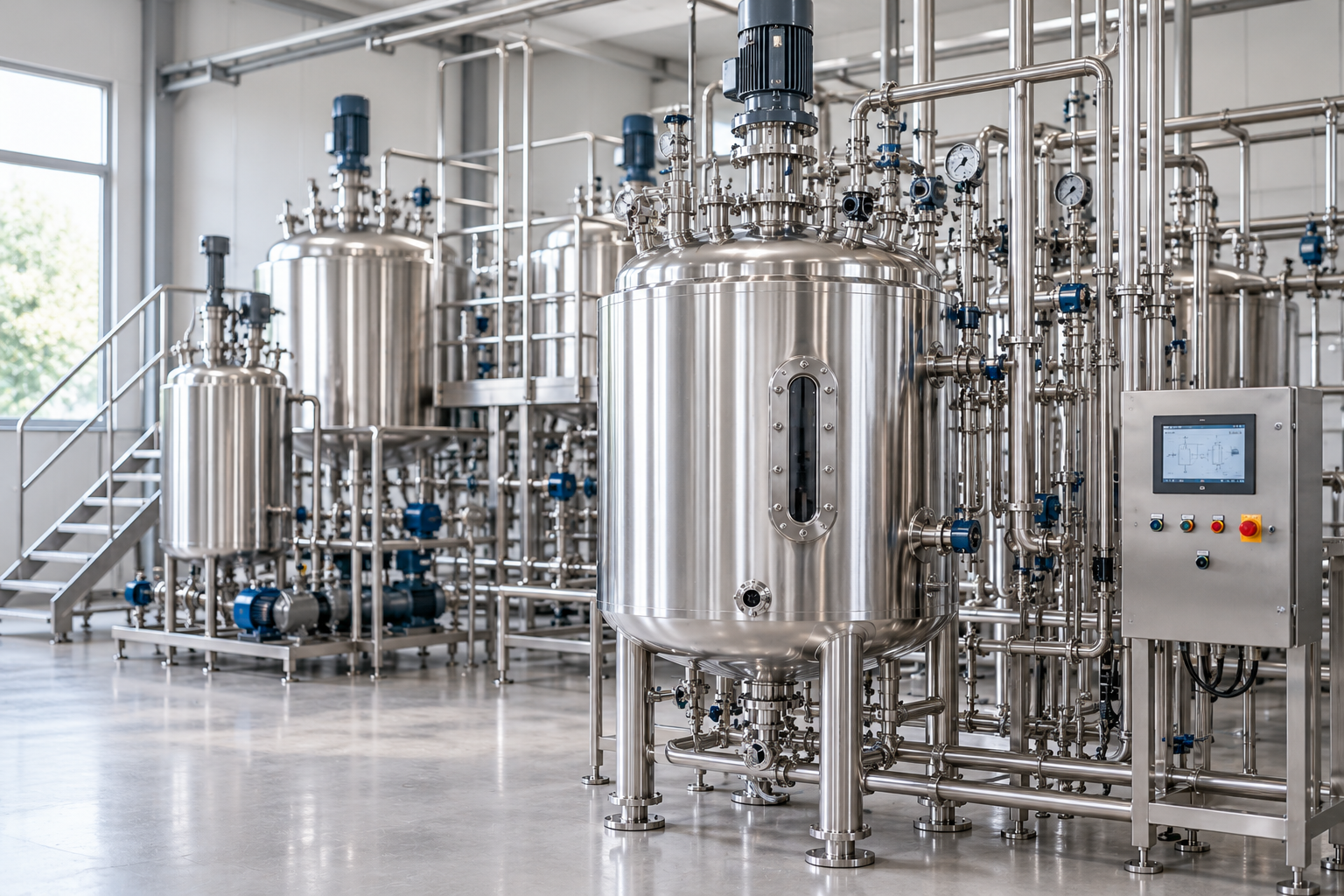
Fermenter / Bioreactor System
A fermenter (bioreactor) is a sterile, agitated and aerated vessel that provides the controlled environment — temperature, pH, dissolved oxygen and agitation — in which microorganisms, cells or enzymes carry out a biological conversion, growing biomass or producing a target metabolite from a nutrient feedstock. Within a bioprocess line it sits upstream of downstream separation and purification, converting raw substrate into a fermentation broth that is subsequently clarified, concentrated and purified into the finished active. It is chosen for reproducible batch-to-batch performance, precise environmental control, and scalability from laboratory strain development through to full commercial production. Mechotech designs and manufactures turnkey fermenter systems, delivering complete engineered vessels and automation for pharmaceutical, nutraceutical, food and industrial biotechnology producers.
A fermenter works by maintaining a sterile, homogeneous environment in which agitation and sparged aeration keep the culture in suspension and supplied with oxygen (for aerobic processes) while a cooling/heating jacket or internal coil holds temperature at the setpoint the organism or cell line requires. Depending on the duty, Mechotech configures stirred-tank, airlift or bubble-column formats, sized from bench/pilot development vessels through to multi-kilolitre production fermenters, to deliver consistent growth kinetics, high product titre, and repeatable batch performance. Product-contact parts are built in SS 316L with a mirror-polished, crevice-free interior finish suited to steam-in-place (SIP) sterilisation and clean-in-place (CIP) turnaround between batches. Systems are supplied with PLC/SCADA-based automation for agitation speed, aeration rate, temperature, pH and dissolved-oxygen control, with batch data logging for regulatory traceability, and vessel geometry, working volume and instrumentation are configured to the client's organism, process mode and target scale rather than a fixed model.
Technical Specifications
| Technology | Stirred-tank / airlift / bubble-column fermentation (aerobic and anaerobic) |
|---|---|
| Working Principle | Controlled temperature, pH, dissolved oxygen and agitation sustain microbial or cell-culture growth and product formation in a sterile vessel |
| Process Mode | Batch, fed-batch or continuous (configured to process requirement) |
| Product-contact Material | SS 316L, mirror-polished, crevice-free |
| Sterilisation | Steam-in-place (SIP) vessel sterilisation |
| Cleaning | Clean-in-place (CIP) between batches |
| Agitation & Aeration | Configurable agitator design and sparged aeration for aerobic duties; agitation only for anaerobic duties |
| Temperature Control | Jacketed or internal-coil heating/cooling to process setpoint |
| Automation | PLC/SCADA with batch data logging (configurable) |
| Working Volume | Configured to requirement — pilot/bench scale to multi-kilolitre commercial scale |
| Utilities | Clean steam, chilled/cooling water, compressed/process air or inert gas, electrical power |
| Compliance | GMP hygienic design; USFDA-ready documentation |
| Output | Fermentation broth for downstream separation and purification |
Manufacturing Process
Media Preparation & Sterilisation
The nutrient medium is batched and sterilised — typically by steam-in-place within the vessel itself or via a continuous steriliser upstream — to eliminate contaminating organisms before inoculation.
Inoculation
A seed culture, grown up through progressively larger seed vessels, is aseptically transferred into the sterilised fermenter to begin the production batch.
Controlled Fermentation
Agitation and sparged aeration keep the culture suspended and oxygenated while automated control loops hold temperature, pH and dissolved oxygen at the organism's setpoints through the growth and production phases.
In-Process Monitoring
Online sensors and periodic sampling track biomass growth, substrate consumption and product titre, allowing feed rate (for fed-batch operation) or process parameters to be adjusted through the run.
Harvest
At the target endpoint the fermentation broth is discharged from the vessel to downstream processing — typically centrifugation or filtration — for cell/biomass separation and product recovery.
Clean-in-Place & Sterilise-in-Place
CIP and SIP cycles clean and re-sterilise the vessel and product-contact surfaces between batches, restoring the aseptic state required for the next fermentation run.
Applications
- Microbial fermentation for enzyme and organic-acid production
- Probiotic and starter-culture biomass production
- Antibiotic and secondary-metabolite fermentation
- Cell-culture bioprocessing for biopharmaceutical intermediates
- Single-cell protein and microbial biomass production
- Fermented nutraceutical and functional-food ingredient production
- Pilot-scale strain and process development
- Export to regulated-market bioprocess equipment buyers
Key Features
Sterile, Hygienic GMP Design
Mirror-polished, crevice-free SS 316L product-contact surfaces support steam-in-place sterilisation and clean-in-place turnaround, meeting WHO-GMP and Schedule M requirements.
Precise Environmental Control
PLC/SCADA-based automation holds agitation, aeration, temperature, pH and dissolved oxygen at process setpoints, with batch data logging for reproducible runs and regulatory traceability.
Configurable Vessel Format
Stirred-tank, airlift or bubble-column formats and agitator/sparger design are selected to match aerobic or anaerobic process requirements and shear sensitivity of the organism or cell line.
Scalable From Pilot to Commercial
Working volume is sized to the client's process, from bench/pilot development vessels through to multi-kilolitre production fermenters, with a consistent scale-up basis across sizes.
Turnkey Engineering
Design, fabrication, installation, and commissioning are delivered as one accountable scope, so the client deals with a single engineering team from drawing to handover.
Frequently Asked Questions
What is a fermenter?
What is the difference between a fermenter and a bioreactor?
How does a fermenter work?
What process modes does Mechotech's fermenter support?
What working volumes are available for the Fermenter?
What materials and sterilisation standards apply?
Where does a fermenter fit in a bioprocess line?
Does Mechotech supply the fermenter as a turnkey system?
Ready to discuss your project?
Get a free quote and technical consultation from our engineering team.