
RCVD – Rotary Cone Vacuum Dryer
RCVD – Rotary Cone Vacuum Dryer
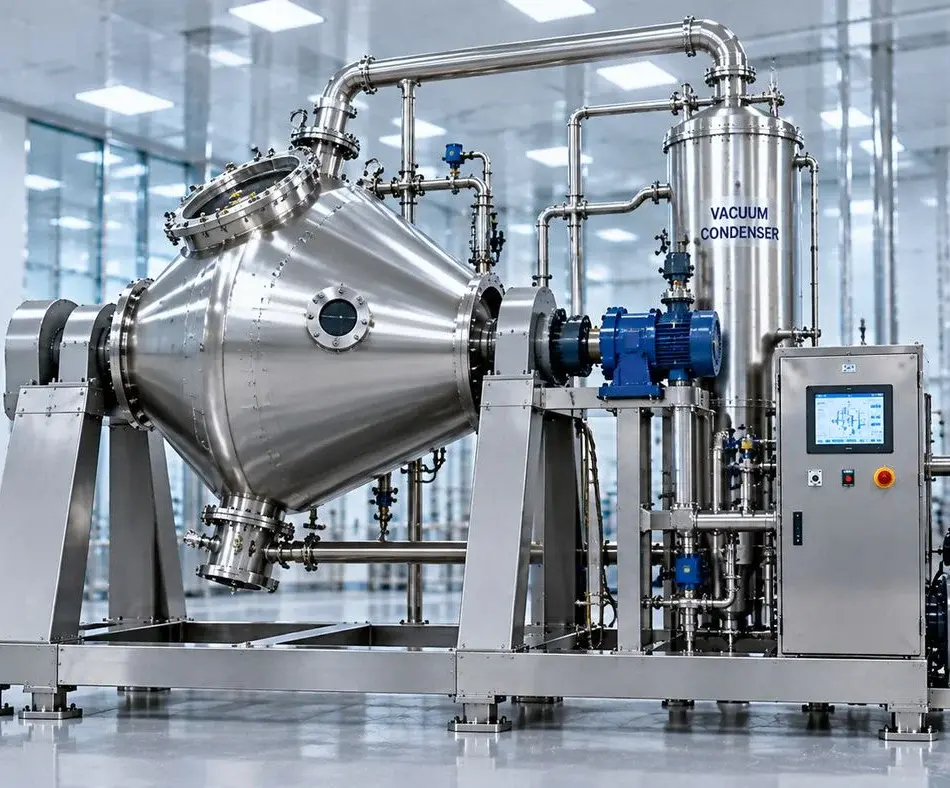
Mechotech engineers and manufactures the RCVD Rotary Cone Vacuum Dryer as turnkey process equipment for pharmaceutical, nutraceutical, food and botanical processing lines that need low-shear drying of solids, pastes and filter cakes under vacuum. A double-cone vessel rotates slowly end-over-end on a horizontal axis so the product tumbles and folds over itself against the heated wall; because the whole vessel rotates, there is no internal agitator shaft in the product zone, which lowers mechanical stress on friable or crystalline material compared with an internally agitated dryer.
The RCVD Rotary Cone Vacuum Dryer is built in SS 316L (or a process-appropriate grade) as a symmetrical double-cone (or bi-conical) vessel mounted on trunnions and rotated by an external drive at low speed; the whole shell, not an internal blade, does the mixing, so wet solid, paste or filter cake charged into the vessel is repeatedly lifted and tumbled as the cone rotates, continuously exposing fresh surface to the jacketed, heated wall. With the vessel under vacuum, moisture evaporates at reduced temperature and is drawn off through a rotary vacuum joint to a condenser for recovery, while the absence of an internal agitator shaft or seal in the product zone reduces product hold-up, dead zones and the risk of localised overheating or attrition. Electropolished product-contact surfaces, a fully enclosed shell for contained charging and discharge, and PLC-based control of rotation speed, jacket temperature and vacuum level support gentle, uniform batch drying, and capacity is configured to the customer's requirement from pilot-scale vessels for process trials to larger commercial units.
Process Flow
Technical Specifications
| Equipment Type | Rotary Cone Vacuum Dryer (RCVD) — double-cone rotating vessel, vacuum drying |
|---|---|
| Vessel Shape | Symmetrical double-cone (bi-conical) shell rotating end-over-end on a horizontal axis |
| Construction | SS 316L (or process-appropriate alloy), electropolished product-contact surfaces |
| Mixing Mechanism | Whole-vessel rotation (no internal agitator shaft in the product zone) |
| Heating | Jacketed shell, heated by hot water / steam / thermic fluid |
| Vacuum System | Vacuum pump with rotary vacuum joint at the trunnion and external condenser |
| Rotation Speed | Low speed, variable/controlled (process-specific) |
| Charging | Sealable charge port; vacuum transfer or gravity feed |
| Discharge | Gravity or valve discharge on vessel rotation to discharge orientation |
| Sampling | In-process sampling port without breaking vacuum |
| Automation | PLC-based control of rotation speed, jacket temperature and vacuum level |
| Cleaning | CIP-capable, fully enclosed vessel |
| Capacity | Configured to requirement — pilot-scale vessels to larger commercial units |
| Utilities | Hot water / steam / thermic fluid for jacket heating, vacuum system utilities, electric power |
| Compliance | GMP hygienic design; full documentation for qualification |
Plant Capacities
| Vessel Scale | Typical Use | Rotation Type | Vacuum Level |
|---|---|---|---|
| Pilot-scale | Process trials, low-shear drying validation | Whole-vessel, end-over-end | Configurable |
| Production-scale | Commercial batch manufacturing | Whole-vessel, end-over-end | Configurable |
| Large production-scale | High-volume, low-attrition drying | Whole-vessel, end-over-end | Configurable |
Vessel volume, jacket area and rotation speed are sized to the product's bulk density and permissible fill ratio; exact capacity is configured to your batch size and drying-time target.
Manufacturing Process
Charging
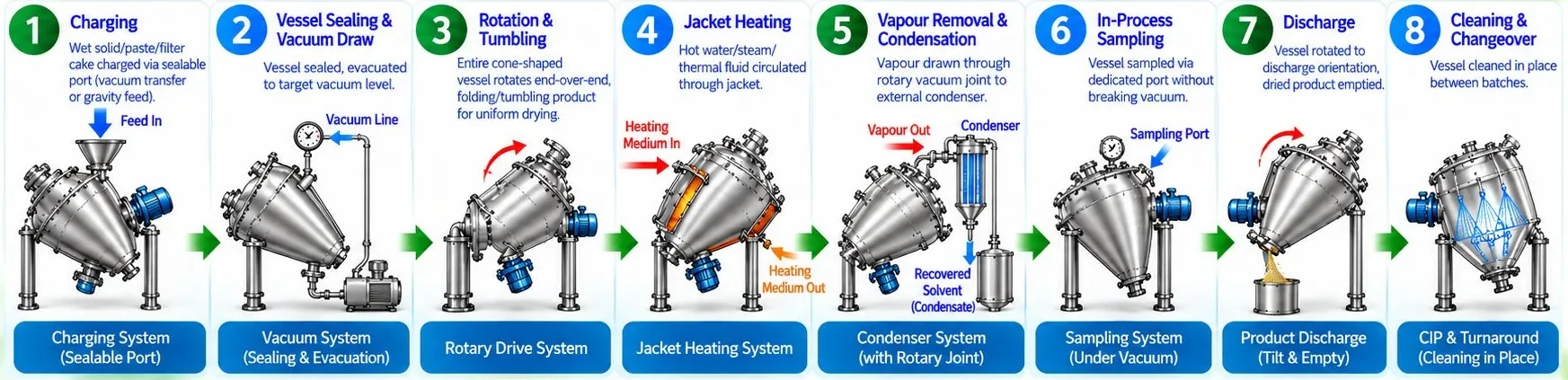
The wet solid, paste, or filter cake is charged into the double-cone vessel through a sealable charge port, typically by vacuum transfer or gravity feed from an upstream filter or centrifuge.
Vessel Sealing & Vacuum Draw
The vessel is sealed and evacuated to the target vacuum level, lowering the boiling point of residual moisture or solvent so drying can proceed at a controlled, generally low temperature.
Rotation & Tumbling
The entire cone-shaped vessel rotates slowly end-over-end on its horizontal axis, so the product bed continuously folds and tumbles, exposing new surface to the heated wall on every rotation.
Jacket Heating
Hot water, steam or thermic fluid circulated through the vessel's jacket conducts heat through the shell wall into the tumbling product, evaporating moisture without direct flame or high-temperature contact.
Vapour Removal & Condensation
Evaporated moisture or solvent vapour is drawn through a rotary vacuum joint at the trunnion to an external condenser, where it is recovered, sustaining vacuum throughout the drying cycle.
In-Process Sampling
The vessel can be sampled through a dedicated port during the cycle to check residual moisture without breaking the vacuum, allowing the endpoint to be confirmed before the cycle is closed out.
Discharge
Once dry, the vessel is rotated to align its discharge port and the dried product is emptied, typically by gravity or a bottom valve, minimising manual handling of the dry solid.
Cleaning & Changeover
The fully enclosed vessel is cleaned in place between batches, supporting fast, validated changeover on multi-product pharmaceutical and nutraceutical lines.
Major Plant Equipment
- Double-cone (bi-conical) rotating vessel (SS 316L, electropolished)
- Trunnion mounting and support structure
- External rotation drive motor and gearbox
- Rotary vacuum joint at trunnion
- Jacket heating system (hot water / steam / thermic fluid)
- Vacuum pump and vacuum receiver
- Solvent/vapour recovery condenser
- Sealable charge port
- Discharge valve / port
- In-process sampling port
- Instrumentation (vacuum, jacket temperature, rotation speed)
- PLC-based control panel
Plant Output
Applications
- Drying of friable or attrition-sensitive crystalline solids
- Bulk drug (API) and fine-chemical drying under vacuum
- Drying of filter cakes from upstream filtration or centrifugation
- Nutraceutical and botanical extract powder or granule drying
- Drying of solvent-wet solids where solvent recovery is wanted
- Pharmaceutical intermediate drying where product attrition must be minimised
Key Features
Low-Shear Tumbling Action
Because the whole vessel rotates rather than an internal blade, the product folds over itself gently, which lowers attrition and particle breakage for friable or crystalline solids.
No Internal Agitator Shaft or Seal
The absence of an internal shaft in the product zone reduces dead zones and product hold-up and simplifies cleaning.
Heat Transfer through the Rotating Shell
Continuous tumbling exposes fresh product surface to the jacketed wall on every rotation.
Vapour and Solvent Recovery
A rotary vacuum joint and external condenser recover evaporated solvent or moisture.
Enclosed Vessel
Sealable charge and discharge ports and an enclosed shell allow contained charging, drying and discharge; suitability for potent or dusty products is specified per project.
Hygienic, CIP-Capable Construction
Electropolished SS 316L surfaces and a CIP-capable enclosed vessel, with documentation to support GMP qualification.
Frequently Asked Questions
What is a Rotary Cone Vacuum Dryer (RCVD) used for?
How does an RCVD dry the product without an internal agitator?
Why choose an RCVD over an agitated dryer for some products?
Can an RCVD recover solvent during drying?
Is the RCVD suitable for potent or dusty products?
What capacity range is available?
How does an RCVD compare with a Rotary Vacuum Paddle Dryer?
What information is needed to specify an RCVD?
Which related equipment pages does Mechotech list?
Ready to discuss your project?
Get a free quote and technical consultation from our engineering team.