Ginger Extraction Plant
Ginger Extraction Plant
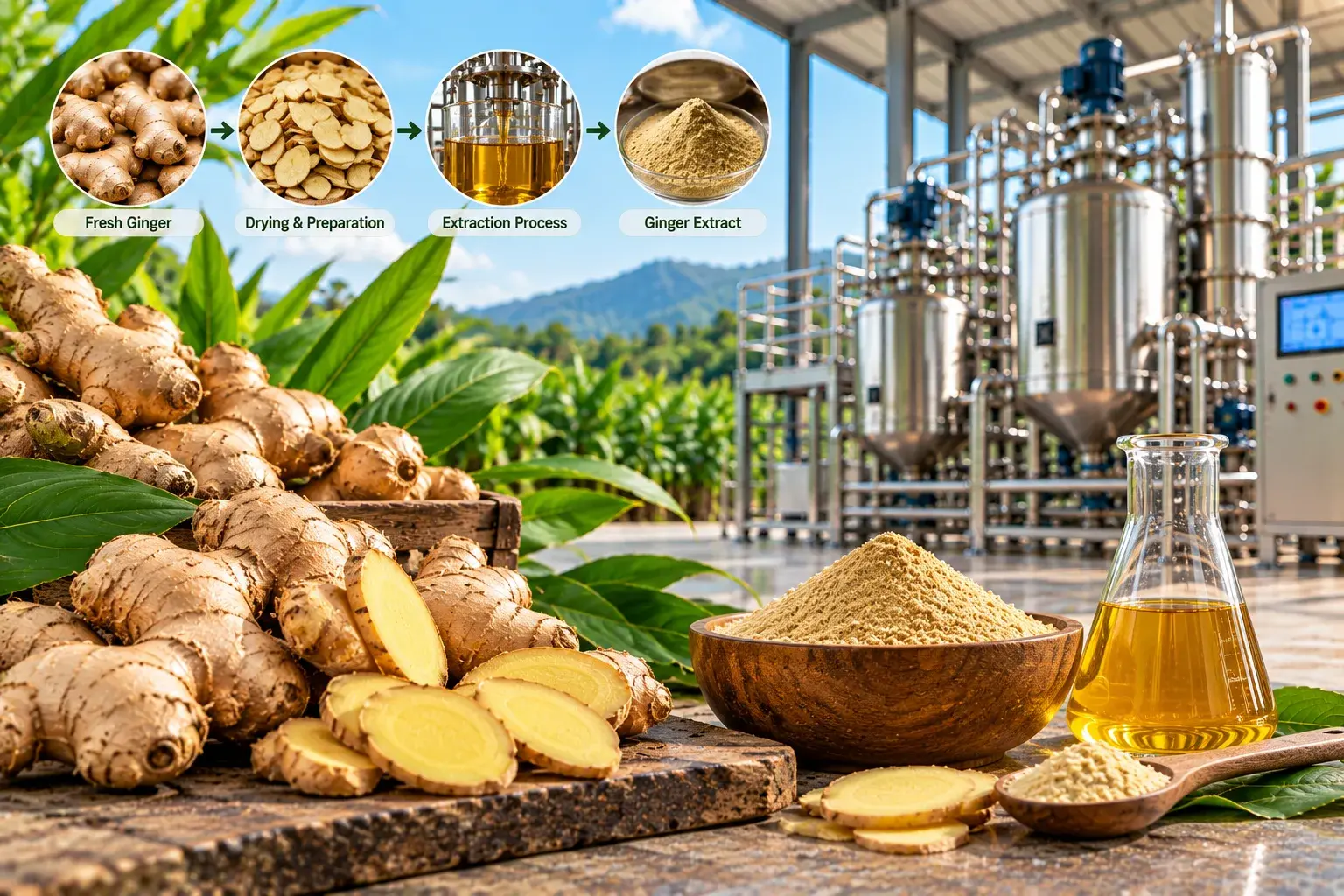
Mechotech designs and manufactures turnkey ginger extraction plants, engineered and built at our Hyderabad, India works. Ginger gives four distinct products and the catalogue lists a plant for each: ginger oleoresin by solvent extraction, a gingerol-standardised extract, a steam-distilled essential oil, and a CO2 oil. This page is for spice, nutraceutical and flavour manufacturers who need to decide which ginger route fits the product they want to sell before a plant is specified.
All four routes start from dried ginger rhizome that is cleaned and size-reduced. The oleoresin plant uses closed jacketed SS 316L extractors, pressure leaf filtration, a multi-effect vacuum evaporator and a dedicated aroma-recovery unit. The gingerol-extract plant uses alcohol or hydro-alcoholic extraction, a filter press, a falling-film / vacuum evaporator and a spray or vacuum dryer. The oil plants use either an SS 316L still with multi-tube condenser and Florentine flask, or a high-pressure CO2 unit with CO2 recovery. The design is GMP-oriented and hygienic, with documentation to support the customer's own qualification. Final configuration depends on raw material, process requirement, capacity and engineering review.
Technical Specifications
| Plant Type | Ginger extraction plant: oleoresin, gingerol extract, steam-distilled oil or CO2 oil, by route |
|---|---|
| Botanical / Feedstock | Zingiber officinale, dried rhizome (typically 8-10% moisture on the oleoresin page) |
| Oleoresin Route | Food-grade solvent extraction in closed jacketed SS 316L extractors; multi-effect vacuum evaporator with dedicated aroma recovery; standardised to customer specification for gingerol, shogaol, volatile oil and viscosity |
| Gingerol Extract Route | Alcohol / hydro-alcoholic extraction; configurable range listed on the product page: 2.5% to 60% Total Gingerols by HPLC; powder or liquid concentrate (5 candidate technologies screened) |
| Oil by Distillation | Steam distillation of dried rhizome (hydro, vacuum or pressure modes can be evaluated); sesquiterpene-rich oil without the non-volatile gingerols and shogaols |
| CO2 Oil Route | Supercritical CO2 extraction in SS 316L high-pressure vessels with CO2 recompression and recirculation; ethanol modifier can be evaluated |
| Filtration | Pressure leaf filtration with polishing filters, or plate-and-frame filter press with cartridge polish filters, by route |
| Drying | Spray dryer or vacuum tray dryer on the gingerol extract route; not applicable to oleoresin, which is a viscous concentrate |
| Product-contact Material | SS 316L, electropolished, CIP-cleanable |
| Automation | PLC-SCADA with recipe-based batch control, traceability and production reporting on the extraction routes |
| Utilities | Steam, chilled/cooling water, compressed air, nitrogen, power (project-specific) |
| Plant Capacity | Configured to requirement; the reference project in the case study processes 20 MT/day of dried ginger rhizomes |
Manufacturing Process
Raw Material Cleaning & Size Reduction
Dried ginger rhizome is authenticated, tested for moisture, cleaned and milled to a particle size that is sized for efficient extraction, with conditions set to help protect gingerols, shogaols and volatile oil.
Solvent Extraction
Ground ginger is extracted with a food-grade solvent (ethanol / hydro-alcoholic on the gingerol route) in closed jacketed SS 316L vessels at controlled, moderate temperature over multiple cycles.
Filtration
The extract (miscella) is clarified through pressure leaf filtration or a plate-and-frame filter press, followed by polishing or cartridge filters, to remove fibre and spent marc.
Vacuum Concentration & Solvent Recovery
The clarified extract is concentrated under reduced pressure to minimise thermal degradation, with solvent condensed, purified and recycled in a closed loop.
Aroma Recovery (Oleoresin Route)
A dedicated aroma-recovery section captures the volatile compounds that carry ginger's flavour and fragrance, which are reintroduced to the finished oleoresin.
Standardisation
Oleoresin is standardised for gingerol, shogaol, volatile oil, viscosity, moisture and residual-solvent limits. The gingerol extract is assayed by HPLC for total gingerols and adjusted to the declared specification.
Drying (Gingerol Extract Route)
The standardised gingerol extract is spray- or vacuum-dried into a free-flowing powder ready for encapsulation and blending, or supplied as a liquid concentrate.
Alternative Oil Routes: Steam Distillation or CO2
For an oil instead of an oleoresin, rhizome is steam-distilled on an extended run with a generously sized condenser and Florentine flask, or extracted with supercritical CO2 and the CO2 recovered and recirculated.
Quality Control & Packing
Each batch is released after assay or GC-MS profiling, residual-solvent, heavy-metal, microbial and moisture testing as the route requires, with certificate-of-analysis documentation.
Major Plant Equipment
- Raw material cleaning and inspection system
- Hammer mill / pulveriser
- Stainless-steel jacketed extraction vessels (SS 316L)
- Solvent storage tanks and transfer pumps
- Pressure leaf filters, plate-and-frame filter press and cartridge polish filters
- Multi-effect vacuum evaporator or falling-film / vacuum evaporator
- Aroma recovery system
- Closed-loop solvent recovery unit with condensers
- Spray dryer / vacuum tray dryer
- Ribbon blender (standardisation)
- SS 316L distillation still, multi-tube condenser and Florentine flask (oil route)
- High-pressure supercritical CO2 extraction vessel, separator and CO2 recovery system (CO2 route)
- CIP (clean-in-place) system
- PLC-SCADA automation panel, electrical MCC and instrumentation
Plant Output
Case Study
Ginger Oleoresin Extraction Plant
See how this plant was engineered and delivered for a real project.
Applications
- Pharmaceutical standardised ginger ingredient supply
- Nutraceutical capsule, tablet and joint or digestive-health supplement manufacturing
- Food, flavour and beverage applications, including ginger ale, ginger beer and confectionery
- Fragrance applications and aromatherapy blends
- Cosmetic and personal care active ingredients
- Ayurvedic and traditional medicine preparations
Key Features
Four Ginger Routes, Each Distinct
Oleoresin, gingerol extract, distilled oil and CO2 oil have separate catalogue pages, because gingerols and shogaols are non-volatile while the oil carries the sesquiterpene fraction.
Dedicated Aroma Recovery
On the oleoresin route, a dedicated aroma-recovery unit captures ginger's volatile flavour and fragrance compounds for reintroduction.
Low-Temperature Processing
Vacuum concentration and controlled-temperature extraction limit dehydration of gingerols to shogaols, to protect pungency and aroma.
Extended Sesquiterpene Distillation
The oil plant is designed for the longer run and extra condenser area that ginger's heavier sesquiterpene fraction needs.
Closed-Loop Solvent Recovery
Integrated recovery returns solvent for reuse within the process; recovery performance is established during process development.
Frequently Asked Questions
Should I make ginger oleoresin, gingerol extract or ginger oil?
Why does distilled ginger oil not contain gingerols?
What gingerol range can the extract plant be configured for?
What ginger raw material do you need to know about?
Can ginger be extracted with CO2 instead of solvent?
What does the ginger reference case study show?
Can the ginger extract be spray dried?
What should I send to request a ginger plant proposal, and can I trial first?
Project Enquiry Pages
Country pages that include this equipment among their project areas:
Ready to discuss your project?
Get a free quote and technical consultation from our engineering team.