Grape Skin Extract Powder
Grape Skin Extract Powder
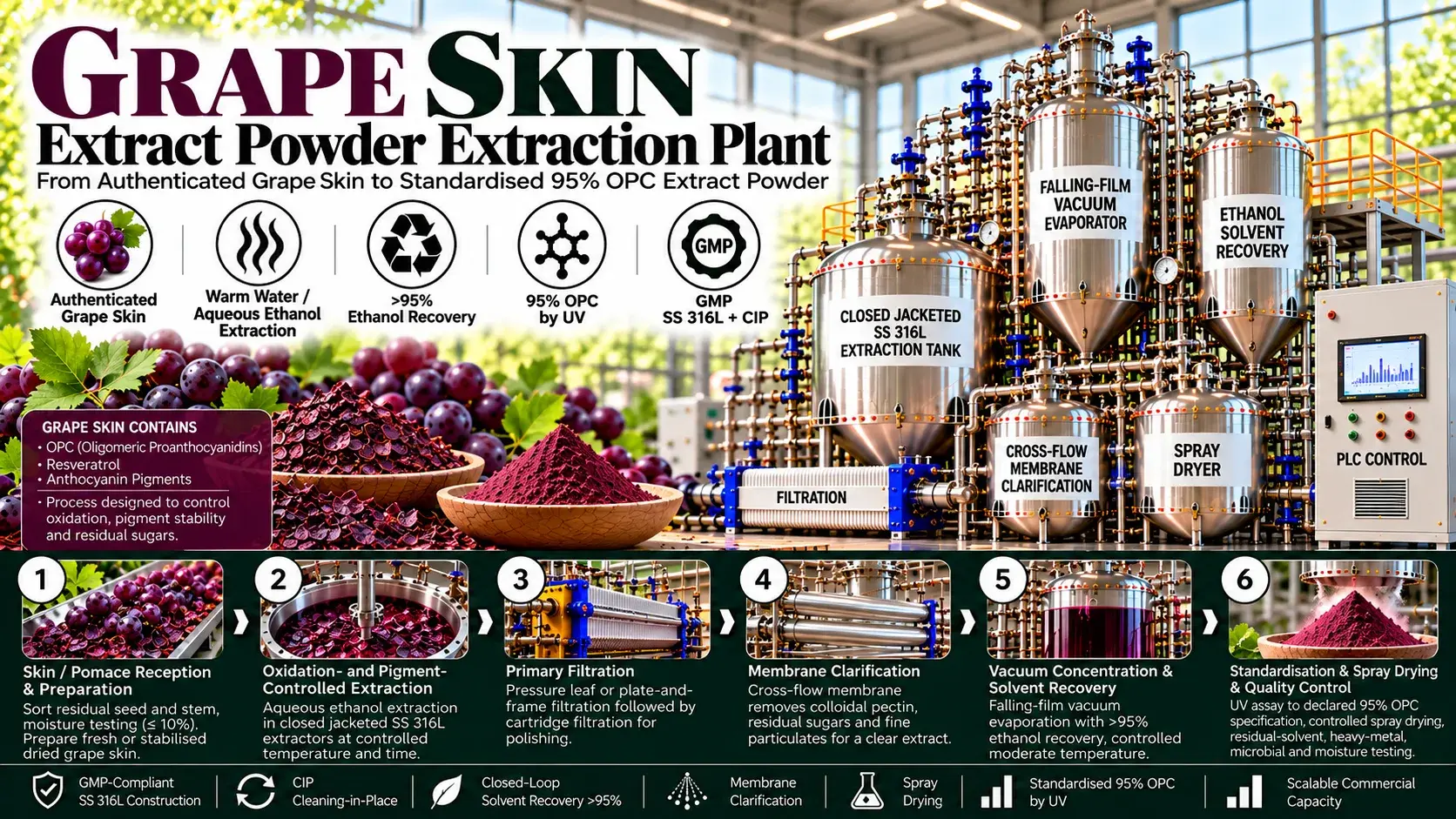
Mechotech designs and manufactures turnkey extraction plants for Grape Skin Extract Powder, processing the skin (pomace) of Vitis vinifera grapes — a genuinely distinct plant part and polyphenol profile from grape seed — into an extract standardised to 95% OPC by UV. Unlike grape seed, whose polyphenol content is dominated by proanthocyanidins, grape skin also carries resveratrol (a stilbene) and anthocyanins (the red/purple pigment flavonoids responsible for red-wine colour), giving skin-derived extract a broader, pigment-rich polyphenol composition alongside its OPC fraction. We supply the complete machinery — skin/pomace preparation, aqueous-ethanol extraction, filtration, membrane clarification, vacuum concentration, closed-loop solvent recovery, standardisation and spray drying — as a single turnkey system for the antioxidant nutraceutical, functional food, and cosmetic industries.
Mechotech's Grape Skin Extract plant is engineered around the specific chemistry of grape skin/pomace: a soft-tissue, pigment-dense raw material typically sourced as a winery by-product, which requires careful, oxidation-controlled aqueous-ethanol extraction to co-recover its oligomeric proanthocyanidins together with resveratrol and anthocyanin pigments without excessive colour or pigment degradation. Because anthocyanins are pH- and temperature-sensitive, the line is run at controlled, moderate temperature with tight residence-time control through concentration and drying, and a dedicated clarification/membrane stage manages the higher pigment and residual-sugar load typical of skin/pomace versus seed raw material. Built in SS 316L with electropolished product-contact surfaces, closed-loop solvent recovery, and full batch documentation, each plant is delivered as a commissioned turnkey system engineered to the declared 95% OPC by UV specification.
Technical Specifications
| Product | Grape Skin Extract Powder Extraction Plant |
|---|---|
| Botanical Name | Vitis vinifera |
| Raw Material | Grape skin / pomace (winery by-product) |
| Plant Part | Skin (fruit pericarp) |
| Extract Type | Standardised OPC/polyphenol extract, spray-dried powder |
| Standardisation | 95% OPC (Oligomeric Proanthocyanidins) by UV |
| Extraction Method | Aqueous-ethanol extraction, oxidation- and pigment-controlled (closed jacketed extractors) |
| Product-contact Material | SS 316L, electropolished, CIP-cleanable |
| Filtration System | Pressure leaf/plate-and-frame filtration with cross-flow membrane clarification for pigment and sugar control |
| Concentration System | Falling-film vacuum evaporator with closed-loop solvent recovery |
| Drying System | Spray dryer |
| Automation | Configurable — manual, semi-automatic or fully automatic PLC-SCADA (recipe-based) |
| Plant Capacity | Configured to requirement |
| Utility Requirements | Steam, chilled/cooling water, compressed air, soft water, power (project-specific) |
| Compliance | GMP, FSSAI, HACCP hygienic design; full documentation for qualification |
| Final Product Form | Free-flowing standardised OPC/polyphenol powder |
Plant Capacities
| Plant Scale | Skin/Pomace Throughput | Typical Use |
|---|---|---|
| Pilot | Configured to your feedstock and trial plan | Product development, pigment-stability parameter validation |
| Semi-Commercial | Configured between pilot and commercial scale | Contract manufacturing, scale-up trials |
| Commercial | Configured to raw-material supply and confirmed buyer volume | Export-grade continuous production |
Capacity is configured to raw skin/pomace supply (often seasonal, tied to winery or juice-processing schedules) and confirmed buyer volume; we recommend a pilot plant to validate anthocyanin/resveratrol stability parameters before scaling.
Manufacturing Process
Skin/Pomace Reception & Preparation
Grape skin/pomace — typically a winery or juice-processing by-product — is received, sorted to remove residual seed and stem fragments, tested for moisture and sugar content, and prepared for extraction while fresh or from stabilised dried stock.
Oxidation- and Pigment-Controlled Extraction
Prepared skin is extracted with a controlled aqueous-ethanol solvent system in closed jacketed SS 316L extractors under moderate, regulated temperature, co-recovering the oligomeric proanthocyanidin fraction alongside skin-specific resveratrol and anthocyanin pigments while limiting oxidative browning.
Primary Filtration
The extract is clarified through pressure leaf or plate-and-frame filters followed by cartridge polish filters, removing skin fibre and pulp residue.
Membrane Clarification
Cross-flow membrane filtration removes colloidal pectin, residual sugars, and fine particulate carried over from the soft, pigment-dense skin matrix, improving downstream concentration efficiency and colour consistency.
Vacuum Concentration & Solvent Recovery
The clarified extract is concentrated in a falling-film vacuum evaporator at controlled, moderate temperature to protect the anthocyanin pigments from thermal degradation, with ethanol recovered and recycled through the closed-loop system.
Standardisation
The concentrate is assayed by UV for OPC content and adjusted to the declared 95% OPC by UV specification before drying.
Spray Drying & Quality Control
The standardised concentrate is spray-dried at controlled inlet/outlet temperature to a fine, free-flowing powder that preserves colour and antioxidant activity, then released after UV assay, residual-solvent, heavy-metal, microbial, and moisture testing with full certificate-of-analysis documentation.
Major Plant Equipment
- Skin/pomace reception & sorting system
- Pulp/seed separation screen
- Stainless-steel jacketed extraction vessels (SS 316L)
- Solvent storage tanks
- Solvent transfer pumps
- Pressure leaf / plate-and-frame filters
- Cross-flow membrane clarification system
- Falling-film vacuum evaporator
- Closed-loop solvent recovery system & condensers
- Spray dryer
- CIP (clean-in-place) system
- Finished-product storage tanks
- PLC-SCADA control panel, electrical MCC & instrumentation
Plant Output
Applications
- Antioxidant and cardiovascular-support nutraceutical formulations
- Anti-ageing cosmetic and personal care active ingredients
- Natural colourant and pigment-stable functional food applications
- Functional beverage formulations
- Pharmaceutical standardised ingredient supply
- Export to regulated-market ingredient buyers
Key Features
Skin-Specific Polyphenol Recovery
Extraction and clarification are tuned to co-recover grape skin's resveratrol and anthocyanin pigments alongside its OPC fraction — a broader polyphenol profile than grape seed's proanthocyanidin-dominant chemistry.
Pigment- and Oxidation-Controlled Processing
Moderate extraction and drying temperatures, plus membrane clarification, limit oxidative browning and preserve anthocyanin colour stability through to the finished powder.
GMP Hygienic SS 316L Construction
Electropolished SS 316L product-contact surfaces use GMP hygienic design, with CIP operation between batches.
Closed-Loop Solvent Recovery
Integrated recovery returns ethanol for reuse each batch, reducing fresh-solvent consumption.
Standardised 95% Assay by UV
In-process and batch-release UV assay are used to check the finished powder against its declared 95% OPC specification for consistent, buyer-ready quality.
Scalable Batch Capacity
Plants are configured to requirement from pilot scale upward, with modular expansion.
Frequently Asked Questions
How is Grape Skin Extract different from Mechotech's Grape Seed Extract?
What is Grape Skin Extract Powder, and why is it commercially extracted?
Does Mechotech supply the complete machinery for Grape Skin Extract Powder?
Why does grape skin extraction need pigment- and oxidation-control steps?
What testing method confirms the Grape Skin Extract Powder specification?
What production capacities are available for the Grape Skin Extract Powder plant?
Which industries buy Grape Skin Extract Powder, and does the plant support GMP qualification?
Ready to discuss your project?
Get a free quote and technical consultation from our engineering team.