Curcumin Extraction Plant
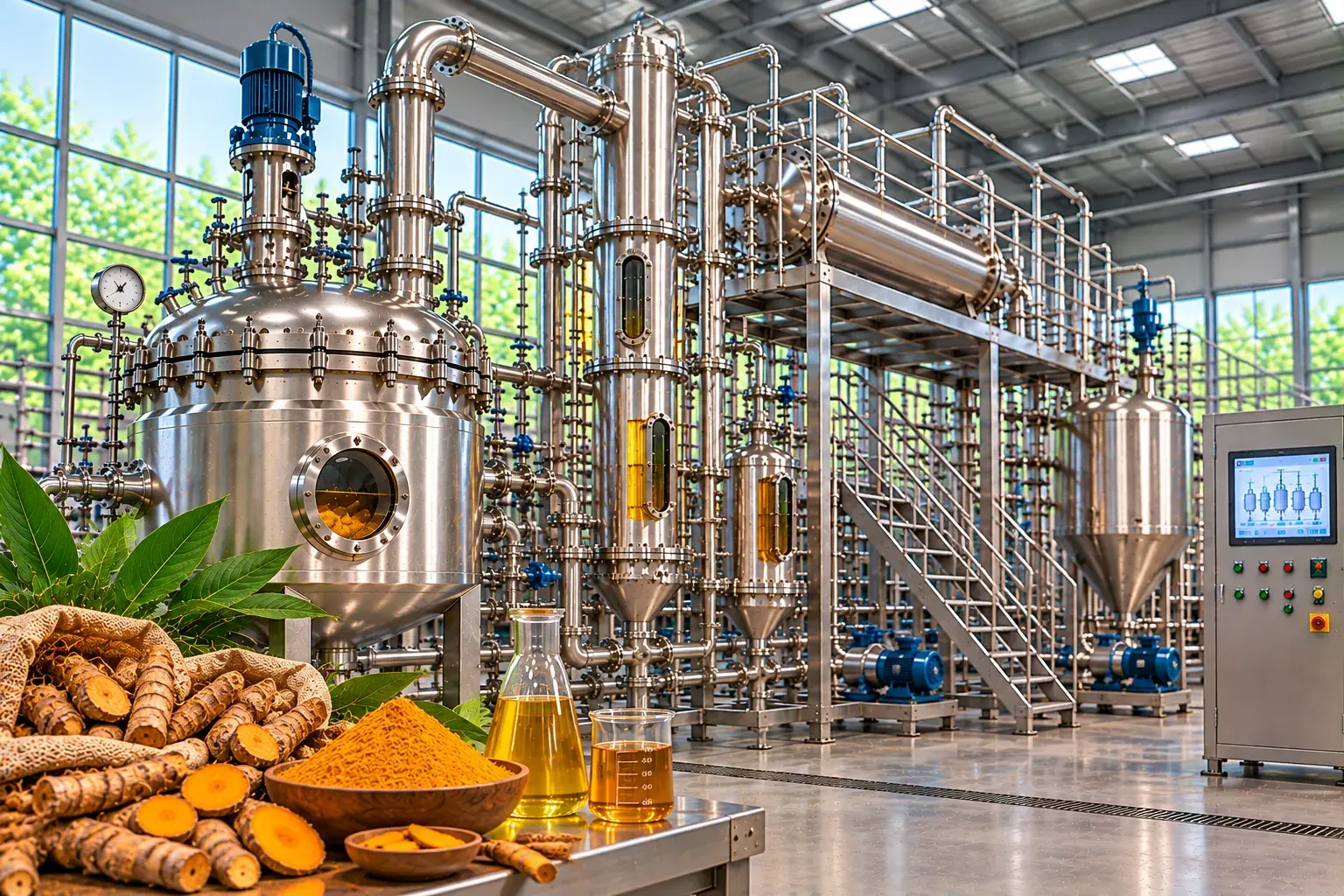
Curcumin Extraction Plant
Mechotech designs and manufactures turnkey curcumin extraction plants that process turmeric (Curcuma longa) rhizome into a standardised curcuminoid powder, with a configurable grade range listed on the product page. Around that core solvent-and-crystallisation line the catalogue lists neighbouring turmeric routes: nano curcumin, tetrahydrocurcumin, and turmeric oil by distillation or by CO2 extraction. This page is for ingredient manufacturers deciding which turmeric route fits the product they want to make.
The curcumin line is a closed-loop plant: raw material cleaning and hammer mill, jacketed SS 316L extraction tanks, plate-and-frame filter press and centrifugal separator with cartridge polish filters, a falling-film / vacuum concentrator, solvent recovery, purification, crystallisers and industrial centrifuges, a spray or vacuum dryer, pulveriser and blending, CIP and PLC-SCADA automation. Curcumin is heat-, light- and oxidation-sensitive, so solvent choice (ethanol, acetone or hydro-alcoholic blends) and closed-loop handling are set around the target grade. The plant uses GMP-oriented hygienic design with documentation to support the customer's own qualification. Final configuration depends on raw material, process requirement, capacity and engineering review.
Technical Specifications
| Plant Type | Curcumin (curcuminoid) extraction plant, solvent extraction with crystallisation |
|---|---|
| Botanical / Feedstock | Curcuma longa (turmeric) rhizome |
| Target Extract | Curcuminoids and turmerones |
| Standardisation | Configurable range listed on the product page: up to 95% Curcuminoids by HPLC; custom specifications available |
| Extraction Conditions | Closed-loop solvent extraction (ethanol, acetone or hydro-alcoholic blends) in jacketed SS 316L tanks |
| Candidate Technologies | Counter-current, supercritical CO2, subcritical water, ultrasound-assisted, enzyme-assisted, hybrid and microwave-assisted (7 screened on the product page) |
| Filtration & Concentration | Plate-and-frame filter press, centrifugal separator and cartridge polish filters; falling-film / vacuum concentrator with solvent recovery |
| Isolation | Purification, then crystallisation and industrial centrifuges |
| Drying | Spray dryer or vacuum dryer |
| Product-contact Material | SS 316L, CIP-cleanable, electropolished |
| Automation | Configurable: manual, semi-automatic or fully automatic PLC-SCADA |
| Plant Capacity | Configured to requirement; the reference project in the case study processes 10 MT/day of turmeric rhizomes |
Manufacturing Process
Raw Material Preparation
Turmeric rhizome is authenticated with an incoming curcuminoid assay, cleaned and milled to a uniform particle size to maximise surface area for solvent contact.
Solvent Extraction
Milled turmeric is extracted in closed, jacketed SS 316L tanks under controlled temperature and agitation. Solvent (ethanol, acetone or hydro-alcoholic blends) is selected to match the target grade, because food-grade and pharmaceutical-grade extraction carry different solvent and residue requirements.
Filtration & Clarification
The extract (miscella) is clarified through a plate-and-frame filter press and centrifugal separator, then cartridge polish filters, to remove fines and fibrous matter.
Concentration & Solvent Recovery
The miscella is concentrated in a falling-film / vacuum concentrator, with solvent recovered through the condenser return system.
Purification
The concentrate is purified to reduce colour bodies, resinous impurities and unwanted plant constituents ahead of crystallisation.
Crystallisation & Centrifugation
The purified concentrate goes to dedicated crystallisers with controlled temperature, cooling rate and residence time. Industrial centrifuges separate the crystals from the mother liquor, which is recycled to the solvent-recovery circuit.
Standardisation & Quality Control
Isolated crystals are assayed by HPLC and adjusted to the declared curcuminoid specification before drying, with release after assay, residual-solvent, heavy-metal, microbial and moisture testing.
Drying
The standardised curcumin extract is spray- or vacuum-dried to a free-flowing powder ready for encapsulation, blending or bulk packing.
Major Plant Equipment
- Raw material cleaning system and hammer mill
- Stainless-steel jacketed extraction vessels
- Solvent storage tanks and extraction pumps
- Pressure leaf filters and plate-and-frame filter press
- Centrifugal separator
- Vacuum evaporator / falling-film concentrator
- Multi-stage condensers
- Crystallisers
- Industrial centrifuges
- Spray dryer / vacuum tray dryer
- Pulveriser and blending system
- Solvent recovery unit
- CIP (clean-in-place) system
- PLC-SCADA automation, electrical MCC and instrumentation
Plant Output
Case Study
Curcumin Extraction Plant
See how this plant was engineered and delivered for a real project.
Applications
- Pharmaceutical standardised ingredient supply
- Nutraceutical capsule, tablet and supplement manufacturing
- Natural food colour and flavour applications
- Cosmetic and personal care active ingredients
- Ayurvedic and traditional medicine preparations
- High-bioavailability nano curcumin and colourless tetrahydrocurcumin ingredients (separate plant pages)
Key Features
Clear Turmeric Route Map
Curcuminoids by solvent extraction and crystallisation, nano curcumin by a second particle-size stage, tetrahydrocurcumin by catalytic hydrogenation, and turmeric oil by distillation or CO2 each have their own catalogue page.
Crystallisation Stage
Dedicated crystallisers and centrifuges isolate curcumin crystals from the mother liquor, which is recycled into the solvent-recovery circuit.
Closed-Loop Solvent Recovery
Integrated recovery returns solvent for reuse within the process; recovery performance is established during process development.
Assay-Led Standardisation
In-process and batch-release HPLC assay are used to check the extract against the declared curcuminoid specification.
Alternative Extraction Methods on Request
Supercritical CO2, ultrasound-assisted or microwave-assisted extraction can be scoped during process design where a project calls for it.
Frequently Asked Questions
Which turmeric route should I choose: curcuminoids, nano curcumin, THC or oil?
How do nano curcumin and tetrahydrocurcumin differ from standard curcumin?
What turmeric raw-material information do you need?
Can the extraction use CO2, ultrasound or microwave instead of solvent extraction?
What does the curcumin reference case study show?
Is the curcumin dried by spray dryer?
What does turnkey scope include, and who is responsible for compliance?
What should I send to request a curcumin plant quote?
Project Enquiry Pages
Country pages that include this equipment among their project areas:
Ready to discuss your project?
Get a free quote and technical consultation from our engineering team.