Nano Curcumin
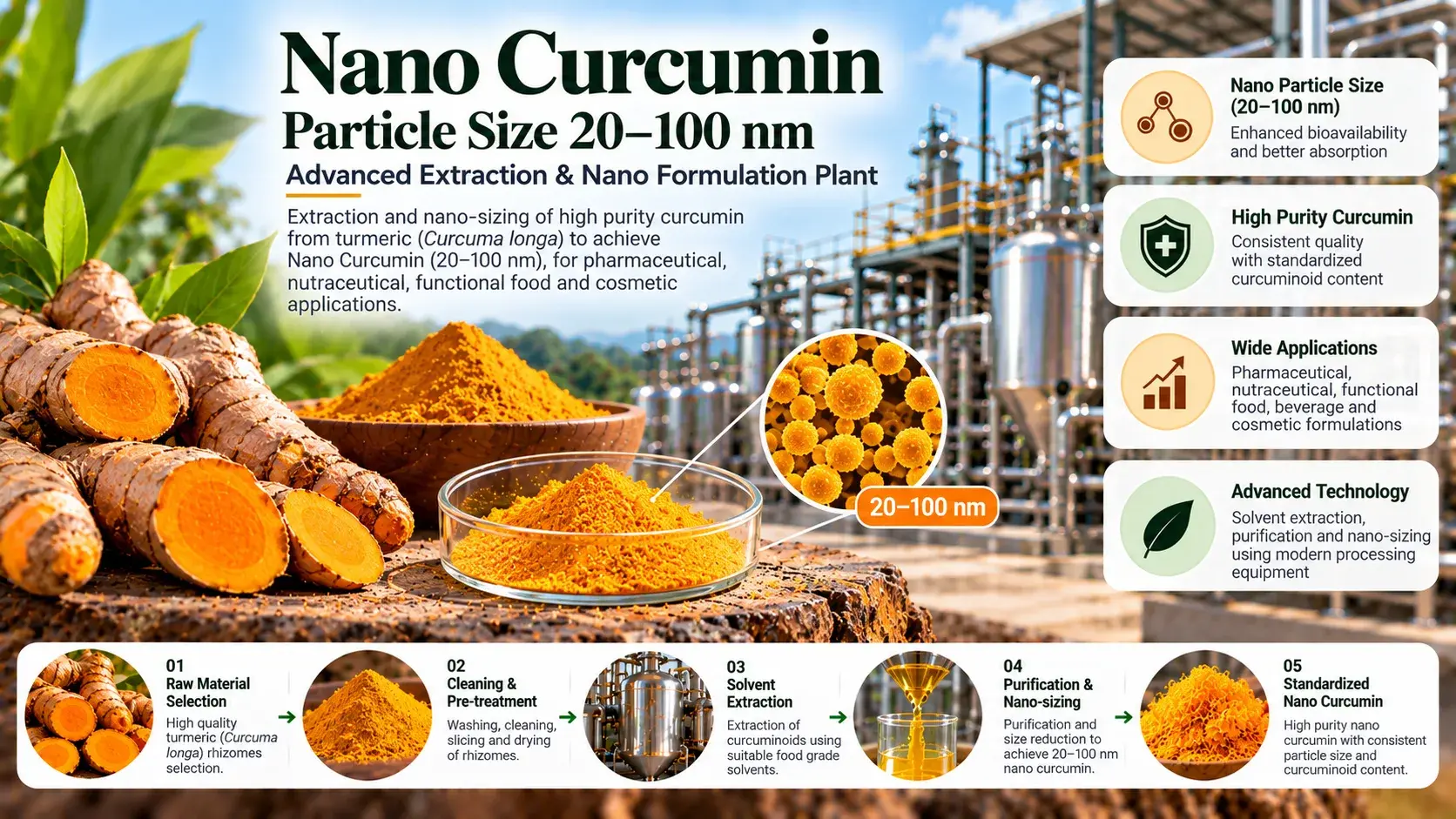
Nano Curcumin
Purity Levels
20-100nm particle size, enhanced bioavailability
Nano Curcumin is not a different curcuminoid grade of turmeric — it is a standard, already-standardised curcuminoid extract (typically 95% Curcuminoids by HPLC) that has been through a second, distinct manufacturing stage: particle-size reduction to the 20-100nm range. Standard curcumin is poorly water-soluble and rapidly metabolised, so very little reaches the bloodstream unmodified; reducing particle size into the nano range dramatically increases surface area and dissolution rate, improving absorption without changing the underlying curcuminoid chemistry. Because the declared specification is a physical particle-size distribution verified by dynamic light scattering (DLS) rather than an HPLC purity percentage, Mechotech's plant is built as a conventional curcumin extraction line feeding directly into a dedicated nanoformulation and DLS quality-control stage.
Mechotech's Nano Curcumin plant is engineered as two integrated process stages, not one. Stage one is conventional turmeric (Curcuma longa) rhizome extraction and HPLC standardisation — identical in principle to our Curcumin extraction plant — producing a standardised curcuminoid feedstock. Stage two is a dedicated nanoformulation train: high-pressure homogenisation, nanoprecipitation, or microfluidisation (selected to match your target particle size, throughput and stabiliser system) reduces that feedstock to a 20-100nm particle size, which is then locked in by lyophilisation or spray-drying to a stable, redispersible nano powder. This is why the declared specification on this page is a particle size, not a curcuminoid percentage: the curcuminoid content is already fixed by stage one, and the nanoformulation stage's job is bioavailability enhancement, verified by in-line and batch dynamic light scattering (DLS) rather than HPLC assay. All product-contact surfaces are SS 316L, electropolished and CIP-cleanable, with PLC-SCADA batch control, and the system is delivered commissioned to GMP hygienic design.
Technical Specifications
| Product | Nano Curcumin Extraction & Nanoformulation Plant |
|---|---|
| Botanical Source | Curcuma longa (turmeric rhizome), standardised curcuminoid feedstock |
| Feedstock Specification | Standardised curcuminoid extract (typically up to 95% Curcuminoids by HPLC) prior to nanoformulation |
| Declared Spec (Finished Product) | 20-100nm particle size, verified by dynamic light scattering (DLS) |
| Why Particle Size, Not % | Nanoformulation is a bioavailability-enhancement step on an already-standardised extract, not a change in curcuminoid purity grade |
| Nanoformulation Method | High-pressure homogenisation, nanoprecipitation, or microfluidisation (selected to application) |
| Stabiliser System | Food/pharma-grade phospholipid or polymer encapsulation, matched to target formulation |
| Particle Size QC Method | In-line and batch dynamic light scattering (DLS) |
| Product-contact Material | SS 316L, electropolished, CIP-cleanable |
| Filtration System | Multi-stage pre-filtration and post-homogenisation polish filtration |
| Drying System | Spray dryer or lyophiliser (freeze dryer), selected to preserve nano particle size |
| Automation | PLC-SCADA with recipe management, batch traceability and production reporting |
| Plant Capacity | Configured to requirement, pilot to commercial scale |
| Utility Requirements | Steam, chilled/cooling water, compressed air, soft water, power (project-specific) |
| Compliance | GMP hygienic design; full documentation for qualification |
| Final Product Form | Stable, redispersible nano curcumin powder (or nanosuspension, on request) |
Plant Capacities
| Plant Scale | Batch Throughput | Typical Use |
|---|---|---|
| Pilot | Configured to your feedstock and trial plan | Nanoformulation R&D, particle-size and stabiliser validation |
| Semi-Commercial | Configured between pilot and commercial scale | Contract manufacturing, scale-up trials |
| Commercial | Configured to raw-material supply and confirmed buyer volume | Export-grade continuous nano curcumin production |
Capacity is configured to raw-material supply and confirmed buyer volume; we recommend a pilot plant to validate particle-size distribution and stabiliser performance before scaling.
Manufacturing Process
Curcumin Extraction & Standardisation
Turmeric rhizome is extracted and standardised to a high-purity curcuminoid extract using the same closed-loop SS 316L extraction, filtration, concentration and solvent-recovery process as our standard curcumin plant — this is the feedstock for nanoformulation, not the finished product.
Nanoformulation
The standardised curcuminoid extract is reduced to a 20-100nm particle size via high-pressure homogenisation, nanoprecipitation, or microfluidisation, with a food/pharma-grade stabiliser system (e.g. phospholipid or polymer encapsulation) selected for your target application and delivery form.
Particle Size Verification (DLS)
In-line and batch dynamic light scattering (DLS) confirms the particle size distribution is within the declared 20-100nm range before the batch proceeds to drying — this measurement, not HPLC assay, is the primary release specification for the nanoformulation stage.
Stabilisation & Drying
The nano-suspension is spray-dried or lyophilised (freeze-dried) to a stable, redispersible powder, with process parameters controlled to preserve the nano particle size through the drying step.
Quality Control & Release
Batch release testing covers particle size distribution (DLS), curcuminoid assay carried over from the feedstock, residual solvent, heavy metals, microbial load, and moisture, with full certificate of analysis.
Major Plant Equipment
- Curcumin extraction & standardisation train (extraction vessels, filtration, vacuum concentrator)
- High-pressure homogeniser
- Nanoprecipitation / microfluidisation unit
- Stabiliser (phospholipid/polymer) dosing system
- In-line dynamic light scattering (DLS) particle-size analyser
- Multi-stage pre- and post-homogenisation filtration
- Lyophiliser (freeze dryer) or spray dryer
- Storage tanks & finished-product handling
- CIP (clean-in-place) system
- PLC-SCADA control panel, electrical MCC & instrumentation
Plant Output
Applications
- High-bioavailability nutraceutical capsules and softgels
- Pharmaceutical formulations requiring enhanced absorption
- Premium functional food and beverage fortification
- Cosmeceutical and topical delivery formulations
- Clinical and research-grade curcumin supply
- Export to regulated markets requiring documented particle-size and bioavailability data
Key Features
20-100nm Particle Size Control
In-line and batch DLS monitoring is used to check the finished product against the declared nano particle-size range, batch after batch — the specification that defines this product, not a curcuminoid percentage.
Two-Stage Process: Extraction Then Nanoformulation
A conventional curcumin extraction and standardisation stage feeds a dedicated homogenisation/nanoprecipitation stage, so feedstock purity and nano particle size are each controlled and verified independently.
GMP Hygienic SS 316L Construction
Electropolished SS 316L product-contact surfaces use GMP hygienic design, with CIP operation between batches.
Configurable Nanoformulation Method
High-pressure homogenisation, nanoprecipitation, or microfluidisation is selected and engineered around your target particle size and stabiliser system.
Stable, Redispersible Powder Output
Spray-drying or lyophilisation is matched to the formulation to preserve nano particle size through to the finished powder.
Scalable Batch Capacity
Plants are configured from pilot scale for formulation development to commercial capacity with modular expansion.
Frequently Asked Questions
Why is Nano Curcumin specified by particle size instead of a curcuminoid percentage?
How is Nano Curcumin different from standard curcumin or Tetrahydrocurcumin (THC)?
Why does curcumin need to be nano-formulated at all?
What nanoformulation methods does Mechotech's plant support?
How is the 20-100nm particle size verified?
Can the same plant produce standard curcumin and Nano Curcumin?
What drying method keeps Nano Curcumin stable at the nano scale?
What batch capacities are available for Nano Curcumin production?
Ready to discuss your project?
Get a free quote and technical consultation from our engineering team.