Banaba (Lagerstroemia Speciosa)
Banaba (Lagerstroemia Speciosa)
Purity Levels
Corosolic Acid By HPLC 1% to 20%
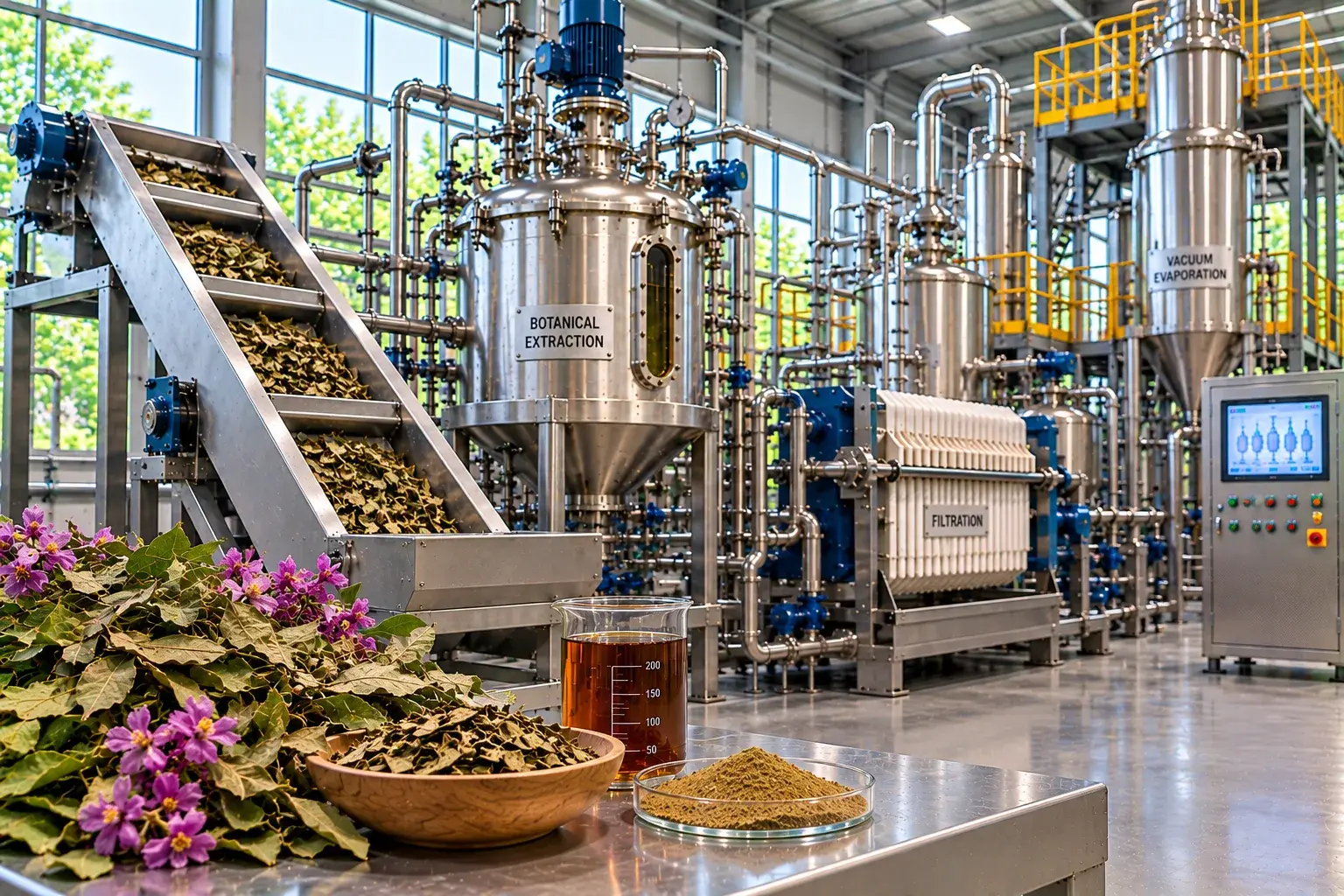
Mechotech designs and manufactures turnkey herbal extraction plants for Banaba (Lagerstroemia speciosa), the tropical flowering tree whose leaf is used across Southeast Asian traditional medicine for glycemic support, standardised to Corosolic Acid By HPLC. Corosolic acid, a triterpenoid, is present in Banaba leaf only in small quantities relative to bulk leaf matter, so most commercial-grade extract is standardised at 1% to 2% corosolic acid, with select ultra-concentrated grades pushed toward 18-20% for specialised ingredient buyers requiring a more potent input for further formulation. We supply the complete machinery — leaf cleaning, milling, hydro-alcoholic extraction, filtration, vacuum concentration, closed-loop solvent recovery, HPLC-verified standardisation and drying — to process Banaba leaf into a consistent corosolic acid extract for the nutraceutical and functional-food industries.
Mechotech's Banaba plant is engineered around the specific chemistry of a low-yield triterpenoid marker: because corosolic acid occurs at very low native concentration in the leaf, the process is built around efficient hydro-alcoholic extraction and multi-stage concentration to achieve commercially practical yields, with tighter process control required as the target specification moves toward higher-grade, more concentrated output. Built in SS 316L with electropolished product-contact surfaces, closed-loop solvent recovery, PLC-based automation and full batch documentation, each plant is delivered as a commissioned turnkey system configured to the declared Corosolic Acid By HPLC specification across the 1% to 20% range.
Technical Specifications
| Product | Banaba (Lagerstroemia speciosa) Extraction Plant |
|---|---|
| Botanical Name | Lagerstroemia speciosa |
| Raw Material | Dried Banaba leaves |
| Plant Part | Leaf |
| Extract Type | Standardised dry extract (powder) |
| Standardisation | Corosolic Acid By HPLC 1% to 20% |
| Extraction Method | Hydro-alcoholic solvent extraction (closed, jacketed SS 316L extractors) |
| Product-contact Material | SS 316L, electropolished, CIP-cleanable |
| Filtration System | Plate-and-frame filter press with cartridge polish filtration |
| Concentration System | Multi-stage falling-film / vacuum evaporator with closed-loop solvent recovery |
| Drying System | Spray dryer or vacuum tray dryer |
| Automation | PLC-SCADA with recipe management, batch traceability and production reporting |
| Plant Capacity | Configured to requirement — pilot to commercial scale |
| Utility Requirements | Steam, chilled/cooling water, compressed air, soft water, power (project-specific) |
| Compliance | GMP hygienic design; full documentation for qualification |
| Final Product Form | Free-flowing standardised extract powder |
Plant Capacities
| Plant Scale | Leaf Throughput | Typical Use |
|---|---|---|
| Pilot | Configured to your feedstock and trial plan | Product development, parameter validation |
| Semi-Commercial | Configured between pilot and commercial scale | Contract manufacturing, scale-up trials |
| Commercial | Configured to raw-material supply and confirmed buyer volume | Export-grade continuous production |
Capacity is configured to raw-material supply and confirmed buyer volume; higher-grade specifications (above 5% corosolic acid) require proportionally more leaf input per kg of finished extract, so we recommend a pilot plant to validate yield before scaling.
Manufacturing Process
Raw Material Cleaning & Size Reduction
Dried Banaba leaves are cleaned to remove stem fragments, dust and foreign matter, then milled to a uniform particle size to maximise solvent contact with the leaf's low-concentration corosolic acid content before extraction.
Hydro-Alcoholic Extraction
Milled leaf is charged into closed, jacketed SS 316L extraction vessels and extracted with a controlled hydro-alcoholic solvent system across multiple cycles under regulated temperature to maximise recovery of the triterpenoid actives from the bulk leaf matter.
Solid-Liquid Separation & Filtration
The extract slurry is clarified through a plate-and-frame filter press followed by cartridge polish filters, removing leaf fibre and chlorophyll-rich particulate to achieve a clear miscella.
Multi-Stage Vacuum Concentration
The filtered miscella is concentrated in a multi-stage falling-film / vacuum evaporator under reduced pressure, with additional concentration stages applied when targeting higher-grade corosolic acid specifications.
Solvent Recovery
A closed-loop recovery system condenses, purifies and recycles the recovered solvent back into production.
Standardisation
The concentrate is assayed by HPLC and adjusted to the declared specification — Corosolic Acid By HPLC within the 1% to 20% range — before drying, with tighter in-process control applied for higher-grade output.
Drying & Quality Control
The standardised Banaba extract is spray- or vacuum-tray dried to a free-flowing, low-moisture powder, then released after HPLC assay, residual-solvent, heavy-metal, microbial, and moisture testing with full certificate-of-analysis documentation.
Major Plant Equipment
- Raw material cleaning system
- Hammer mill (size reduction)
- Stainless-steel hydro-alcoholic extraction vessels (jacketed, SS 316L)
- Solvent storage tanks
- Solvent transfer pumps
- Plate heat exchangers
- Plate-and-frame filter press / pressure leaf filter
- Cartridge polish filters
- Multi-stage falling-film / vacuum evaporator
- Closed-loop solvent recovery system
- Condensers & vacuum pumps
- Spray dryer / vacuum tray dryer
- CIP (clean-in-place) system
- Storage tanks & finished-product tanks
- PLC-SCADA control panel, electrical MCC & instrumentation
Plant Output
Applications
- Nutraceutical ingredient supply for glycemic-support and metabolic-health supplements
- Weight-management and blood-sugar-support capsule and tablet manufacturing
- Functional food and beverage ingredient applications
- Traditional Southeast Asian herbal formulation supply
- Pharmaceutical standardised ingredient supply
- Export to regulated-market nutraceutical ingredient buyers
Key Features
GMP Hygienic SS 316L Construction
Electropolished SS 316L product-contact surfaces use GMP hygienic design, with CIP operation between batches.
Closed-Loop Solvent Recovery
Integrated recovery returns solvent per batch for reuse.
Multi-Stage Concentration for Low-Yield Actives
Additional concentration stages are configured for higher-grade corosolic acid specifications, where the target compound occurs at very low native concentration in the leaf.
HPLC-Verified Standardisation Across a Wide Range
In-process and batch-release HPLC assay are used to check the finished extract against its declared corosolic acid band, from standard 1-2% grades up to concentrated 20% output.
Integrated Drying
A matched spray/vacuum dryer produces a free-flowing, low-moisture powder ready for encapsulation and blending.
Scalable Batch Capacity
Plants are configured to requirement from pilot scale upward, with modular expansion.
Frequently Asked Questions
Does Mechotech supply the complete machinery for Banaba (Lagerstroemia speciosa)?
What specification can the Banaba plant achieve?
Which part of the Banaba plant is used, and why?
What extraction method is used, and how much solvent is recovered?
What production capacities are available for the Banaba plant?
Which industries use Banaba extract?
Does Mechotech offer other glycemic-support botanical extraction plants?
Ready to discuss your project?
Get a free quote and technical consultation from our engineering team.