Rasana Leaf
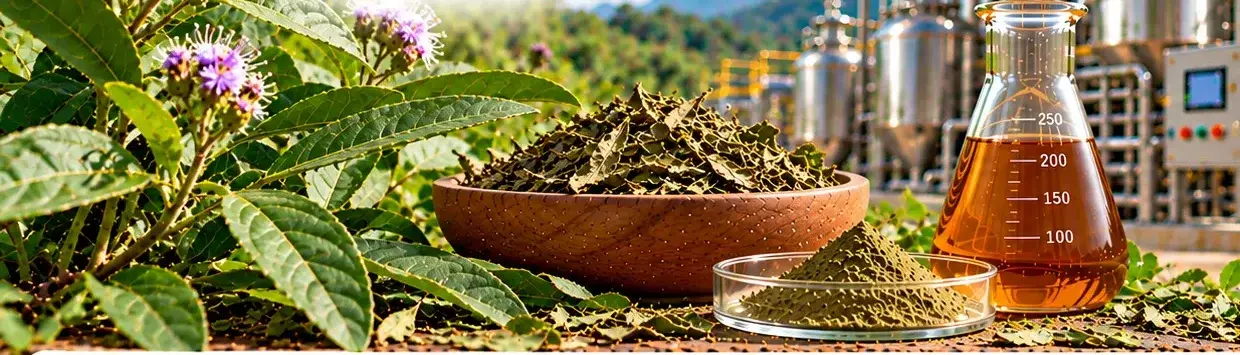
Rasana Leaf
Purity Levels
2.5% Alkaloids
Mechotech designs and manufactures turnkey herbal extraction plants for Rasana Leaf, listed in the catalogue with a 2.5% alkaloids figure. Mechotech’s legacy page for Rasna Leaf names the leaves of Pluchea lanceolata, commonly known as Rasna, as the raw material, lists the raw material as air-dried, and says Rasna extracts are widely used in formulations for joint health and musculoskeletal disorders. The Sureka Life Sciences catalogue has no Rasna entry, so no further marker or assay method is stated. The spelling differs between the product tree (Rasana) and the legacy page (Rasna).
Mechotech’s Rasana Leaf plant is configured around the specific chemistry and processing requirements of the raw material. Built in SS 316L with integrated solvent recovery, automation and full documentation, each plant is delivered as a commissioned turnkey system. The figure 2.5% Alkaloids is the catalogue standardisation; the specification actually targeted is set during process development and pilot validation.
Technical Specifications
| Product | Rasana Leaf Extraction Plant |
|---|---|
| Process Category | Herbal Extraction Plants |
| Botanical Name | Pluchea lanceolata (per the text of Mechotech’s legacy Rasna Leaf page) |
| Raw Material | Rasana (Rasna) leaves (Pluchea lanceolata) |
| Plant Part / Feed Form | Leaves, air-dried (as named in the text of Mechotech’s legacy Rasna Leaf page; exact feed form confirmed with the client) |
| Principal Documented Constituent | Alkaloids (as listed in the product tree; no individual alkaloid and no assay method stated) |
| Standardisation | 2.5% Alkaloids (catalogue figure) |
| Extract Type | Standardised extract (liquid concentrate or dried powder, per specification) |
| Extraction Method | Food-grade solvent (alcohol / aqueous) extraction in closed, jacketed SS 316L extractors |
| Product-contact Material | SS 316L, electropolished, CIP-cleanable |
| Filtration System | Plate-and-frame filter press with cartridge polish filtration |
| Concentration System | Falling-film / vacuum evaporator with closed-loop solvent recovery |
| Drying System | Spray dryer or vacuum dryer, where a powder is required |
| Utility Requirements | Steam, chilled/cooling water, vacuum, compressed air, soft water, power (project-specific) |
| Automation | PLC-based automation |
| Plant Capacity | Configured to requirement |
| Compliance | GMP hygienic design; full documentation for qualification |
| Final Product Form | Standardised extract (concentrate or free-flowing powder) |
Plant Capacities
| Plant Scale | Raw Material Throughput | Typical Use |
|---|---|---|
| Pilot | Configured to your feedstock and trial plan | Product development, parameter validation |
| Semi-Commercial | Configured between pilot and commercial scale | Scale-up trials, contract manufacturing |
| Commercial | Configured to raw-material supply and confirmed buyer volume | Commercial production |
Capacity is configured to raw-material supply, confirmed buyer volume and investment timeline; a pilot plant is recommended to validate parameters before scaling.
Manufacturing Process
Raw Material Preparation
Rasana (Rasna) leaf raw material is authenticated, cleaned, tested for moisture and milled to a uniform particle size to maximise solvent contact before extraction. The air-dried leaf feed form named in the legacy page is confirmed with the client.
Extraction
The prepared Rasana Leaf raw material is extracted with food-grade solvent (alcohol / aqueous) in closed jacketed SS 316L extractors under controlled temperature and over multiple cycles to recover the target constituents.
Filtration
The extract (miscella) is clarified through a plate-and-frame filter press followed by cartridge polish filters.
Concentration & Solvent Recovery
The miscella is concentrated in a falling-film / vacuum evaporator, with solvent recovered through the condenser return system.
Standardisation
The concentrate is assayed and adjusted to the client’s target specification (catalogue figure: 2.5% Alkaloids) before the final finishing step.
Drying & Quality Control
The standardised Rasana Leaf extract is kept as a concentrate or spray- or vacuum-dried to the required form, then released after assay, residual-solvent, heavy-metal, microbial and moisture testing.
Major Plant Equipment
- Raw material authentication, cleaning and moisture testing
- Mill (size reduction)
- Jacketed SS 316L extraction vessels
- Plate-and-frame filter press
- Cartridge polish filters
- Falling-film / vacuum evaporator
- Closed-loop solvent recovery system (condenser return)
- Spray dryer / vacuum dryer
- CIP (clean-in-place) system
- PLC-based automation panel
Plant Output
Applications
- Joint-health and musculoskeletal-care formulations (per Mechotech’s legacy page)
- Ayurvedic and traditional medicine preparations (the legacy page describes Rasna as revered in Ayurveda)
- Herbal extract ingredient supply to the standardisation the buyer specifies
Key Features
SS 316L Construction
Electropolished SS 316L product-contact surfaces with CIP operation between batches.
Closed-Loop Solvent Recovery
Integrated condenser-return recovery reuses solvent between batches and reduces solvent loss.
Standardised to Specification
In-process and batch-release assay are used to check the finished extract against its agreed target specification (catalogue figure: 2.5% Alkaloids).
Flexible Finishing
The extract can be finished as a concentrate or, with a matched spray or vacuum dryer, as a free-flowing powder.
Scalable Batch Capacity
Plants are configured to requirement from pilot scale upward, with modular expansion.
Frequently Asked Questions
Does Mechotech supply the complete machinery for Rasana Leaf?
What specification does the catalogue list for Rasana Leaf?
What production capacities are available for the Rasana Leaf plant?
How is Rasana Leaf extract produced in Mechotech’s extraction plant?
Which plant is Rasana Leaf, and which part is used?
What does the 2.5% alkaloids figure mean?
Which use areas does Mechotech’s legacy page describe for Rasna?
Which equipment finishes the Rasana Leaf extract as a concentrate or powder?
Which related routes and pages does Mechotech list alongside Rasana Leaf?
Ready to discuss your project?
Get a free quote and technical consultation from our engineering team.