Picrorhiza Kurroa Root Extract
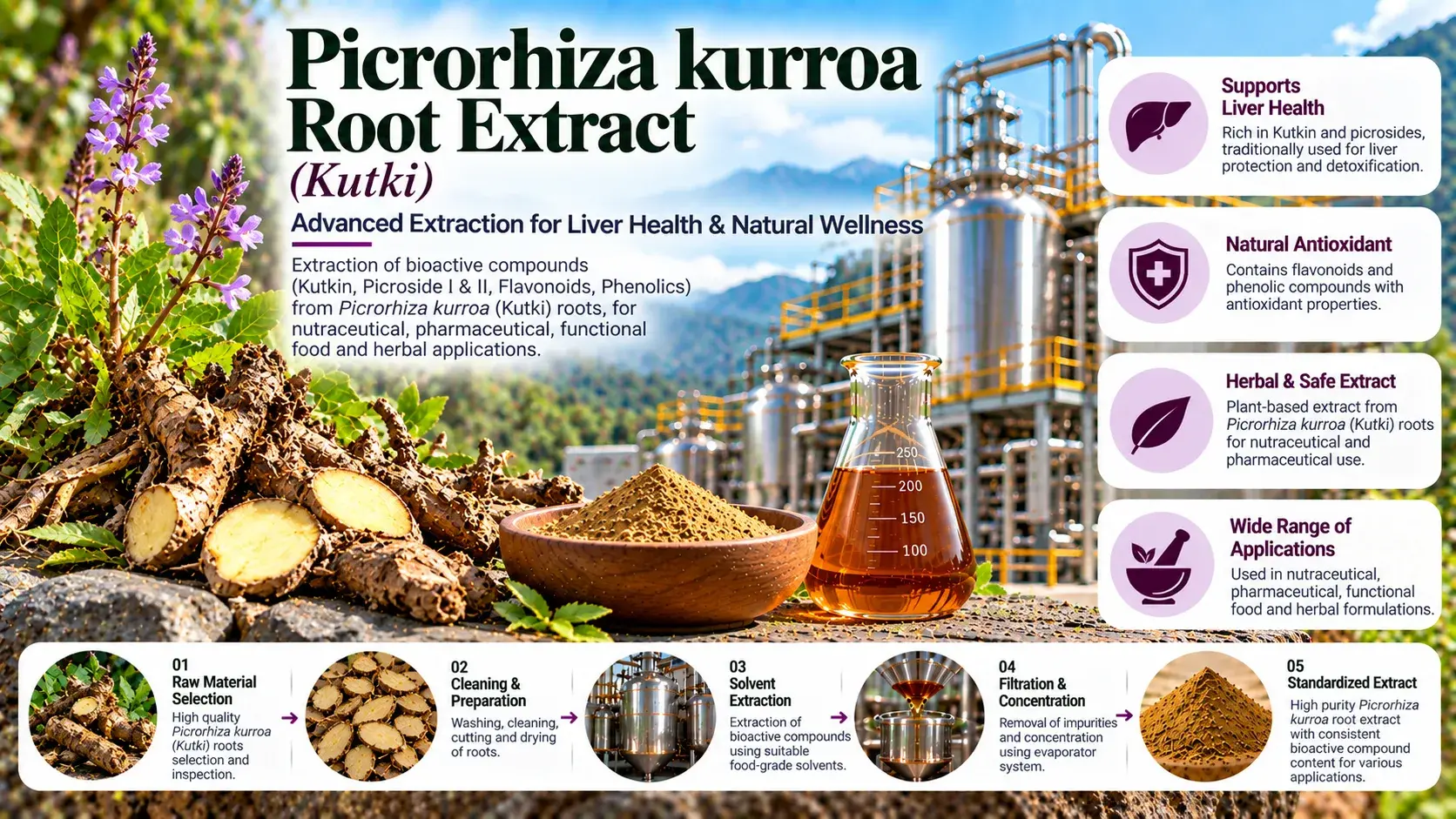
Picrorhiza Kurroa Root Extract
Purity Levels
2% to 8% Bitter by Gravimetry
Mechotech designs and manufactures turnkey extraction plants for Picrorhiza kurroa (Kutki), processing the dried root and rhizome — the source of the plant's characteristic iridoid glycoside bitter principles, Picroside I and Picroside II (jointly assayed as Kutkin) — into an extract standardised to 2% to 8% Bitter principles by Gravimetry. We supply the complete machinery — root/rhizome cleaning, size reduction, hydro-alcoholic extraction, filtration, vacuum concentration, closed-loop solvent recovery, standardisation and drying — for the hepatoprotective nutraceutical and Ayurvedic industries.
Mechotech's Picrorhiza kurroa plant is engineered around the chemistry of the dried root/rhizome, which yields its bitter iridoid glycosides (Picroside I and II, together termed Kutkin) alongside apocynin and other minor bitters. Hydro-alcoholic extraction in closed jacketed SS 316L vessels is used to recover this bitter fraction efficiently from the woody rhizome matrix, and the concentrate is assayed gravimetrically for total bitter content and standardised to the declared 2% to 8% specification range before drying. Built with integrated solvent recovery, automation, and full batch documentation, each plant is delivered as a commissioned turnkey system to GMP and HACCP standards.
Technical Specifications
| Product | Picrorhiza Kurroa Root Extract Extraction Plant |
|---|---|
| Botanical Name | Picrorhiza kurroa |
| Raw Material | Cleaned, dried Picrorhiza kurroa root and rhizome |
| Plant Part | Root / rhizome |
| Extract Type | Standardised hydro-alcoholic extract, spray- or vacuum-dried powder |
| Standardisation | 2% to 8% Bitter principles (Picrosides / Kutkin) by Gravimetry |
| Extraction Method | Hydro-alcoholic extraction (closed jacketed extractors, multiple cycles for rhizome matrix) |
| Product-contact Material | SS 316L, electropolished, CIP-cleanable |
| Filtration System | Plate-and-frame filter press with cartridge polish filtration |
| Concentration System | Falling-film / vacuum evaporator with closed-loop solvent recovery |
| Drying System | Spray dryer or vacuum tray dryer |
| Automation | Configurable — manual, semi-automatic or fully automatic PLC-SCADA (recipe-based) |
| Plant Capacity | Configured to requirement |
| Utility Requirements | Steam, chilled/cooling water, compressed air, soft/RO water, power (project-specific) |
| Compliance | GMP, HACCP, FSSAI hygienic design; full documentation for qualification |
| Final Product Form | Free-flowing standardised powder |
Plant Capacities
| Plant Scale | Root/Rhizome Throughput | Typical Use |
|---|---|---|
| Pilot | Configured to your feedstock and trial plan | Product development, parameter validation |
| Semi-Commercial | Configured between pilot and commercial scale | Contract manufacturing, scale-up trials |
| Commercial | Configured to raw-material supply and confirmed buyer volume | Export-grade continuous production |
Capacity is configured to raw-material supply and confirmed buyer volume; we recommend a pilot plant to validate bitter-principle recovery before scaling.
Manufacturing Process
Raw Material Reception & Cleaning
Picrorhiza kurroa root and rhizome are authenticated, cleaned of soil and foreign matter, tested for moisture, and graded before processing.
Size Reduction
Cleaned root/rhizome is milled to a uniform particle size to expose the internal bitter-glycoside-bearing tissue for efficient solvent contact.
Hydro-Alcoholic Extraction
Milled material is extracted with a controlled hydro-alcoholic solvent system in closed jacketed SS 316L extractors under regulated temperature and multiple cycles to maximise recovery of Picroside I, Picroside II, and associated bitter principles.
Filtration
The crude extract is clarified through pressure leaf or plate-and-frame filter presses followed by cartridge polish filters to remove suspended root fibre before concentration.
Vacuum Concentration & Solvent Recovery
The filtered extract is concentrated in a falling-film / vacuum evaporator at controlled temperature, with solvent recovered, condensed and recycled through the condenser return system.
Standardisation
The concentrate is assayed gravimetrically for total bitter content and adjusted to the declared 2% to 8% Bitter by Gravimetry specification before drying.
Drying & Quality Control
The standardised Picrorhiza extract is spray- or vacuum-dried to a free-flowing powder, then released after gravimetric assay, residual-solvent, heavy-metal, microbial, and moisture testing with full certificate-of-analysis documentation.
Major Plant Equipment
- Raw material cleaning system
- Root/rhizome cutting unit
- Grinding mill
- Stainless-steel jacketed extraction vessels (SS 316L)
- Solvent storage tanks
- Solvent transfer pumps
- Plate heat exchangers
- Pressure leaf / plate-and-frame filter press
- Cartridge polish filters
- Falling-film vacuum evaporator
- Solvent recovery & condenser system
- Spray dryer / vacuum tray dryer
- Product storage tanks
- CIP/SIP system
- PLC-SCADA automation panel, electrical MCC & instrumentation
Plant Output
Applications
- Hepatoprotective and liver-support nutraceutical formulations
- Ayurvedic and traditional medicine preparations (Kutki formulations)
- Digestive-support and bitter-tonic herbal blends
- Pharmaceutical standardised ingredient supply
- Immune-modulating supplement blends
- Export to regulated-market ingredient buyers
Key Features
GMP Hygienic SS 316L Construction
Electropolished SS 316L product-contact surfaces use GMP hygienic design, with CIP operation between batches.
Rhizome-Matched Extraction Cycles
Extraction cycle count and hold time are set to suit Picrorhiza's woody root/rhizome matrix, ensuring consistent recovery of Picrosides across batches.
Closed-Loop Solvent Recovery
Integrated recovery returns solvent for reuse each batch, reducing fresh-solvent consumption.
Gravimetric Bitter-Principle Standardisation
In-process and batch-release gravimetric assay are used to check the finished extract against its declared 2% to 8% Bitter specification range.
Integrated Drying
A matched spray/vacuum dryer produces a free-flowing, low-moisture powder ready for encapsulation and blending.
Scalable Batch Capacity
Plants are configured to requirement from pilot scale upward, with modular expansion.
Frequently Asked Questions
How does this differ from Mechotech's Kutki (Picrorhiza Kurroa) 2.5% Bitters page?
Does Mechotech supply the complete machinery for Picrorhiza Kurroa Root Extract?
What specification can the Picrorhiza Kurroa Root Extract plant achieve?
Which plant part of Picrorhiza kurroa is used, and what actives does it contain?
Why is the specification given as a 2% to 8% range rather than a single number?
What production capacities are available for the Picrorhiza Kurroa Root Extract plant?
Which industries use the Picrorhiza Kurroa Root Extract plant?
What does a Picrorhiza Kurroa Root Extract plant cost, and how is pricing structured?
Ready to discuss your project?
Get a free quote and technical consultation from our engineering team.