Ashwagandha
Ashwagandha
Purity Levels
Withanolides By HPLC 25%
Extraction Technologies
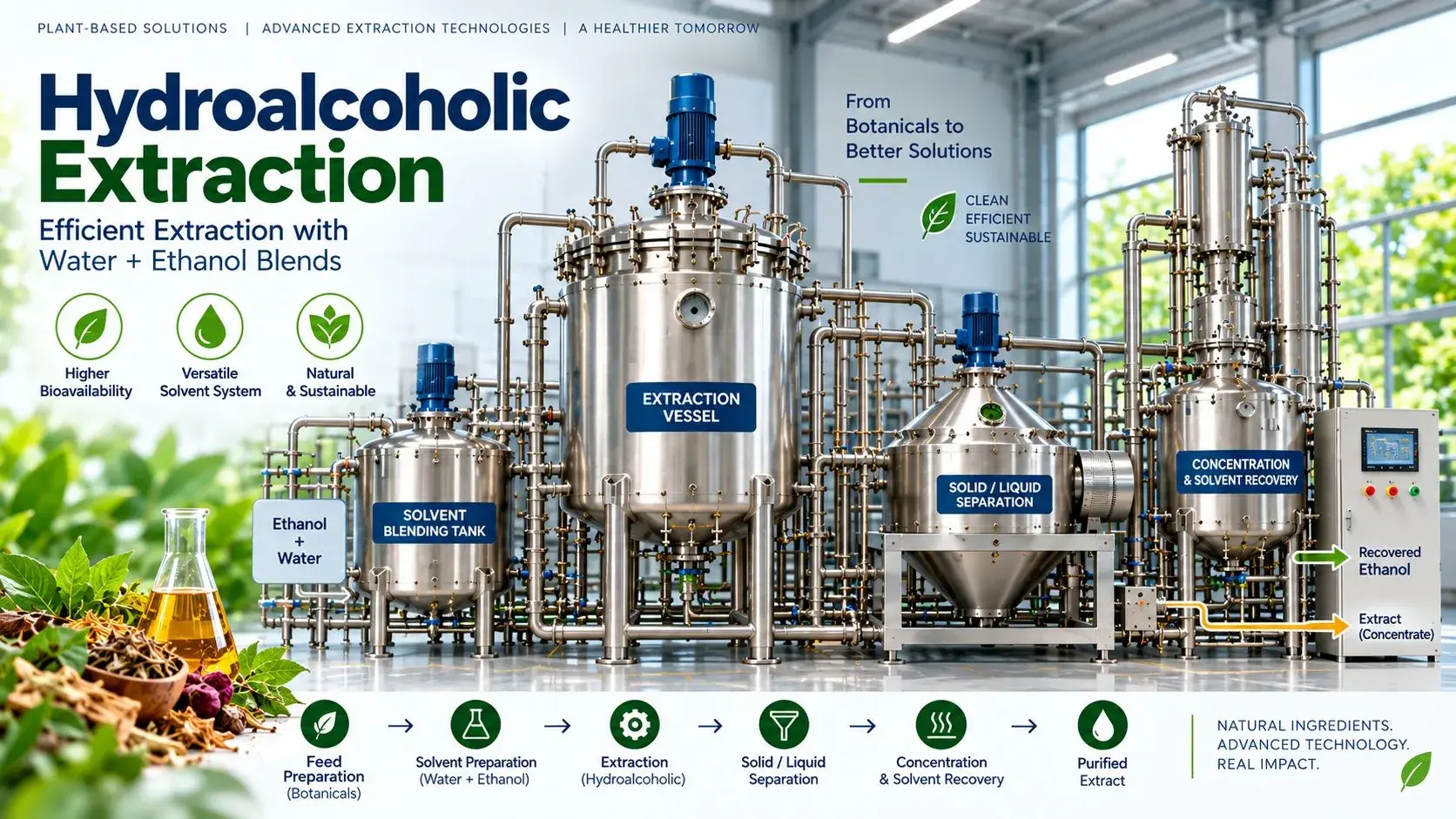
Mechotech designs and manufactures turnkey herbal extraction plants for Ashwagandha (Withania somnifera), standardised to Withanolides By HPLC 25%. We supply the complete machinery — root cleaning, milling, hydro-alcoholic extraction, filtration, vacuum concentration, closed-loop solvent recovery, standardisation and drying — to process Ashwagandha roots into a standardised extract for the pharmaceutical, nutraceutical, food, and fragrance industries.
Mechotech's Ashwagandha plant is engineered from first principles around the specific chemistry and processing requirements of Withania somnifera root: controlled hydro-alcoholic extraction maximises Withanolide recovery while minimising thermal degradation, and a high-efficiency recovery loop returns up to 98% of the ethanol used per batch. Built in SS 316L with electropolished product-contact surfaces, PLC-SCADA automation and full documentation, each plant is delivered as a commissioned turnkey system configured for the Withanolides By HPLC 25% specification (with 2.5%, 5% and 10% grades also achievable), with the specification confirmed during process development and pilot validation and documentation to support the customer's own GMP qualification.
Technical Specifications
| Product | Ashwagandha Extraction Plant |
|---|---|
| Botanical Name | Withania somnifera |
| Feedstock | Ashwagandha roots |
| Part / Feed Form | Roots |
| Target Extract | Withanolides |
| Extract Type | Standardised dry extract (powder) |
| Standardisation | Withanolides By HPLC 25% (2.5%, 5% and 10% grades also achievable) |
| Extraction Method | Counter-current, UAE, Hybrid, MAE |
| Technology Count | 4 |
| Product-contact Material | SS 316L, electropolished, CIP-cleanable |
| Filtration System | Plate-and-frame filter press with cartridge polish filtration |
| Concentration System | Falling-film / vacuum evaporator with closed-loop solvent recovery (up to 98%) |
| Drying System | Spray dryer or vacuum tray dryer |
| Automation | PLC-SCADA with recipe management, batch traceability and production reporting |
| Plant Capacity | Configured to requirement — pilot (100 kg/batch) to 5,000+ kg roots/day commercial |
| Utility Requirements | Steam, chilled/cooling water, compressed air, soft water, nitrogen, power (project-specific) |
| Compliance | GMP hygienic design; full documentation for qualification |
| Final Product Form | Free-flowing standardised extract powder |
Plant Capacities
| Plant Scale | Root Throughput | Typical Use |
|---|---|---|
| Pilot | 100 kg/batch | Product development, parameter validation |
| Semi-Commercial | 500–1,000 kg/batch | Contract manufacturing, scale-up trials |
| Commercial | 2,000+ kg/batch (up to 5,000 kg roots/day) | Export-grade continuous production |
Capacity is configured to raw-material supply and confirmed buyer volume; we recommend a pilot plant to validate parameters before scaling.
Manufacturing Process
Each extraction method follows a different process — pick a method to see its steps.
Root Preparation
Cleaned, dried Ashwagandha roots are milled to a uniform particle size for even solvent contact.
Counter-Current Loading
Milled root is fed into a multi-stage counter-current extractor, where fresh hydro-alcoholic solvent meets the most-depleted material while spent solvent meets the fresh feed.
Continuous Extraction
Solvent flows counter to the solids across stages, giving high, uniform withanolide recovery with the least solvent per kg of root.
Miscella Collection
The concentrated, withanolide-rich extract (miscella) is drawn continuously from the feed end of the extractor.
Vacuum Concentration & Solvent Recovery
Ethanol is stripped from the miscella under vacuum and recycled through the closed loop (up to 98% recovery).
Standardisation & Drying
The concentrate is assayed, adjusted to Withanolides By HPLC 25%, then spray- or vacuum-dried to a free-flowing powder.
Root Preparation
Milled Ashwagandha root is slurried with the hydro-alcoholic solvent in the extraction vessel.
Ultrasonic Cavitation
High-frequency ultrasound generates cavitation that ruptures the root cell walls, releasing withanolides rapidly at a lower temperature.
Low-Temperature Extraction
Short extraction cycles at reduced temperature protect heat-sensitive withanolides and cut overall cycle time.
Separation
Solids are removed by filter press or centrifuge and the miscella is clarified through polish filters.
Vacuum Concentration & Solvent Recovery
Ethanol is removed under vacuum and recycled through the closed-loop recovery system.
Standardisation & Drying
The extract is assayed to Withanolides By HPLC 25% and dried to a free-flowing powder.
Root Preparation & Conditioning
Milled root is slurried and pH/temperature conditioned to suit enzyme activity.
Enzymatic Pre-Treatment
Cell-wall-degrading enzymes (cellulase / pectinase) loosen the lignocellulosic matrix, freeing bound withanolides.
Ultrasound-Assisted Extraction
Ultrasonic cavitation is applied together with the enzyme action for a synergistic boost in yield and extraction speed.
Extraction & Separation
Combined UAE + EAE extraction runs at mild temperature, followed by solid-liquid separation and polish filtration.
Vacuum Concentration & Solvent Recovery
Ethanol is stripped under vacuum and recycled through the closed loop.
Standardisation & Drying
The concentrate is adjusted to specification and dried to a free-flowing powder.
Root Preparation
Milled Ashwagandha root is mixed with solvent in the microwave extraction vessel.
Microwave Heating
Microwave energy rapidly heats the moisture inside the root cells, building internal pressure that ruptures the cell walls.
Rapid Extraction
A very short, energy-efficient extraction delivers high withanolide release with minimal solvent and time.
Separation
The extract is clarified by filtration or centrifugation to remove spent solids.
Vacuum Concentration & Solvent Recovery
Ethanol is removed under vacuum and recycled through the closed-loop system.
Standardisation & Drying
The extract is assayed to Withanolides By HPLC 25% and dried to a free-flowing powder.
Major Plant Equipment
- Raw material cleaning system
- Hammer mill (size reduction)
- Stainless-steel hydro-alcoholic extraction vessels (jacketed, SS 316L)
- Solvent storage tanks
- Solvent transfer pumps
- Plate heat exchangers
- Plate-and-frame filter press / pressure leaf filter
- Cartridge polish filters
- Falling-film / multi-stage vacuum evaporator
- Closed-loop solvent recovery system
- Condensers & vacuum pumps
- Spray dryer / vacuum tray dryer
- CIP (clean-in-place) system
- Storage tanks & finished-product tanks
- PLC-SCADA control panel, electrical MCC & instrumentation
Plant Output
Case Study
Ashwagandha Extraction Plant — 98% Solvent Recovery Turnkey Project
See how this plant was engineered and delivered for a real project.
From Plant to Product
Ashwagandha Extract
This botanical is also in the product range of Sureka Life Sciences, our sister concern in botanical ingredients.
Applications
- Pharmaceutical standardised ingredient supply
- Nutraceutical capsule, tablet, and supplement manufacturing
- Food, flavour, and beverage applications
- Cosmetic and personal care active ingredients
- Ayurvedic and traditional medicine preparations
- Export to regulated-market ingredient buyers
Key Features
Hygienic SS 316L Construction
Electropolished SS 316L product-contact surfaces with CIP operation between batches, and documentation to support the customer's own GMP qualification.
Closed-Loop Solvent Recovery (Up to 98%)
Integrated recovery returns up to 98% of the solvent per batch, cutting operating cost and meeting CPCB discharge norms.
Standardised to Specification
In-process and batch-release assay hold the finished Ashwagandha extract within its declared specification (Withanolides By HPLC 25%).
Integrated Drying
A matched spray/vacuum dryer produces a free-flowing, low-moisture powder ready for encapsulation and blending.
Scalable Batch Capacity
Plants are configured from 100 kg/batch pilot scale to 2,000+ kg/batch commercial capacity with modular expansion.
Frequently Asked Questions
Does Mechotech supply the complete machinery for Ashwagandha?
What specification can the Ashwagandha plant achieve?
What extraction method is used, and how much solvent is recovered?
What production capacities are available for the Ashwagandha plant?
What is the typical cost and delivery timeline for an Ashwagandha extraction plant?
Which industries use the Ashwagandha plant, and does it support GMP qualification?
Ready to discuss your project?
Get a free quote and technical consultation from our engineering team.