SafedMusli (Chlorophytum Borivilianum)
SafedMusli (Chlorophytum Borivilianum)
Purity Levels
30% Saponins
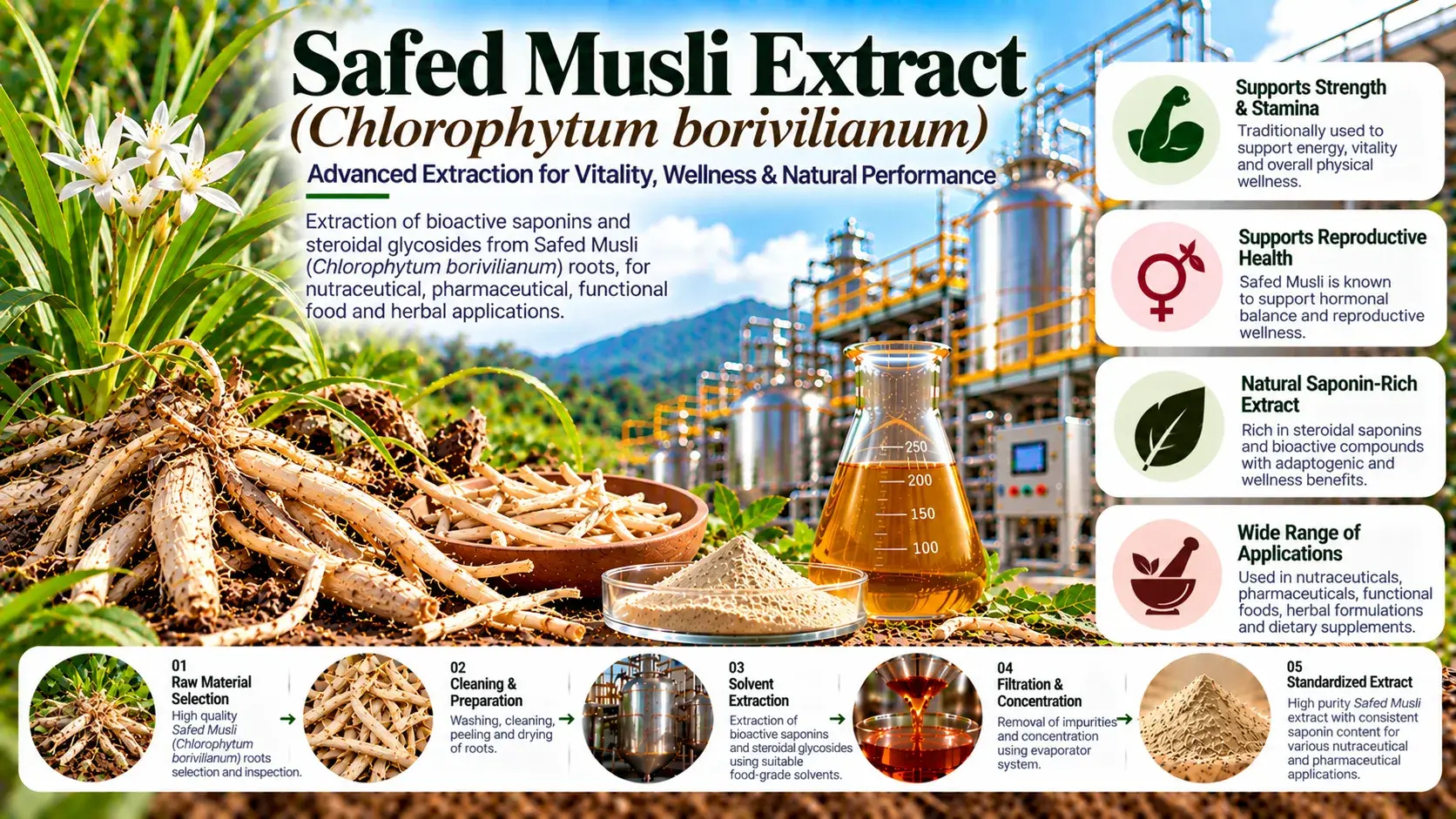
Mechotech designs and manufactures turnkey herbal extraction plants for Safed Musli (Chlorophytum borivilianum), processing the plant's tuberous root into an extract standardised to 30% Saponins. Safed Musli saponins are documented in the literature as furostanol- and spirostanol-type steroidal saponins, and the tuberous root is a high-value Indian botanical with major domestic Ayurvedic demand and significant export nutraceutical demand, marketed internationally in the vitality/stamina-support botanical category. We supply the complete machinery — tuber cleaning, peeling, size reduction, extraction, filtration, concentration and drying — to convert Safed Musli tuberous root into a consistent, saponin-standardised extract for the nutraceutical, pharmaceutical, and Ayurvedic manufacturing industries.
Mechotech's Safed Musli plant is engineered around the specific chemistry and raw-material form of Chlorophytum borivilianum: the saponin fraction — documented as furostanol- and spirostanol-type steroidal saponins — is concentrated in the fleshy tuberous root, so the line is built around dedicated tuber washing, peeling and size-reduction stages ahead of extraction, distinct from leaf- or bark-based botanical lines. Built in SS 316L with integrated solvent recovery, automation, and full documentation, each plant is delivered as a commissioned turnkey system engineered to the 30% Saponins specification, supplying both the large domestic Ayurvedic market and export nutraceutical buyers. Any vitality or stamina-adjacent language used in connection with this extract refers to an established nutraceutical structure/function product category, not a medical claim.
Technical Specifications
| Product | Safed Musli (Chlorophytum Borivilianum) Extraction Plant |
|---|---|
| Botanical Name | Chlorophytum borivilianum |
| Raw Material | Fresh or dried Safed Musli tuberous root |
| Plant Part | Tuberous root |
| Extract Type | Standardised dry extract (powder) |
| Standardisation | 30% Saponins (furostanol/spirostanol-type steroidal saponins) |
| Extraction Method | Aqueous / hydro-alcoholic extraction (closed, jacketed SS 316L extractors) |
| Product-contact Material | SS 316L, electropolished, CIP-cleanable |
| Pre-treatment | Tuber washing, peeling and size reduction (sized for fleshy tuberous root) |
| Filtration System | Plate-and-frame filter press with cartridge polish filtration |
| Concentration System | Falling-film / vacuum evaporator with closed-loop solvent recovery |
| Drying System | Spray dryer or vacuum tray dryer |
| Automation | PLC-SCADA with recipe management, batch traceability and production reporting |
| Plant Capacity | Configured to requirement |
| Utility Requirements | Steam, chilled/cooling water, compressed air, soft water, power (project-specific) |
| Compliance | GMP, HACCP hygienic design; full documentation for qualification |
| Final Product Form | Free-flowing standardised extract powder |
Plant Capacities
| Plant Scale | Tuber Throughput | Typical Use |
|---|---|---|
| Pilot | Configured to your feedstock and trial plan | Product development, saponin-yield parameter validation |
| Semi-Commercial | Configured between pilot and commercial scale | Contract manufacturing, scale-up trials |
| Commercial | Configured to raw-material supply and confirmed buyer volume | Export-grade continuous production for Ayurvedic and nutraceutical buyers |
Capacity is configured to raw-material supply and confirmed buyer volume; we recommend a pilot plant to validate saponin recovery before scaling. Authenticated tuber supply is a planning item for Safed Musli, so buyers sizing commercial-scale capacity should confirm raw-material availability, seasonality and lead time ahead of plant commissioning.
Manufacturing Process
Tuber Reception, Washing & Peeling
Fresh or dried Safed Musli tuberous roots are authenticated, washed to remove soil, and peeled where required, given the fleshy, moisture-rich nature of the tuber compared to a dry leaf or bark raw material.
Size Reduction
Cleaned tubers are sliced and milled to a uniform particle size to maximise solvent contact and accelerate saponin diffusion during extraction.
Aqueous / Hydro-Alcoholic Extraction
Prepared tuber material is charged into closed, jacketed SS 316L extraction vessels and extracted with water or a controlled hydro-alcoholic solvent system under regulated temperature across multiple cycles to maximise recovery of the furostanol/spirostanol saponin fraction.
Solid-Liquid Separation & Filtration
The extract slurry is clarified through a plate-and-frame filter press followed by cartridge polish filters to remove fibrous tuber residue and mucilage.
Vacuum Concentration & Solvent Recovery
The filtered extract is concentrated in a falling-film / vacuum evaporator under reduced pressure, with a closed-loop system recovering solvent for reuse.
Standardisation
The concentrate is assayed for total saponin content and adjusted to the declared 30% Saponins specification before drying.
Drying & Quality Control
The standardised extract is spray- or vacuum-tray dried to a free-flowing, low-moisture powder, then released after saponin assay, heavy-metal, microbial, and moisture testing with full certificate-of-analysis documentation.
Major Plant Equipment
- Tuber washing and peeling system
- Slicing and size-reduction unit
- Stainless-steel aqueous/hydro-alcoholic extraction vessels (jacketed, SS 316L)
- Solvent storage tanks
- Solvent transfer pumps
- Plate-and-frame filter press / pressure leaf filter
- Cartridge polish filters
- Falling-film / vacuum evaporator
- Closed-loop solvent recovery system
- Condensers & vacuum pumps
- Saponin assay / QC laboratory equipment
- Spray dryer / vacuum tray dryer
- CIP (clean-in-place) system
- Storage tanks & finished-product tanks
- PLC-SCADA control panel, electrical MCC & instrumentation
Plant Output
Case Study
Safed Musli Extraction Plant
See how this plant was engineered and delivered for a real project.
Applications
- Vitality and stamina-support category nutraceutical formulations
- Ayurvedic and traditional medicine preparations (Safed Musli formulations)
- Export nutraceutical ingredient supply to international sports-nutrition category buyers
- Pharmaceutical standardised botanical ingredient supply
- General wellness capsule, tablet, and powder blend formulations
- Domestic Indian Ayurvedic ingredient supply
Key Features
GMP Hygienic SS 316L Construction
Electropolished SS 316L product-contact surfaces use GMP hygienic design, with CIP operation between batches.
Tuberous-Root Pre-Treatment
Dedicated washing, peeling and size-reduction stages are sized for Safed Musli's fleshy tuberous root — a genuinely different raw-material handling profile from dry leaf or bark botanicals.
Closed-Loop Solvent Recovery
Integrated recovery returns solvent for reuse each batch, reducing fresh-solvent consumption.
Standardised to Specification
In-process and batch-release assay are used to check the finished Safed Musli extract against its declared 30% Saponins specification.
Export-Grade Consistency
Batch-to-batch standardisation and full documentation support both large domestic Ayurvedic demand and international nutraceutical export requirements.
Scalable Batch Capacity
Plants are configured to requirement from pilot scale upward, with modular expansion.
Frequently Asked Questions
Does Mechotech supply the complete machinery for Safed Musli (Chlorophytum Borivilianum)?
What specification can the Safed Musli plant achieve?
What type of saponins does Safed Musli contain?
How does Mechotech's process address authenticity and adulteration concerns in Safed Musli raw material?
What plant part of Safed Musli is used, and why does it need special handling?
Is Safed Musli only used in the Indian Ayurvedic market?
What production capacities are available for the Safed Musli plant?
Which industries use the Safed Musli plant, and does the plant support GMP qualification?
Why does raw-material supply planning matter for Safed Musli?
Ready to discuss your project?
Get a free quote and technical consultation from our engineering team.