Centella Asiatica Extract
Centella Asiatica Extract
Purity Levels
10% to 40% Asiaticosides by HPLC
Extraction Technologies
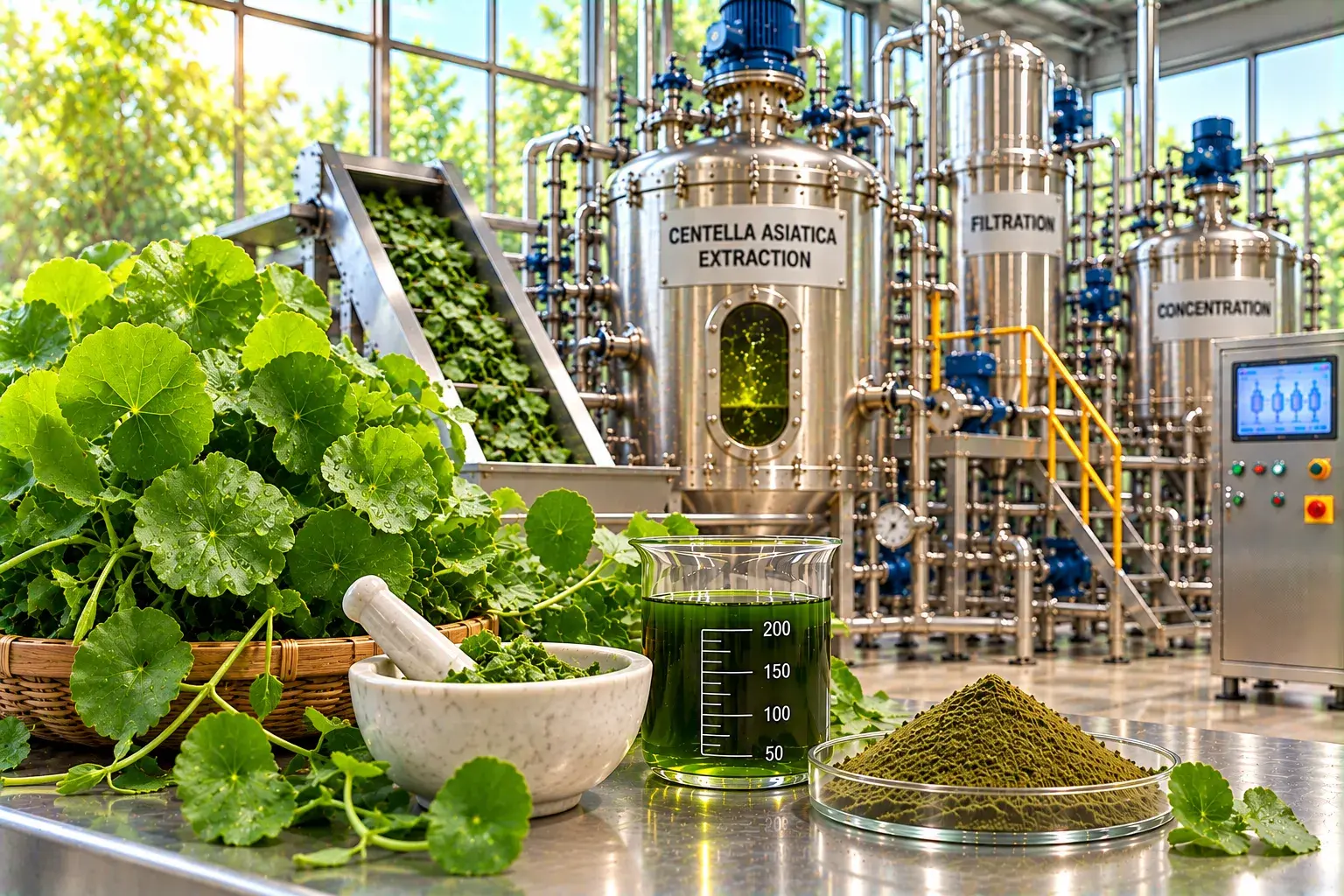
Mechotech designs and manufactures turnkey herbal extraction plants for Centella Asiatica (Centella asiatica, commonly known as Gotu Kola), a creeping herb containing the triterpenoid saponin glycosides asiaticoside and madecassoside along with their corresponding aglycone acids, compounds widely used in wound-care, skin-repair, and cognitive-support formulations. We supply the complete machinery — herb cleaning, size reduction, hydro-alcoholic extraction, filtration, concentration, closed-loop solvent recovery, standardisation and drying — to convert dried Centella asiatica leaf into a consistent extract standardised to 10% to 40% Asiaticosides by HPLC for the cosmetic, nutraceutical, and pharmaceutical industries. Candidate extraction technologies for asiaticoside: Counter-Current Extraction (CCE), Ultrasound-Assisted Extraction (UAE), Hybrid Extraction and Microwave-Assisted Extraction (MAE) (4 in total). The catalogue also lists this botanical, with a 40% Asiaticosides grade, under the names Gotukola and Brahmi; both are covered on this page.
Mechotech's Centella Asiatica plant is engineered around the specific chemistry of the plant's triterpenoid saponin actives: asiaticosides are moderately polar glycosides best recovered through a controlled hydro-alcoholic solvent system, and gentle, temperature-regulated processing preserves the saponin-to-aglycone ratio that determines finished-extract quality. Built in SS 316L with electropolished product-contact surfaces, PLC-SCADA automation and complete batch documentation, each plant is delivered as a commissioned turnkey system configured to the declared Asiaticosides By HPLC specification across the 10% to 40% range.
Technical Specifications
| Product | Centella Asiatica Extraction Plant |
|---|---|
| Botanical Name | Centella asiatica |
| Feedstock | Gotu kola herb |
| Part / Feed Form | Confirm exact plant part / form (to be confirmed with the client) |
| Target Extract | Asiaticoside |
| Extract Type | Standardised dry extract (powder) |
| Standardisation | 10% to 40% Asiaticosides by HPLC (multiple grades on the same line, including the 40% grade listed in the catalogue as Gotukola and Brahmi) |
| Extraction Method | Counter-current, UAE, Hybrid, MAE |
| Technology Count | 4 |
| Extraction Conditions | Hydro-alcoholic solvent extraction (closed, jacketed SS 316L extractors) |
| Product-contact Material | SS 316L, electropolished, CIP-cleanable |
| Filtration System | Plate-and-frame filter press with cartridge polish filtration |
| Concentration System | Falling-film / vacuum evaporator with closed-loop solvent recovery |
| Drying System | Spray dryer or vacuum tray dryer |
| Automation | PLC-SCADA with recipe management, batch traceability and production reporting |
| Utility Requirements | Steam, chilled/cooling water, compressed air, soft water, power (project-specific) |
| Compliance | GMP hygienic design; full documentation for qualification |
| Final Product Form | Free-flowing standardised extract powder |
Plant Capacities
| Plant Scale | Raw Material Throughput | Typical Use |
|---|---|---|
| Pilot | Configured to your feedstock and trial plan | Product development, parameter validation |
| Semi-Commercial | Configured to raw-material supply and buyer volume | Contract manufacturing, scale-up trials |
| Commercial | Configured to raw-material supply and confirmed buyer volume | Commercial production at confirmed buyer volume |
Capacity is configured to raw-material supply and confirmed buyer volume; we recommend a pilot plant to validate process parameters before scaling. No fixed throughput is quoted for this product.
Manufacturing Process
Each extraction method follows a different process — pick a method to see its steps.
Raw-Material Preparation
Gotu kola herb is cleaned and size-reduced so asiaticoside can be reached by the extraction medium; particle size and moisture are set during process development.
Counter-Current Loading
Prepared gotu kola herb is fed into a multi-stage solid–liquid counter-current extractor where fresh ethanol/water or a suitable food-grade solvent meets the most-depleted material.
Counter-Current Extraction
Solvent flows against the solids across stages to draw out asiaticoside; bed flow and fines management are verified during pilot work.
Extract (Miscella) Collection
The asiaticoside-bearing miscella is collected from the fresh-feed end while spent solids are discharged from the solvent-entry end.
Concentration & Solvent Recovery
Solvent is removed from the clarified asiaticoside-bearing extract under vacuum and returned through a solvent-recovery loop; recovery performance is confirmed at pilot scale.
Standardisation & Drying
The asiaticoside extract is assayed against the declared target specification and dried or supplied as a concentrate, according to the requirement.
Raw-Material Preparation
Gotu kola herb is cleaned and size-reduced so asiaticoside can be reached by the extraction medium; particle size and moisture are set during process development.
Slurrying
Prepared gotu kola herb is slurried with ethanol/water or water in the extraction vessel.
Ultrasonic Cavitation
Ultrasound creates cavitation that disrupts the plant matrix and speeds release of asiaticoside; probe intensity, temperature and filtration behaviour are piloted.
Separation
Spent solids are separated by filtration or centrifugation and the extract is clarified before concentration.
Concentration & Solvent Recovery
Solvent is removed from the clarified asiaticoside-bearing extract under vacuum and returned through a solvent-recovery loop; recovery performance is confirmed at pilot scale.
Standardisation & Drying
The asiaticoside extract is assayed against the declared target specification and dried or supplied as a concentrate, according to the requirement.
Raw-Material Preparation
Gotu kola herb is cleaned and size-reduced so asiaticoside can be reached by the extraction medium; particle size and moisture are set during process development.
Stage Sequence Selection
A deliberate combined extraction train is used: the sequence of stages is selected for asiaticoside in pilot screening and each stage is designed separately.
First Assisted Stage
The first stage releases asiaticoside from the prepared feed under controlled conditions set for that stage.
Second / Combined Stage
The second stage completes recovery of asiaticoside from the partially extracted material; stage conditions are optimised separately.
Separation & Concentration
Spent solids are removed and the combined extract is clarified and concentrated; solvent is recovered where a solvent is used.
Standardisation & Drying
The asiaticoside extract is assayed against the declared target specification and dried or supplied as a concentrate, according to the requirement.
Raw-Material Preparation
Gotu kola herb is cleaned and size-reduced so asiaticoside can be reached by the extraction medium; particle size and moisture are set during process development.
Medium Mixing
Prepared gotu kola herb is mixed with ethanol/water or water in the microwave extraction vessel.
Microwave Heating & Extraction
Controlled microwave heating drives asiaticoside out of the prepared feed in a short cycle; heating, moisture, solvent safety and temperature-sensitive targets are controlled, with limits set during process development and pilot validation.
Separation
Spent solids are separated by filtration or centrifugation and the extract is clarified before concentration.
Concentration & Solvent Recovery
Solvent is removed from the clarified asiaticoside-bearing extract under vacuum and returned through a solvent-recovery loop; recovery performance is confirmed at pilot scale.
Standardisation & Drying
The asiaticoside extract is assayed against the declared target specification and dried or supplied as a concentrate, according to the requirement.
Major Plant Equipment
- Raw material cleaning system
- Hammer mill / cutting mill (size reduction)
- Stainless-steel hydro-alcoholic extraction vessels (jacketed, SS 316L)
- Solvent storage tanks
- Solvent transfer pumps
- Plate heat exchangers
- Plate-and-frame filter press / pressure leaf filter
- Cartridge polish filters
- Decolourisation unit (activated carbon treatment)
- Falling-film / vacuum evaporator
- Closed-loop solvent recovery system
- Condensers & vacuum pumps
- Spray dryer / vacuum tray dryer
- CIP (clean-in-place) system
- PLC-SCADA control panel, electrical MCC & instrumentation
Plant Output
From Plant to Product
Centella Asiatica Extract
This botanical is also in the product range of Sureka Life Sciences, our sister concern in botanical ingredients.
Applications
- Cosmetic and skincare formulations (serums, creams, wound-care topicals)
- Nutraceutical capsule, tablet, and supplement manufacturing
- Cognitive-support and stress-relief supplement blends
- Wound-healing and dermatological ingredient supply
- Personal-care and anti-ageing active ingredient formulations
- Ayurvedic and traditional medicine preparations
- Export to regulated-market nutraceutical and cosmetic ingredient buyers
Key Features
GMP Hygienic SS 316L Construction
Electropolished SS 316L product-contact surfaces use GMP hygienic design, with CIP operation between batches.
Multi-Grade Standardisation on One Line
The same plant is configured to target grades across the 10% to 40% Asiaticosides By HPLC range for both cosmetic and nutraceutical buyers.
Integrated Decolourisation
A dedicated decolourisation stage reduces plant-pigment and chlorophyll carryover, giving a lighter, cosmetic-grade finished powder.
Closed-Loop Solvent Recovery
Integrated recovery condenses and recycles solvent per batch.
Gentle, Temperature-Controlled Concentration
Vacuum-stage concentration protects the saponin-to-aglycone balance that determines finished extract quality.
Scalable Batch Capacity
Plants are configured to raw-material supply and confirmed buyer volume, with modular expansion.
Frequently Asked Questions
Do Brahmi and Gotukola have their own pages?
Does Mechotech supply the complete machinery for Centella Asiatica extraction?
What specification range can the Centella Asiatica plant achieve?
What extraction method is used for Centella Asiatica herb?
Is Centella Asiatica extract used in cosmetics as well as supplements?
What production capacities are available for the Centella Asiatica plant?
Which industries use Centella Asiatica extract, and does the plant support GMP qualification?
Which plant part or feed form does the gotu kola plant process?
Which extraction technologies are suitable for gotu kola herb?
How does the gotu kola extraction process work?
What equipment does the gotu kola extraction plant include?
Which related Mechotech extraction pages cover the same material or target?
What is the typical delivery timeline for a Centella Asiatica extraction plant?
Is Brahmi on this page Bacopa monnieri?
Ready to discuss your project?
Get a free quote and technical consultation from our engineering team.