Deglycyrrhizinated Licorice
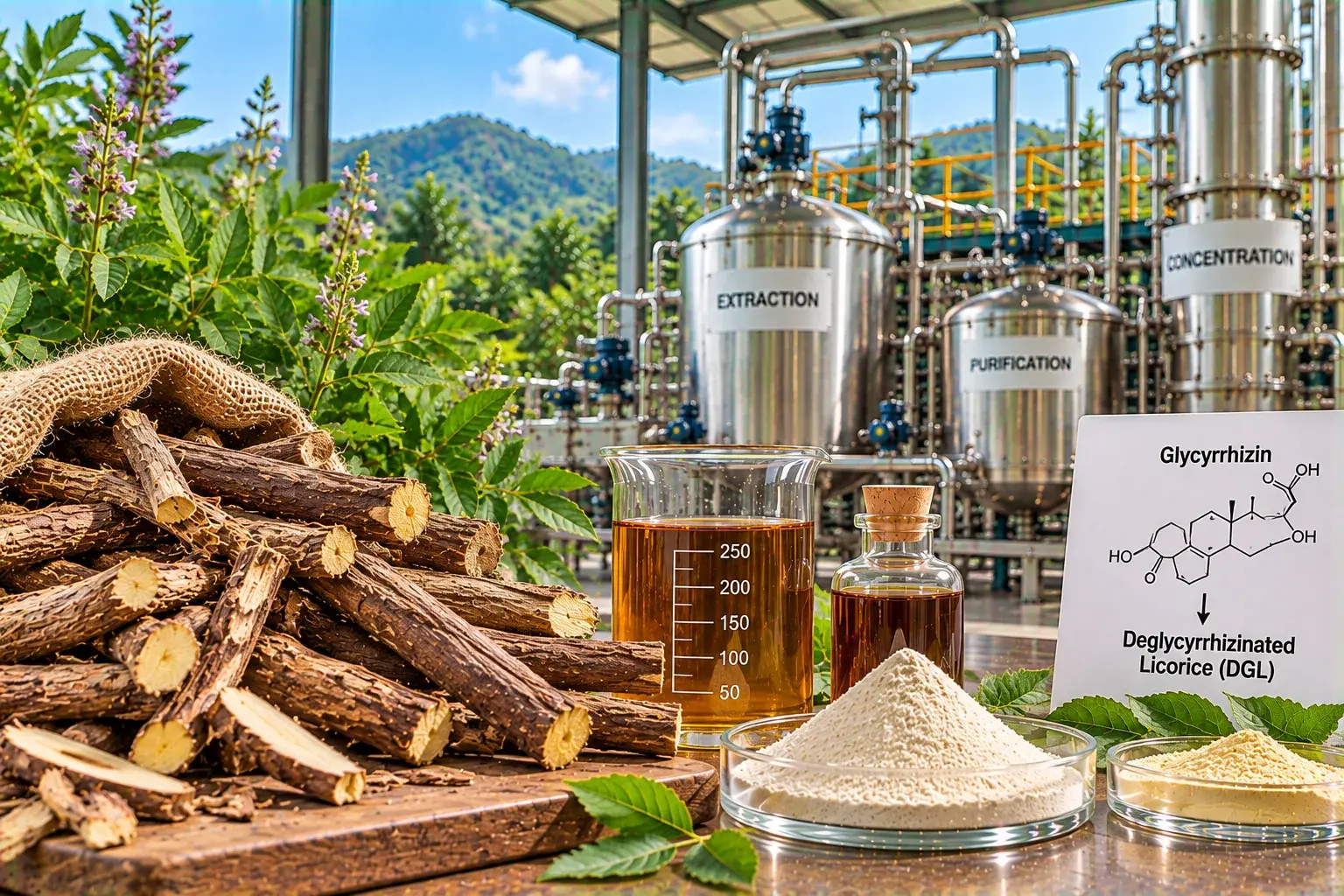
Deglycyrrhizinated Licorice
Purity Levels
3% Glycyrrhizin by HPLC & Flavonoids 1%
Deglycyrrhizinated Licorice (DGL) is standard licorice (Glycyrrhiza glabra) root extract that has been through an additional, dedicated processing stage: glycyrrhizin removal. This is the inverse processing goal of Mechotech's standard Licorice (Glycyrrhiza Glabra) plant, which instead concentrates glycyrrhizic acid to as much as 95%. DGL exists because glycyrrhizin, while pharmacologically active, is associated with hypertensive-risk effects at high or prolonged intake — so buyers needing a GI-supportive licorice ingredient without that risk profile require glycyrrhizin specifically depleted while the flavonoid fraction, responsible for much of licorice's GI-soothing activity, is retained. Mechotech's plant is standardised to 3% Glycyrrhizin by HPLC & Flavonoids 1%.
Mechotech's Deglycyrrhizinated Licorice plant is engineered around a genuinely distinct process reality: standard licorice extraction followed by a dedicated glycyrrhizin-removal stage using chromatographic or resin-based separation, which selectively strips glycyrrhizic acid while leaving the flavonoid fraction intact. This is a real additional process stage, not a lower-concentration variant of the same extraction — the separation equipment and process control required to selectively deplete one class of actives while preserving another is meaningfully different from simply standardising to a lower percentage. The separation stage must be validated to hit both ends of the specification simultaneously — glycyrrhizin driven down to 3% or below while flavonoids are held at or above 1% — which is why DGL process design is treated as its own engineering problem rather than a downstream dilution step. Built in SS 316L with integrated solvent recovery, automation, and full documentation, each plant is delivered as a commissioned turnkey system configured to meet the 3% Glycyrrhizin by HPLC & Flavonoids 1% specification.
Technical Specifications
| Product | Deglycyrrhizinated Licorice (DGL) Extraction Plant |
|---|---|
| Botanical Name | Glycyrrhiza glabra |
| Raw Material | Dried licorice root |
| Plant Part | Root |
| Processing Goal | Glycyrrhizin-depleted extract (opposite of standard Licorice extract, which is glycyrrhizin-concentrated) |
| Standardisation | 3% Glycyrrhizin by HPLC & Flavonoids 1% |
| Extraction Method | Aqueous / hydro-alcoholic solvent extraction, closed jacketed SS 316L extractors |
| Glycyrrhizin-Removal Method | Dedicated chromatographic or resin-based separation stage, added after standard extraction |
| Product-contact Material | SS 316L, electropolished, CIP-cleanable |
| Filtration System | Plate-and-frame filter press with cartridge polish filtration |
| Concentration System | Falling-film / vacuum evaporator with closed-loop solvent recovery |
| Drying System | Spray dryer or vacuum tray dryer |
| Automation | PLC-SCADA with recipe management, batch traceability and production reporting |
| Plant Capacity | Configured to requirement |
| Utility Requirements | Steam, chilled/cooling water, compressed air, soft water, power (project-specific) |
| Compliance | GMP hygienic design; full documentation for qualification |
| Final Product Form | Free-flowing standardised extract powder |
Plant Capacities
| Plant Scale | Root Throughput | Typical Use |
|---|---|---|
| Pilot | Configured to your feedstock and trial plan | Product development, glycyrrhizin-removal validation |
| Semi-Commercial | Configured between pilot and commercial scale | Contract manufacturing, scale-up trials |
| Commercial | Configured to raw-material supply and confirmed buyer volume | Export-grade continuous production |
Capacity is configured to raw-material supply and confirmed buyer volume; we recommend a pilot plant to validate glycyrrhizin-removal efficiency and flavonoid retention before scaling.
Manufacturing Process
Raw Material Preparation
Dried licorice root is authenticated, tested for moisture, and milled to a uniform particle size to maximise solvent contact before extraction.
Standard Extraction
Milled root is extracted with an aqueous or hydro-alcoholic solvent system in closed jacketed SS 316L extractors — the same base extraction principle used for standard glycyrrhizin-concentrated licorice extract.
Filtration
The extract (miscella) is clarified through a plate-and-frame filter press followed by cartridge polish filters to remove root fibre and fines.
Glycyrrhizin Removal
A dedicated chromatographic or resin-based separation stage selectively removes glycyrrhizic acid from the extract while preserving the flavonoid fraction — the genuinely distinct additional process step that defines DGL manufacturing, absent from standard licorice extraction.
Concentration & Solvent Recovery
The glycyrrhizin-depleted miscella is concentrated in a falling-film / vacuum evaporator, with solvent recovered through the condenser return system.
Standardisation
The concentrate is assayed and adjusted to the declared specification of 3% Glycyrrhizin by HPLC & Flavonoids 1% before drying.
Drying & Quality Control
The standardised DGL extract is spray- or vacuum-dried, then released after assay (glycyrrhizin and flavonoid content), residual-solvent, heavy-metal, microbial, and moisture testing.
Major Plant Equipment
- Raw material cleaning system
- Hammer mill (size reduction)
- Stainless-steel jacketed extraction vessels (SS 316L)
- Plate-and-frame filter press / cartridge polish filters
- Chromatographic / resin-based glycyrrhizin-separation column
- Falling-film / vacuum evaporator
- Closed-loop solvent recovery system
- Spray dryer / vacuum tray dryer
- CIP (clean-in-place) system
- Storage tanks & finished-product handling
- PLC-SCADA control panel, electrical MCC & instrumentation
Plant Output
From Plant to Product
Deglycyrrhizinated Licorice Extract
This botanical is also in the product range of Sureka Life Sciences, our sister concern in botanical ingredients.
Applications
- GI-support and digestive-comfort nutraceutical formulations
- Chewable tablets and lozenges for gastric-mucosa support
- Pharmaceutical formulations requiring a low-glycyrrhizin licorice ingredient
- Nutraceutical capsule, tablet, and supplement manufacturing
- Ayurvedic and traditional medicine preparations
- Export to regulated-market ingredient buyers requiring low-glycyrrhizin certification
Key Features
GMP Hygienic SS 316L Construction
Electropolished SS 316L product-contact surfaces use GMP hygienic design, with CIP operation between batches.
Dedicated Glycyrrhizin-Removal Stage
A chromatographic/resin-based separation step, added after standard extraction, selectively depletes glycyrrhizic acid while preserving the flavonoid fraction — a genuine process addition, not a different assay target on the same line.
Closed-Loop Solvent Recovery
Integrated recovery returns solvent per batch for reuse.
Standardised to Specification
In-process and batch-release assay are used to check the finished DGL extract against its declared specification (3% Glycyrrhizin by HPLC & Flavonoids 1%).
Integrated Drying
A matched spray/vacuum dryer produces a free-flowing, low-moisture powder ready for encapsulation and blending.
Scalable Batch Capacity
Plants are configured from pilot scale to commercial capacity with modular expansion.
Frequently Asked Questions
Does Mechotech supply the complete machinery for Deglycyrrhizinated Licorice?
What specification can the Deglycyrrhizinated Licorice plant achieve?
What is deglycyrrhizinated licorice (DGL) and how is it made differently from standard licorice extract?
Should I choose DGL or standard glycyrrhizin-rich Licorice extract?
Why is glycyrrhizin removed rather than simply diluted?
What production capacities are available for the Deglycyrrhizinated Licorice plant?
Which industries use the Deglycyrrhizinated Licorice plant?
Does the DGL process still recover flavonoids efficiently despite the extra separation step?
Ready to discuss your project?
Get a free quote and technical consultation from our engineering team.