Dioscorea Nipponica Extract Powder
Dioscorea Nipponica Extract Powder
Purity Levels
10% - 40% Protodioscin by HPLC
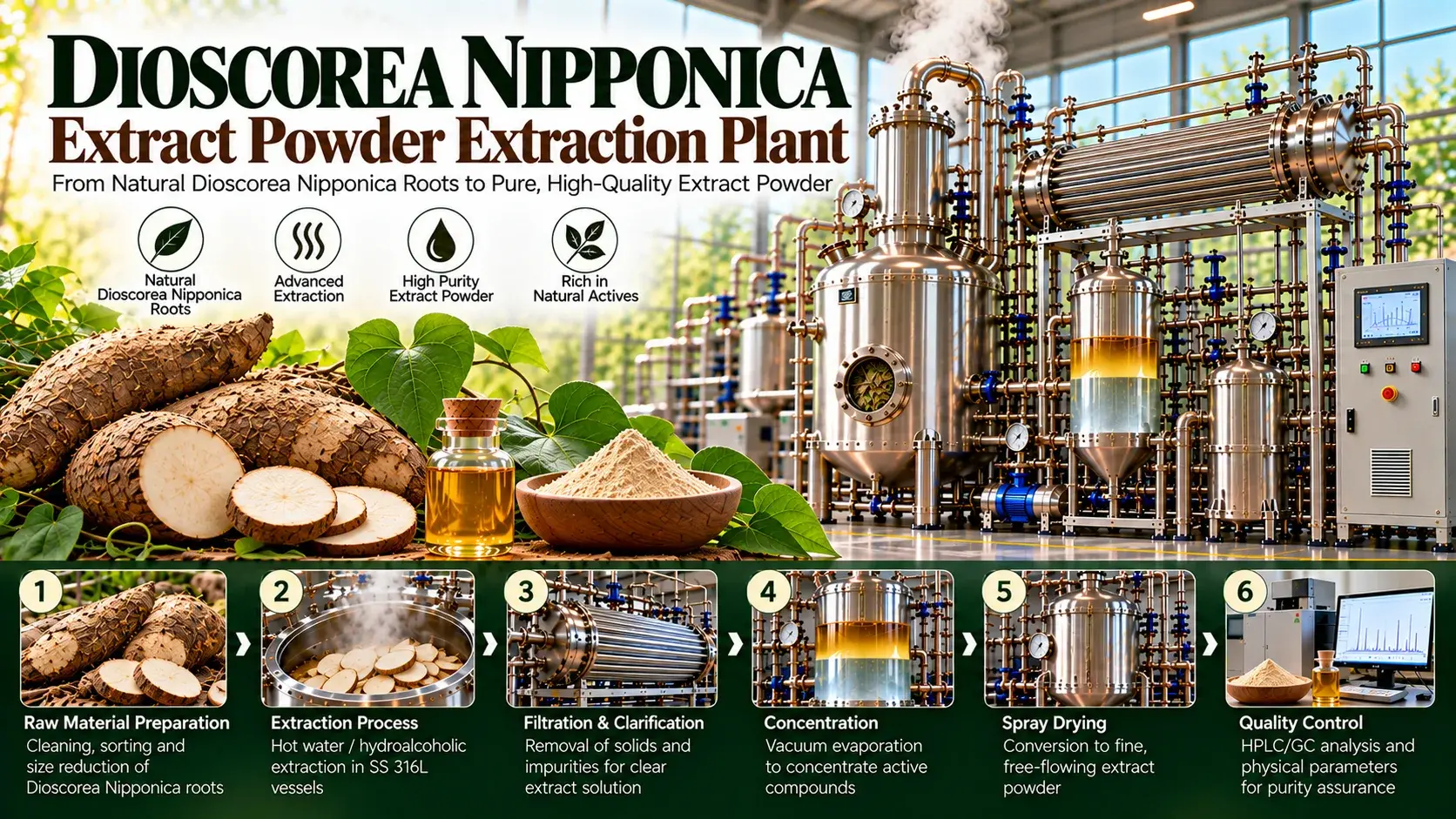
Mechotech supplies the complete machinery for dioscorea nipponica extract powder production, standardised to 10%-40% protodioscin by HPLC. Dioscorea nipponica is a wild yam species whose dried rhizome/root is a rich source of protodioscin, a steroidal saponin distinct from the diosgenin found in Dioscorea villosa (the wild yam species typically grown for DHEA-precursor extraction). Protodioscin has real, growing demand in cardiovascular-support and sports-nutrition nutraceutical formulations. Our turnkey plant extracts, concentrates, and spray-dries this active into a standardised free-flowing powder for the nutraceutical, functional food, and pharmaceutical markets.
Mechotech designs and manufactures the dioscorea nipponica extract powder extraction plant as a turnkey solution with SS 316L construction, low-temperature aqueous-ethanol extraction of the dried rhizome, integrated solvent recovery, and spray drying. The process is engineered around protodioscin — the signature furostanol-type steroidal saponin of Dioscorea nipponica — which is chemically and functionally distinct from the diosgenin extracted from Dioscorea villosa (generic 'wild yam'). Because protodioscin and diosgenin are different molecules used for different applications, the extraction and standardisation parameters below are specific to Dioscorea nipponica rhizome and are not interchangeable with a generic wild-yam diosgenin line. The 10%-40% range reflects genuine grade-tiering rather than a loose specification: a direct hydro-alcoholic extraction and concentration route, without an added purification pass, naturally yields crude extract toward the 10%-20% end of the range, since co-extracted rhizome starch and lower-value saponin fractions dilute the protodioscin content. Reaching the 30%-40% upper band requires the concentrate to pass through the macroporous resin adsorption/desorption stage described below, which selectively strips starch and non-target saponins to enrich protodioscin ahead of drying. The plant achieves a consistent assay across this full range by HPLC and low moisture.
Technical Specifications
| Product | Dioscorea Nipponica Extract Powder Extraction Plant |
|---|---|
| Botanical Name | Dioscorea nipponica (a wild yam species, distinct from Dioscorea villosa) |
| Raw Material | Dried Dioscorea nipponica rhizome/root |
| Plant Part | Rhizome / root |
| Target Compound | Protodioscin (furostanol-type steroidal saponin) — distinct from diosgenin |
| Extract Type | Standardised dry extract (powder) |
| Standardisation | 10%-40% Protodioscin by HPLC |
| Extraction Method | Aqueous-ethanol extraction, closed jacketed SS 316L extractors |
| Product-contact Material | SS 316L, electropolished, CIP-cleanable |
| Filtration System | Plate-and-frame filter press with cartridge polish filtration |
| Concentration System | Falling-film vacuum evaporator with closed-loop solvent recovery |
| Drying System | Spray dryer |
| Automation | PLC-SCADA with recipe management, batch traceability and production reporting |
| Plant Capacity | Configured to requirement |
| Utility Requirements | Steam, chilled/cooling water, compressed air, soft water, power (project-specific) |
| Compliance | GMP, HACCP, FSSAI hygienic design; full documentation for qualification |
| Final Product Form | Free-flowing standardised extract powder |
Plant Capacities
| Plant Scale | Rhizome Throughput | Typical Use |
|---|---|---|
| Pilot | Configured to your feedstock and trial plan | Product development, protodioscin-yield validation |
| Semi-Commercial | Configured between pilot and commercial scale | Contract manufacturing, scale-up trials |
| Commercial | Configured to raw-material supply and confirmed buyer volume | Export-grade continuous production |
Capacity is configured to raw-material supply and confirmed buyer volume; we recommend a pilot plant to validate protodioscin recovery at your target grade before scaling.
Manufacturing Process
Raw Material Preparation
Dried Dioscorea nipponica rhizome is botanically authenticated to confirm species (distinguishing it from Dioscorea villosa and other Dioscorea species), tested for moisture (target below 10%), and milled to a uniform particle size to maximise solvent contact ahead of extraction.
Extraction
Milled rhizome is extracted with warm water or aqueous ethanol (40-70% v/v) in closed jacketed SS 316L extractors at 45-70°C. Multiple cycles with fresh solvent maximise protodioscin recovery while limiting thermal and hydrolytic degradation of the saponin structure.
Filtration
The extract (miscella) is clarified through a plate-and-frame filter press followed by 1-5 micron cartridge polish filters to remove starch and fibrous rhizome particulate before concentration.
Purification & Vacuum Concentration
Target assay dictates the route from here. For grades in the 10%-20% band, the filtered extract goes directly to vacuum concentration. For grades in the 30%-40% band, the extract first passes a macroporous resin adsorption/desorption stage — the extract is loaded onto resin, rinsed to elute starch and lower-value saponins, then desorbed with a higher-ethanol eluent to recover a protodioscin-enriched fraction — before concentration in a falling-film evaporator at 50-65°C under vacuum with closed-loop ethanol recovery.
Standardisation
The concentrate is assayed by HPLC for protodioscin content and blended or maltodextrin-adjusted to the declared 10%-40% specification before drying.
Spray Drying & Quality Control
The standardised concentrate is spray-dried to a free-flowing powder with controlled inlet/outlet temperature to preserve the protodioscin fraction. Each batch undergoes HPLC assay, residual solvent, heavy metals, microbial, and moisture testing before release.
Major Plant Equipment
- Raw material cleaning & moisture-testing station
- Hammer mill (size reduction)
- Jacketed SS 316L extraction vessels
- Solvent storage & metering tanks
- Plate-and-frame filter press
- Cartridge polish filtration
- Macroporous resin purification columns
- Falling-film vacuum evaporator
- Closed-loop solvent recovery system
- Condensers & vacuum pumps
- Spray dryer
- CIP (clean-in-place) system
- Storage tanks & finished-product tanks
- PLC-SCADA control panel, electrical MCC & instrumentation
Plant Output
Applications
- Cardiovascular-support nutraceutical capsule and tablet formulations
- Sports nutrition and performance supplement blends
- Functional food and dietary supplement manufacturing
- Pharmaceutical standardised botanical ingredient supply
- Traditional medicine preparations
- Export to nutraceutical ingredient buyers in regulated markets
Key Features
Species-Specific Protodioscin Process
The extraction and purification parameters are engineered for Dioscorea nipponica rhizome and its protodioscin content — not repurposed from a generic diosgenin/wild-yam line — so the finished powder consistently meets its declared protodioscin assay.
GMP Hygienic SS 316L Construction
All product-contact surfaces are electropolished SS 316L, using GMP hygienic design for botanical extract manufacturing, with clean-in-place (CIP) operation between batches.
Standardised 10%-40% Assay by HPLC
In-process and batch-release HPLC assay are used to check the finished powder against its declared 10%-40% protodioscin specification for consistent, buyer-ready quality.
Resin-Purification Route to Upper-Range Grades
An integrated macroporous resin adsorption/desorption stage can be engaged to move production from crude 10%-20% grades up to the 30%-40% enriched band on the same line, without separate purification equipment.
Closed-Loop Solvent Recovery
Integrated condenser-distillation recovery returns ethanol for reuse each batch, reducing fresh-solvent consumption.
Integrated Spray Drying
A matched spray dryer converts the standardised concentrate into a free-flowing, low-moisture powder ready for encapsulation and blending, completing the turnkey powder line.
Scalable Batch Capacity
Plants are configured to requirement from pilot scale upward, with a modular design that allows expansion without replacing core equipment.
Frequently Asked Questions
What is dioscorea nipponica extract powder and why is it commercially extracted?
Is Dioscorea nipponica the same as the 'wild yam' used for diosgenin extraction?
Why does the protodioscin specification range so widely, from 10% to 40%?
Which plant part of Dioscorea nipponica is used, and why?
Does Mechotech supply the machinery for dioscorea nipponica extract powder?
What testing method confirms the dioscorea nipponica extract powder specification?
What production capacities are available for the dioscorea nipponica extract powder plant?
Which industries use dioscorea nipponica extract powder?
Ready to discuss your project?
Get a free quote and technical consultation from our engineering team.