Milk Thistle Extract Powder
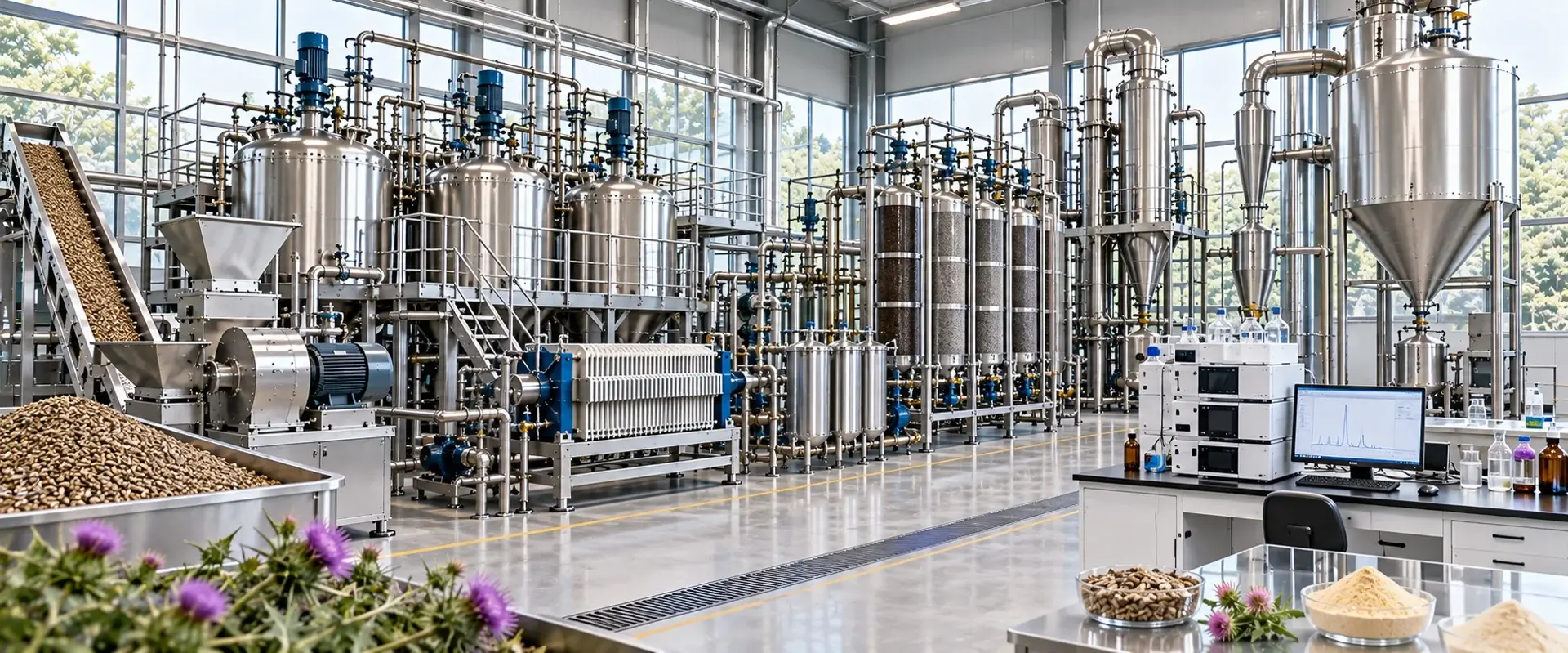
Milk Thistle Extract Powder
Purity Levels
80% Silymarin by HPLC
Mechotech supplies the complete machinery for milk thistle extract powder production, standardised to 80% Silymarin by HPLC. Milk thistle (Silybum marianum) seed is the primary source of the silymarin flavonolignan complex — silybin (silibinin), isosilybin, silychristin and silydianin — valued for hepatoprotective and antioxidant activity. Our turnkey plant takes cleaned, milled seed through controlled solvent extraction, filtration, resin/membrane purification, vacuum concentration with high-rate solvent recovery, and spray drying to deliver a consistent, HPLC-verified 80% silymarin powder for the nutraceutical, functional food, and pharmaceutical markets.
Mechotech designs and manufactures the milk thistle extract powder extraction plant as a turnkey solution with SS 316L construction, low-temperature aqueous-ethanol extraction, integrated solvent recovery, and spray drying. The process is engineered to protect the heat-sensitive silymarin fraction while achieving a consistent 80% silymarin assay by HPLC and low moisture.
Technical Specifications
| Product | Milk Thistle Extract Powder Extraction Plant |
|---|---|
| Botanical Name | Silybum marianum |
| Raw Material | Dried, cleaned Milk Thistle seed |
| Plant Part | Seed |
| Extract Type | Standardised spray-dried flavonolignan extract powder |
| Standardisation | 80% Silymarin by HPLC (silybin, isosilybin, silychristin, silydianin) |
| Extraction Method | Warm-water / aqueous-ethanol (40–70% v/v) extraction, 45–70°C, closed jacketed vessels |
| Purification | Macroporous resin or membrane purification (high-grade specification) |
| Product-contact Material | SS 316L, electropolished, CIP-cleanable |
| Filtration System | Plate-and-frame filter press + 1–5 micron cartridge polish filtration |
| Concentration System | Falling-film vacuum evaporator, 50–65°C |
| Drying System | Spray dryer with controlled inlet/outlet temperature |
| Automation | PLC-SCADA with recipe management and batch traceability |
| Plant Capacity | Configured to requirement — pilot to commercial scale |
| Utility Requirements | Steam, chilled water, compressed air, soft/RO water, power (project-specific) |
| Compliance | GMP hygienic design; full documentation for qualification |
| Final Product Form | Free-flowing standardised powder, HPLC-assayed to 80% silymarin |
Plant Capacities
| Scale | Batch Size | Typical Use |
|---|---|---|
| Pilot | Configured to your feedstock and trial plan | Process validation, sample production, market trials |
| Semi-Commercial | Configured between pilot and commercial scale | Initial commercial supply, capacity building |
| Commercial | Configured to raw-material supply and confirmed buyer volume | Full-scale export and bulk ingredient supply |
Batch size shown is dried seed input per cycle; layout and automation level are configured to the confirmed capacity.
Manufacturing Process
Raw Material Preparation
Dried milk thistle seed is authenticated, tested for moisture (target below 10%), and milled to a uniform particle size to maximise solvent contact and release of the silymarin flavonolignans before extraction.
Extraction
Milled material is extracted with warm water or aqueous ethanol (40–70% v/v) in closed jacketed SS 316L extractors at 45–70°C. Multiple cycles with fresh solvent maximise silymarin recovery while limiting thermal degradation.
Filtration
The extract (miscella) is clarified through a plate-and-frame filter press followed by 1–5 micron cartridge polish filters to remove plant particulates before concentration.
Purification
For high-grade specifications, the extract passes a macroporous resin or membrane purification stage to enrich silymarin content and remove unwanted plant constituents ahead of concentration.
Vacuum Concentration
The purified extract is concentrated in a falling-film evaporator at 50–65°C under vacuum, with ethanol recovered through the condenser return system.
Standardisation
The concentrate is assayed by HPLC for silymarin content and blended or maltodextrin-adjusted to the declared 80% specification before drying.
Spray Drying
The standardised concentrate is spray-dried to a free-flowing powder with controlled inlet/outlet temperature to preserve the actives.
Quality Control & Packing
Each batch undergoes HPLC assay, residual solvent, heavy metals, microbial, and moisture testing before release, then is packed under batch-traceable, GMP-controlled conditions ready for dispatch.
Major Plant Equipment
- Seed cleaning & moisture-testing station
- Milling / size-reduction system
- Jacketed SS 316L extraction vessels (batch, multi-cycle)
- Solvent storage & metering tanks
- Plate-and-frame filter press
- 1–5 micron cartridge polish filtration
- Macroporous resin / membrane purification columns
- Falling-film vacuum evaporator
- Solvent recovery & condensation system
- Standardisation / blending vessel
- HPLC quality-control laboratory setup
- Spray dryer with cyclone separator
- Powder collection, sieving & packing line
- CIP (clean-in-place) system
- PLC-SCADA automation, electrical MCC & instrumentation
Plant Output
Case Study
Milk Thistle (Silymarin) Extraction Plant — Turnkey Silymarin & Silybin Project
See how this plant was engineered and delivered for a real project.
Applications
- Liver-support nutraceutical capsule and tablet formulations
- Functional food and dietary supplement manufacturing
- Pharmaceutical standardised botanical ingredient supply
- Ayurvedic and traditional medicine preparations
- Cosmetic and personal care active ingredient supply
- Export to nutraceutical ingredient buyers in regulated markets
Key Features
GMP Hygienic SS 316L Construction
All product-contact surfaces are electropolished SS 316L, using GMP hygienic design for botanical extract manufacturing, with clean-in-place (CIP) operation between batches.
Standardised 80% Assay by HPLC
In-process and batch-release HPLC assay are used to check the finished powder against its declared 80% silymarin specification for consistent, buyer-ready quality.
Closed-Loop Solvent Recovery
Integrated condenser-distillation recovery returns ethanol per batch for reuse.
Integrated Spray Drying
A matched spray dryer converts the standardised concentrate into a free-flowing, low-moisture powder ready for encapsulation and blending, completing the turnkey powder line.
Scalable Batch Capacity
Plants are configured to requirement from pilot scale upward, with a modular design that allows expansion without replacing core equipment.
Frequently Asked Questions
What is milk thistle extract powder and why is it commercially extracted?
Does Mechotech supply the machinery for milk thistle extract powder?
What is the difference between the HPLC and UV grades of milk thistle extract?
What testing method confirms this milk thistle extract specification?
What plant capacities are available, and how is cost determined?
How do I choose between this plant and a general herbal extraction plant?
Ready to discuss your project?
Get a free quote and technical consultation from our engineering team.