Juniper
Juniper
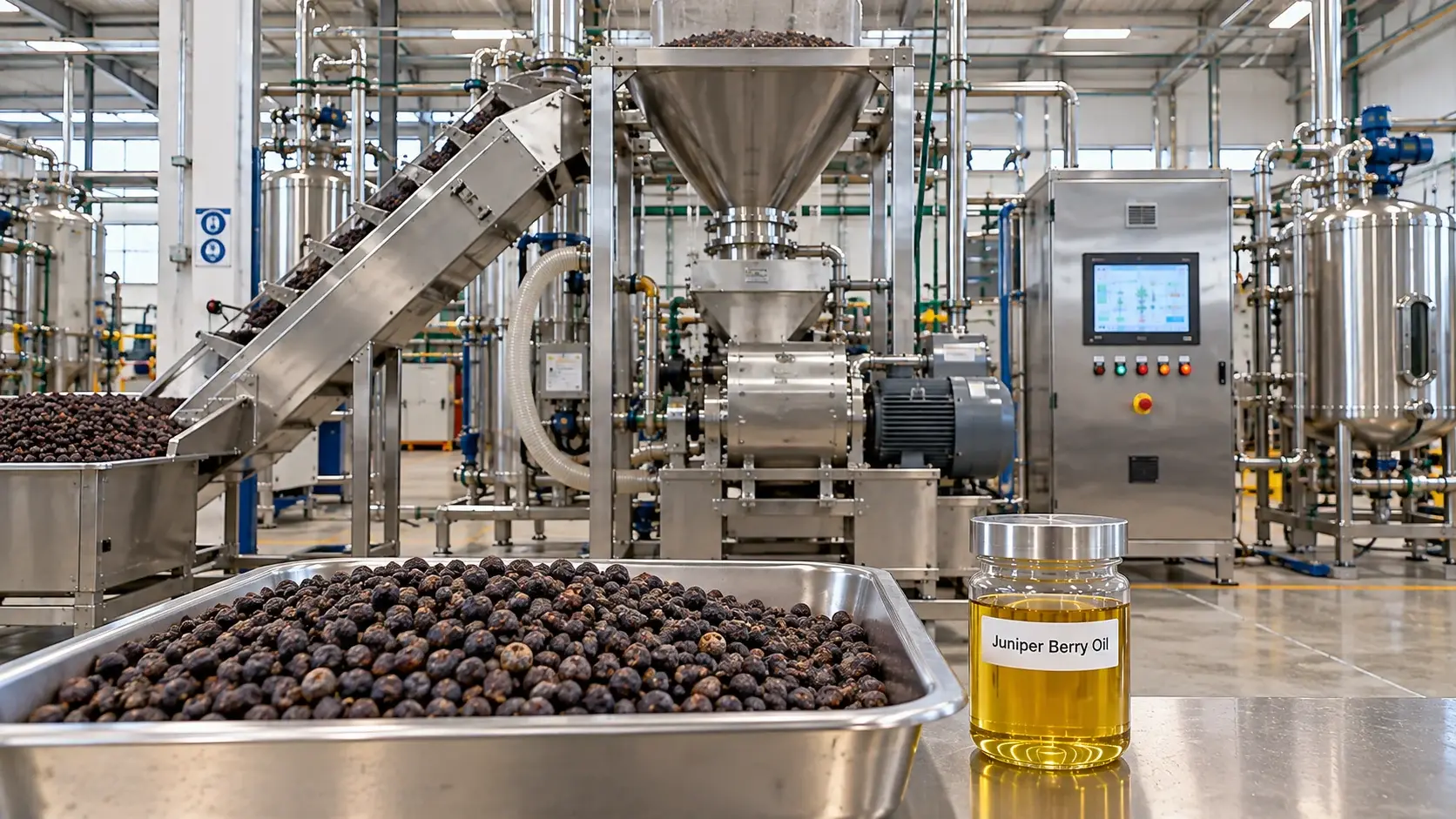
Mechotech designs and manufactures turnkey seeds & berries distillation plants for Juniper (Juniperus communis). We supply the complete machinery to process juniper berries into an essential oil configured to the client’s target specification. The legacy listing describes juniper berry oil as steam-distilled from ripe or semi-ripe berries, with alpha-pinene as the dominant constituent; the Sureka Life Sciences catalogue lists alpha-pinene as the marker.
Mechotech’s Juniper distillation plant is configured around the raw material and the target oil. It is built in SS 316L with integrated condensers and oil–water separation, PLC-based automation and full documentation, and is delivered as a commissioned turnkey system. The distillation mode is selected during process development. Juniper berries are bulky, so the line is built around crushing the berries before charging and a still sized for the bulk volume of the crushed charge; alpha-pinene is the listed marker compound.
Technical Specifications
| Product | Juniper Berry Distillation Plant |
|---|---|
| Botanical Name | Juniperus communis |
| Raw Material | Juniper |
| Plant Part | Berries (ripe or semi-ripe per the legacy listing; botanically fleshy cones); exact feed form to be confirmed with the client |
| Marker Compound | Alpha-pinene (per the Sureka Life Sciences catalogue entry for Juniper Distillation) |
| Key Constituents (legacy listing) | Alpha-pinene 30–50%, myrcene 8–15%, sabinene 5–15%, limonene 3–10% |
| Product Category | Seeds & Berries Distillation Plants |
| Extraction Method | Steam distillation (per the legacy listing); steam, hydro, vacuum or pressure modes are evaluated and the final route is confirmed during process development |
| Still | SS 316L large-volume still sized for the bulk volume of crushed berries (per the legacy listing) |
| Product-contact Material | SS 316L |
| Condensation | Multi-tube condenser with chilled-water circulation |
| Oil–Water Separation | Stainless-steel Florentine flask |
| Finishing | Polish filtration; drying over anhydrous sodium sulphate or by vacuum |
| Automation | PLC-based |
| Plant Capacity | Configured to requirement |
| Final Product Form | Juniper berry essential oil; aromatic hydrosol as co-product |
Plant Capacities
| Plant Scale | Raw Material Throughput | Typical Use |
|---|---|---|
| Pilot | Configured to your feedstock and trial plan | Product development, parameter validation |
| Semi-Commercial | Configured between pilot and commercial scale | Scale-up trials, contract manufacturing |
| Commercial | Configured to raw-material supply and confirmed buyer volume | Commercial production |
Capacity is configured to raw-material supply, confirmed buyer volume and investment timeline; a pilot plant is recommended to validate parameters before scaling.
Manufacturing Process
Raw Material Preparation
Juniper (Juniperus communis) berries are cleaned and crushed before charging so that steam reaches the oil held in the berry; the crushing degree, charge density and berry maturity are set during process development.
Charging & Distillation
The prepared Juniper charge is loaded into the SS 316L still and distilled by steam, hydro (hydrodistillation), vacuum, or pressure distillation — selected for the volatility and heat-sensitivity of the target oil.
Condensation
Vapours pass through an efficient multi-tube condenser with chilled-water circulation, condensing the volatile oil and hydrosol.
Oil–Water Separation
Condensate is separated in a stainless-steel Florentine flask; the essential oil is collected while the hydrosol is drawn off (and can be recovered as a co-product).
Polishing & Drying
The crude oil is polish-filtered and dried over anhydrous sodium sulphate (or by vacuum) to remove residual moisture.
Quality Control
Each batch of Juniper berry oil is verified by GC-MS and physical parameters (specific gravity, refractive index, optical rotation) before release.
Major Plant Equipment
- Raw material cleaning and sorting system
- Berry crushing / size-reduction unit
- SS 316L large-volume distillation still
- Steam supply and injection system
- Multi-tube condenser with chilled-water circulation
- Stainless-steel Florentine flask (oil–water separator)
- Polish filtration system
- Drying unit (anhydrous sodium sulphate or vacuum)
- CIP system
- PLC-based automation and instrumentation
Plant Output
Applications
- Gin and alcoholic-beverage flavouring (per the legacy listing)
- Fragrance — fresh, woody notes (per the legacy listing)
- Aromatherapy, including diffuser use
- Food flavouring (per the legacy listing)
- Cosmetics and topical application
- Natural preservative (as listed by Sureka Life Sciences)
Key Features
SS 316L Construction
All product-contact surfaces are SS 316L for corrosion resistance and product purity, with CIP capability between batches.
Efficient Condensation
High-surface-area multi-tube condensers with chilled-water circulation condense the volatile oil and hydrosol.
Large-Volume Still for Berry Charges
The still is sized for the bulk volume of crushed berries so that the charge is not over-compressed and steam can pass through it; the distillation mode is set during process development.
Berry-Maturity Batching
Green and fully ripe berries can be processed in separate batches where different oil characters are wanted, as described in the legacy listing.
Hydrosol Recovery
Integrated separation allows the aromatic hydrosol to be recovered as a co-product.
Scalable Capacity
Plants are configured to requirement from pilot scale upward, with modular expansion.
Frequently Asked Questions
Does Mechotech supply the complete machinery for Juniper?
What specification can the Juniper plant achieve?
What production capacities are available for the Juniper plant?
Which industries use the Juniper plant?
Which part of Juniper is processed in the distillation plant?
How is Juniper berry oil produced in the plant?
What does the legacy listing say juniper berry oil contains?
Which marker does the Sureka Life Sciences catalogue list for juniper oil?
Can green and ripe juniper berries be processed separately?
How does this page differ from the other Juniper pages?
Ready to discuss your project?
Get a free quote and technical consultation from our engineering team.