
Fennel Oleoresin
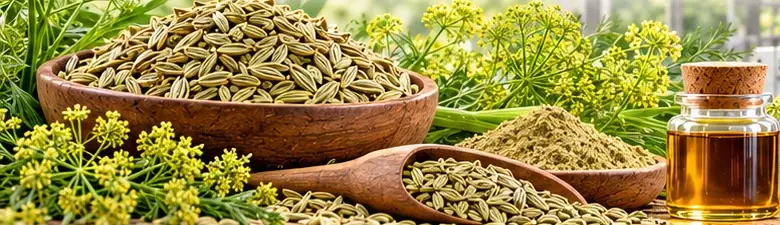
Fennel Oleoresin
Mechotech designs and manufactures solvent extraction plants for fennel oleoresin from fennel seed (Foeniculum vulgare). The catalogue describes the oleoresin as characterised by trans-anethole, fenchone and estragole, giving the sweet, anise-like aroma and flavour used in food, confectionery, liqueur and digestive-supplement products. This page covers the oleoresin route; the steam-distilled essential-oil route has its own page.
Mechotech’s fennel oleoresin plant uses food-grade ethanol or hexane percolation of ground fennel seed to co-extract the aromatic volatile fraction and the non-volatile fixed oil. Because trans-anethole can isomerise to cis-anethole at higher temperatures, extraction and evaporation are temperature-controlled, and the standardisation step includes GC-based quality control for the trans-anethole specification. Solvent, capacity and operating parameters are established during process development and pilot validation.
Technical Specifications
| Product | Fennel Oleoresin Extraction Plant |
|---|---|
| Botanical Name | Foeniculum vulgare |
| Raw Material | Fennel seed |
| Plant Part / Feed Form | Seeds (ground); dried fennel herb and stalk can be processed on a separate protocol |
| Extract Type | Oleoresin — volatile aromatic fraction with non-volatile fixed oil |
| Standardisation | Trans-anethole by GC to the client’s specification |
| Extraction Method | Percolation with food-grade ethanol or hexane at controlled temperature |
| Product-contact Material | SS 316L |
| Filtration | Pressure-leaf (sparkler) filtration with cartridge polish filters |
| Concentration | Falling-film / vacuum evaporation with solvent recovery; temperature-controlled to protect trans-anethole |
| Automation | PLC-based |
| Plant Capacity | Configured to requirement |
| Utility Requirements | Steam, chilled/cooling water, compressed air and power (project-specific) |
| Compliance | GMP hygienic design; solvent-handling areas engineered for flammable solvents; full documentation for qualification |
| Final Product Form | Fennel oleoresin |
Plant Capacities
| Plant Scale | Raw Material Throughput | Typical Use |
|---|---|---|
| Pilot | Configured to your feedstock and trial plan | Product development, parameter validation |
| Semi-Commercial | Configured between pilot and commercial scale | Scale-up trials, contract manufacturing |
| Commercial | Configured to raw-material supply and confirmed buyer volume | Commercial production |
Capacity is configured to raw-material supply, confirmed buyer volume and investment timeline; a pilot plant is recommended to validate parameters before scaling.
Manufacturing Process
Raw Material Preparation
Fennel seed is cleaned of dust and foreign matter, its variety and moisture are confirmed, and the seed is ground to a uniform particle size for percolation.
Percolation Extraction
Ground seed is loaded into SS 316L percolators and extracted with food-grade ethanol or hexane at controlled temperature, co-extracting the volatile aromatic fraction and the fixed oil.
Miscella Filtration
The miscella is clarified through a pressure-leaf filter and cartridge polish filters to remove seed fines.
Evaporation & Solvent Recovery
The miscella is concentrated in a falling-film / vacuum evaporator at controlled temperature, and the solvent is condensed and recovered for reuse.
Standardisation
The oleoresin is analysed by GC for trans-anethole and related markers and adjusted to the client’s target specification.
Packing & Storage
Finished oleoresin is filled and labelled with batch and certificate-of-analysis reference.
Major Plant Equipment
- Seed cleaning and milling system
- Percolators / closed jacketed SS 316L extraction vessels
- Solvent storage tanks and transfer pumps
- Pressure-leaf (sparkler) filter and cartridge polish filtration
- Falling-film / vacuum evaporator
- Solvent recovery unit, condensers and vacuum system
- Standardisation / blending vessel
- CIP system
- PLC-based automation and instrumentation
Plant Output
From Plant to Product
Fennel Extract
This botanical is also in the product range of Sureka Life Sciences, our sister concern in botanical ingredients.
Applications
- Food flavouring — breads, biscuits, sausages, fish products and confectionery
- Liqueur and spirits flavouring — anise-flavoured spirits
- Digestive aid and carminative supplement formulations, including syrups and infant gripe water
- Confectionery flavouring — anise candies, liquorice-flavour products and chewing gum
- Pharmaceutical flavour masking in oral liquid medicines and syrups
- Personal care — toothpaste, mouthwash and breath fresheners
- Fragrance industry — natural anise note ingredient
- Functional food and herbal tea formulations for digestive comfort
Key Features
Trans-Anethole Protection
Extraction and evaporation temperatures are controlled to limit isomerisation of trans-anethole to cis-anethole, and GC analysis checks the isomer ratio.
Dual-Fraction Extraction
Percolation recovers both the volatile aromatic oil and the non-volatile fixed oil into one oleoresin.
Closed-Loop Solvent Recovery
Condenser-return recovery reuses solvent between batches and limits solvent loss.
SS 316L Construction
Product-contact surfaces are SS 316L, with CIP capability between batches.
Scalable Capacity
Plants are configured to requirement from pilot scale upward, with modular expansion.
Frequently Asked Questions
Does Mechotech supply the complete machinery for Fennel Oleoresin?
What specification can the Fennel Oleoresin plant achieve?
What production capacities are available for the Fennel Oleoresin plant?
Which industries does the catalogue list for the fennel oleoresin plant?
Which part of fennel is processed in the oleoresin plant?
How is fennel oleoresin produced?
Why is temperature controlled during fennel extraction and evaporation?
How does the fennel oleoresin plant differ from the fennel oil plant?
Which related plants does the catalogue list with fennel oleoresin?
Ready to discuss your project?
Get a free quote and technical consultation from our engineering team.