Jhatamansi / Spikenard
Jhatamansi / Spikenard
Mechotech designs and manufactures turnkey roots / husk distillation plants for Jhatamansi / Spikenard (Nardostachys jatamansi). We supply the complete machinery to process Jhatamansi / Spikenard roots into an essential oil configured to the client’s target specification. The legacy listing describes spikenard essential oil from Nardostachys jatamansi roots by steam or hydro distillation; the Sureka Life Sciences catalogue lists both Jhatamansi Distillation and Spikenard Distillation with jatamansone as the marker.
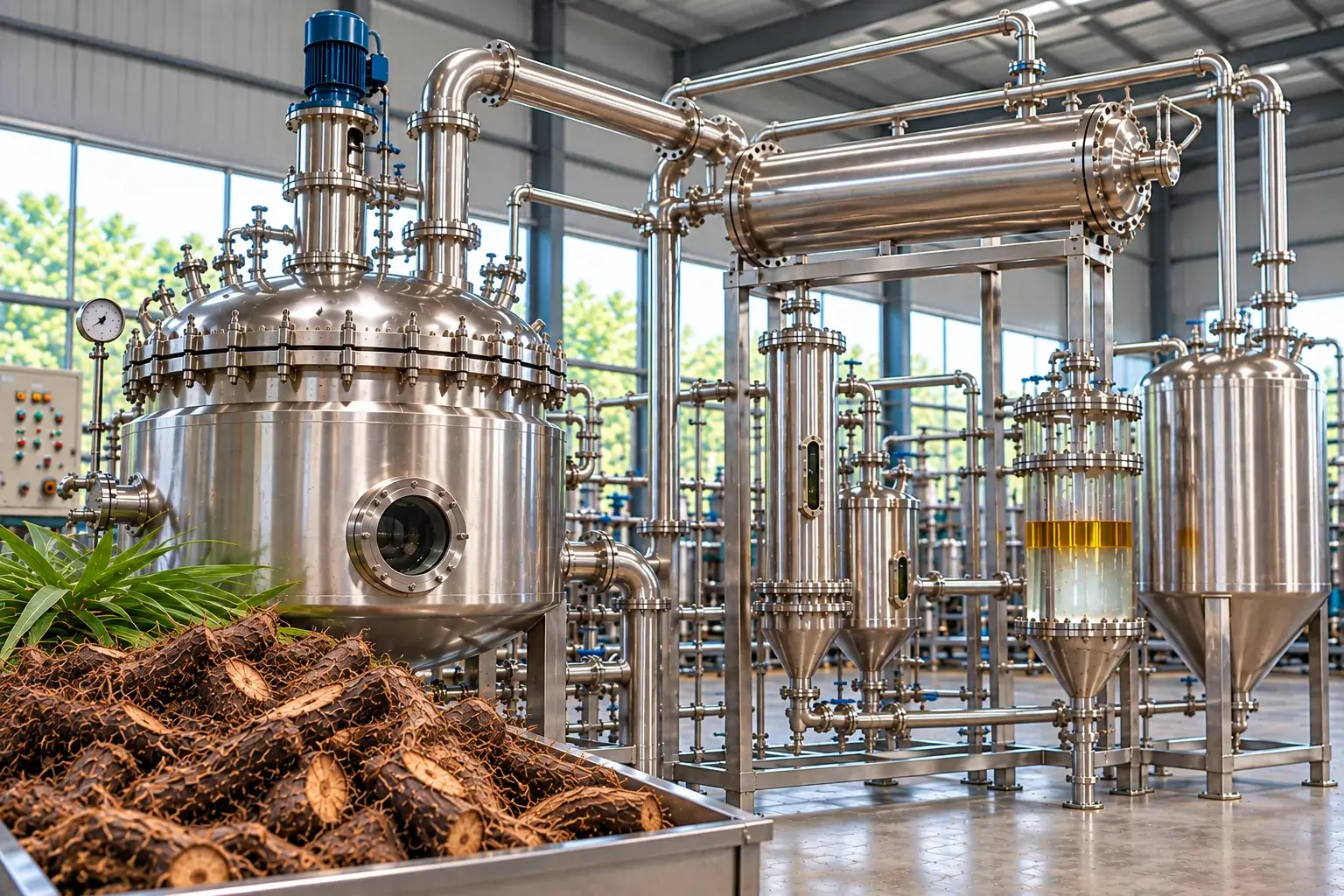
Mechotech’s Jhatamansi / Spikenard distillation plant is configured around the raw material and the target oil. It is built in SS 316L with integrated condensers and oil–water separation, PLC-based automation and full documentation, and is delivered as a commissioned turnkey system. The distillation mode is selected during process development. Jhatamansi / spikenard is a root / rhizome feedstock, so the line is built around cleaning off soil and reducing the dense, fibrous roots before distillation; jatamansone is the listed marker compound.
Technical Specifications
| Product | Jhatamansi / Spikenard Distillation Plant |
|---|---|
| Botanical Name | Nardostachys jatamansi |
| Raw Material | Jhatamansi / Spikenard |
| Plant Part | Roots / rhizomes — the legacy distillation listing says roots and the legacy herbal-extraction listing describes aromatic rhizomes; exact feed form to be confirmed with the client |
| Marker Compound | Jatamansone (per the Sureka Life Sciences catalogue entries for Jhatamansi Distillation and Spikenard Distillation) |
| Product Category | Roots / Husk Distillation Plants |
| Extraction Method | Steam or hydro distillation (per the legacy Jatamansi / Spikenard root listing); vacuum or pressure modes can be evaluated and the final route is confirmed during process development |
| Product-contact Material | SS 316L |
| Condensation | Multi-tube condenser with chilled-water circulation |
| Oil–Water Separation | Stainless-steel Florentine flask |
| Finishing | Polish filtration; drying over anhydrous sodium sulphate or by vacuum |
| Automation | PLC-based |
| Plant Capacity | Configured to requirement |
| Final Product Form | Jhatamansi / Spikenard essential oil; aromatic hydrosol as co-product |
Plant Capacities
| Plant Scale | Raw Material Throughput | Typical Use |
|---|---|---|
| Pilot | Configured to your feedstock and trial plan | Product development, parameter validation |
| Semi-Commercial | Configured between pilot and commercial scale | Scale-up trials, contract manufacturing |
| Commercial | Configured to raw-material supply and confirmed buyer volume | Commercial production |
Capacity is configured to raw-material supply, confirmed buyer volume and investment timeline; a pilot plant is recommended to validate parameters before scaling.
Manufacturing Process
Raw Material Preparation
Jhatamansi / spikenard roots and rhizomes are cleaned of soil and reduced in size so that steam reaches the oil-bearing tissue; the feed form and particle size are set during process development.
Charging & Distillation
The prepared Jhatamansi / Spikenard charge is loaded into the SS 316L still and distilled by steam, hydro (hydrodistillation), vacuum, or pressure distillation — selected for the volatility and heat-sensitivity of the target oil.
Condensation
Vapours pass through an efficient multi-tube condenser with chilled-water circulation, condensing the volatile oil and hydrosol.
Oil–Water Separation
Condensate is separated in a stainless-steel Florentine flask; the essential oil is collected while the hydrosol is drawn off (and can be recovered as a co-product).
Polishing & Drying
The crude oil is polish-filtered and dried over anhydrous sodium sulphate (or by vacuum) to remove residual moisture.
Quality Control
Each batch of Jhatamansi / Spikenard oil is verified by GC-MS and physical parameters (specific gravity, refractive index, optical rotation) before release.
Major Plant Equipment
- Raw material cleaning and sorting system
- Size-reduction unit (where required)
- SS 316L distillation still / extractor
- Multi-tube condenser with chilled-water circulation
- Stainless-steel Florentine flask (oil–water separator)
- Polish filtration system
- Drying unit (anhydrous sodium sulphate or vacuum)
- CIP system
- PLC-based automation and instrumentation
Plant Output
Applications
- Aromatherapy
- Perfumery and cosmetics
- Hair and scalp care
- Skincare
- Massage therapy
- Traditional medicine, including Ayurvedic preparations
Key Features
SS 316L Construction
All product-contact surfaces are SS 316L for corrosion resistance and product purity, with CIP capability between batches.
Efficient Condensation
High-surface-area multi-tube condensers with chilled-water circulation condense the volatile oil and hydrosol.
Root-Charge Distillation
The still is configured for dense, fibrous, size-reduced root and rhizome charges, with the distillation mode set during process development.
Hydrosol Recovery
Integrated separation allows the aromatic hydrosol to be recovered as a co-product.
Scalable Capacity
Plants are configured to requirement from pilot scale upward, with modular expansion.
Frequently Asked Questions
Does Mechotech supply the complete machinery for Jhatamansi / Spikenard?
What specification can the Jhatamansi / Spikenard plant achieve?
What production capacities are available for the Jhatamansi / Spikenard plant?
Which industries use the Jhatamansi / Spikenard plant?
Which part of Jhatamansi / Spikenard is processed in the distillation plant?
How is Jhatamansi / Spikenard oil produced in the plant?
Which marker does the catalogue list for jhatamansi / spikenard oil?
How does this page differ from the Spikenard page?
How do the Jatamansi Brown, Jatamansi Green and Jatamansi pages differ?
Ready to discuss your project?
Get a free quote and technical consultation from our engineering team.