Vetiver
Vetiver
Purity Levels
Root (Vetiveria zizanioides) — sesquiterpenoid-rich oil (vetiverol, vetivone, khusimol)
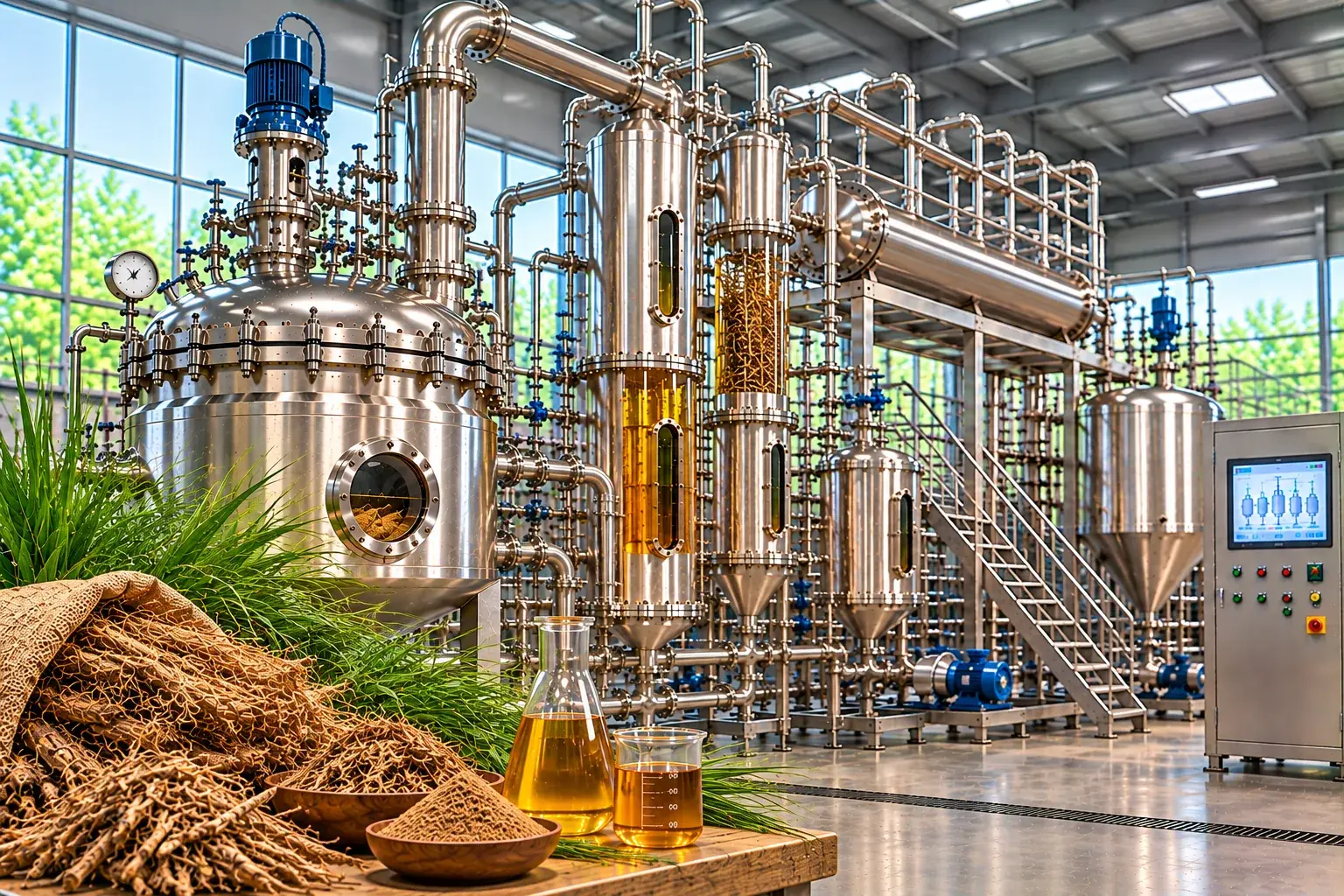
Mechotech designs and manufactures turnkey roots distillation plants for Vetiver (Vetiveria zizanioides), a grass whose fragrance value lies not in its leaves but in its dense fibrous root mass — a genuine departure from most essential-oil crops, where leaf or flower material dominates. As a vetiver oil extraction plant manufacturer, we supply the complete machinery — heavy-duty root washing, chopping, extended-cycle hydro/steam distillation, condensation, and oil-water separation — to process cleaned, cured vetiver roots into a heavy, viscous, deeply woody essential oil for the perfumery, fragrance, and flavour industries.
Mechotech's Vetiver plant is engineered around the specific processing demands of a root-based oil: vetiver roots carry far more adhering soil than leaf or flower feedstock, so the line opens with a heavy-duty washing and root-cleaning stage sized for grit and clay rather than the light rinse used for aerial plant parts. Vetiver oil is also genuinely one of the slowest, heaviest essential oils to distil — its sesquiterpenoid constituents (vetiverol, vetivone, and khusimol among the well-documented major components) are high-boiling and only release gradually from the root's fibrous, waxy tissue, so batch cycles run substantially longer than for leaf or flower oils, a real distillation-engineering fact rather than a marketing claim. Built in SS 316L with a still sized for extended-duration runs, high-capacity condensation, and PLC-based automation, each plant is delivered as a commissioned turnkey system suited to vetiver's uniquely demanding root-to-oil process.
Technical Specifications
| Product | Vetiver Root Oil Distillation Plant |
|---|---|
| Botanical Name | Vetiveria zizanioides (syn. Chrysopogon zizanioides) |
| Raw Material | Cleaned, cured vetiver roots |
| Plant Part | Root (fibrous root mass, not leaf or aerial growth) |
| Extract Type | Essential oil (heavy, viscous) and hydrosol co-product |
| Oil Chemistry | Sesquiterpenoid-rich — vetiverol, vetivone, and khusimol are well-documented major constituents; qualitative profile, no fabricated assay percentage |
| Extraction Method | Hydro-distillation / steam distillation, extended-cycle still |
| Product-contact Material | SS 316L, CIP-cleanable |
| Root Preparation | Heavy-duty washing to remove adhering soil, followed by chopping/size reduction |
| Distillation Cycle | Substantially longer than leaf/flower oils, reflecting vetiver oil's high-molecular-weight, high-boiling sesquiterpenoid fraction |
| Condensation & Separation | Multi-tube shell condenser with chilled-water circulation; stainless-steel Florentine flask for oil-water separation |
| Automation | Configurable — manual, semi-automatic or fully automatic PLC-SCADA |
| Plant Capacity | Configured to requirement — pilot to commercial scale |
| Utility Requirements | Steam, chilled/cooling water, compressed air, soft water, power (project-specific) |
| Compliance | GMP, ISO, IFRA-aligned hygienic design; export documentation support |
| Final Product Form | Heavy, viscous essential oil plus recoverable hydrosol |
Plant Capacities
| Plant Scale | Root Throughput | Typical Use |
|---|---|---|
| Pilot | Configured to your feedstock and trial plan | Distillation-cycle validation, oil-yield trials on new root lots |
| Semi-Commercial | Configured between pilot and commercial scale | Contract distillation, perfumery-house sample runs |
| Commercial | Configured to raw-material supply and confirmed buyer volume | Export-grade continuous vetiver oil production |
Because vetiver's extended distillation cycle ties up still capacity far longer per batch than leaf or flower oils, throughput planning should size still count and cycle time together, not batch weight alone; we recommend a pilot run to confirm optimum cycle length for your root lot before committing to commercial-scale still sizing.
Manufacturing Process
Root Reception, Washing & Cleaning
Harvested vetiver roots arrive carrying substantially more adhering soil, grit, and clay than leaf or flower feedstock. A heavy-duty washing and scrubbing stage — sized for this soil load rather than a light rinse — is essential before distillation, since residual earth both reduces still capacity and can taint the oil's aroma.
Root Chopping & Size Reduction
Cleaned roots are chopped or shredded to expose the fibrous internal tissue where the oil-bearing cells are concentrated, improving steam penetration and reducing the extended cycle time that whole, uncut roots would otherwise require.
Charging & Extended-Cycle Distillation
The prepared root charge is loaded into the SS 316L still and distilled by steam or hydro-distillation. Vetiver's sesquiterpenoid constituents are high-boiling and release slowly from the root's dense, waxy fibre, so the still is engineered for a substantially longer, heavier batch cycle than a leaf or flower distillation — a genuine, well-documented characteristic of vetiver processing, not a shortcut that can be safely compressed without yield loss.
Condensation
Vapours pass through a high-capacity multi-tube condenser with chilled-water circulation, sized to handle the longer vapour-release profile of a root distillation without bottlenecking cycle time.
Oil–Water Separation
Condensate is separated in a stainless-steel Florentine flask. Because vetiver oil is unusually heavy and viscous, separator geometry and residence time are tuned to fully resolve the oil from the hydrosol rather than leaving oil suspended in the aqueous phase — the hydrosol is drawn off and can be recovered as a co-product.
Polishing & Drying
The crude oil is polish-filtered and dried over anhydrous sodium sulphate (or by vacuum) to remove residual moisture, accounting for the oil's higher viscosity during filtration staging.
Quality Control
Each batch of vetiver oil is verified by GC-MS profiling of its sesquiterpenoid fraction alongside physical parameters (specific gravity, refractive index, optical rotation) before release.
Major Plant Equipment
- Root reception & heavy-duty washing/scrubbing system
- Root chopping / size-reduction machine
- SS 316L extended-cycle distillation still
- Steam generator / boiler interface
- High-capacity multi-tube condenser (chilled-water circulation)
- Stainless-steel Florentine oil-water separator
- Polish filtration & drying system
- Hydrosol collection tanks
- Essential-oil storage & drum-filling station
- CIP (clean-in-place) system
- PLC-SCADA automation, electrical MCC & instrumentation
Plant Output
Applications
- Fine fragrance and perfumery base/fixative applications
- Aromatherapy and wellness formulations
- Cosmetic and personal-care actives
- Flavour-house compounding for woody, earthy notes
- Ayurvedic and traditional medicine preparations
- Export to regulated-market perfumery and fragrance buyers
Key Features
Heavy-Duty Root Washing
A dedicated washing and scrubbing stage sized for vetiver's high adhering-soil load, distinct from the light rinse used on leaf or flower feedstock in Mechotech's other distillation lines.
Extended-Cycle Still Engineering
The still and utility sizing are configured for vetiver's genuinely longer, heavier distillation cycle, driven by the high-boiling sesquiterpenoid fraction locked in dense root fibre.
SS 316L Construction
All product-contact surfaces are SS 316L for corrosion resistance and product purity, with CIP capability between batches.
Viscous-Oil Separation Tuning
Florentine flask geometry and residence time are tuned for vetiver oil's unusually high viscosity, ensuring clean oil-water resolution rather than carryover losses.
Hydrosol Recovery
Integrated separation allows recovery of the aromatic hydrosol as a co-product.
Scalable Capacity
Plants are configured to requirement from pilot scale upward, with modular expansion.
Frequently Asked Questions
Why does vetiver oil take longer to distil than most essential oils?
Why is root washing so much more intensive for vetiver than for leaf-based oils?
Does Mechotech supply the complete machinery for Vetiver oil distillation?
What is the difference between vetiver oil and leaf-based essential oils in terms of processing?
What production capacities are available for the Vetiver oil plant?
Which industries use vetiver oil, and what quality control is applied?
Who supplies vetiver oil extraction plants and equipment?
Does the source of the vetiver root — North Indian versus South Indian (Khus) — affect the distillation setup?
Ready to discuss your project?
Get a free quote and technical consultation from our engineering team.