Patchouli
Patchouli
Purity Levels
Leaf (Pogostemon cablin) — patchoulol (patchouli alcohol)-rich sesquiterpene oil
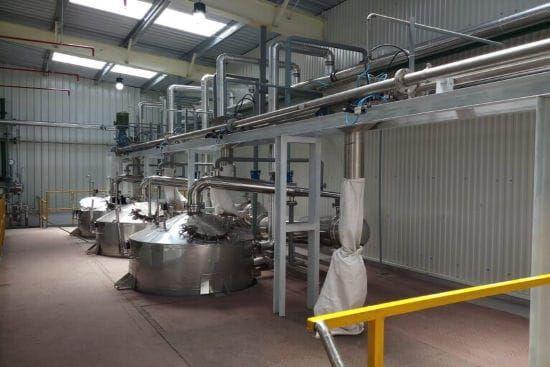
Mechotech designs and manufactures turnkey leaf oils distillation plants for Patchouli (Pogostemon cablin), whose fragrance value depends as much on how the leaf is handled before distillation as on the still itself: patchouli leaves are conventionally dried and lightly fermented (partially wilted and cured) prior to distillation, a genuine, well-documented pre-treatment step that develops the deep, earthy note the fragrance industry prizes. As a patchouli oil extraction plant manufacturer, we supply the complete machinery — leaf drying/curing, steam distillation, condensation, and oil-water separation — to process cured patchouli leaves into a consistent essential oil for the perfumery, fragrance, and flavour industries.
Mechotech's Patchouli plant is engineered around the specific chemistry and handling requirements of Pogostemon cablin leaf: the oil is dominated by patchoulol (patchouli alcohol), a well-documented sesquiterpene alcohol responsible for the oil's characteristic deep, woody-earthy base note. Unlike many essential oils that are distilled from fresh leaf immediately after harvest, patchouli leaf is conventionally dried and partially fermented/cured for a period before distillation, and — a genuinely distinctive, well-documented trait among common essential oils — the distilled oil itself continues to improve and deepen in character with age, so the plant's storage and drum-filling stage is designed for extended maturation rather than immediate dispatch. Built in SS 316L with integrated condensers, oil-water separation, PLC-based automation, and full documentation, each plant is delivered as a commissioned turnkey system suited to patchouli's cure-then-distil-then-age process chain.
Technical Specifications
| Product | Patchouli Leaf Oil Distillation Plant |
|---|---|
| Botanical Name | Pogostemon cablin |
| Raw Material | Dried and lightly fermented/cured patchouli leaves |
| Plant Part | Leaf |
| Extract Type | Essential oil and hydrosol co-product |
| Oil Chemistry | Patchoulol (patchouli alcohol)-dominant sesquiterpene oil; qualitative profile, no fabricated assay percentage |
| Extraction Method | Steam distillation / hydro-distillation following leaf drying-curing |
| Product-contact Material | SS 316L, CIP-cleanable |
| Leaf Pre-treatment | Drying and partial fermentation/curing to develop the characteristic deep, earthy note before distillation |
| Condensation & Separation | Multi-tube condenser with chilled-water circulation; stainless-steel Florentine flask for oil-water separation |
| Post-Distillation Maturation | Extended-storage capability, since patchouli oil is well known to deepen and improve with age |
| Automation | Configurable — manual, semi-automatic or fully automatic PLC-SCADA |
| Plant Capacity | Configured to requirement — pilot to commercial scale |
| Utility Requirements | Steam, chilled/cooling water, compressed air, soft water, power (project-specific) |
| Compliance | GMP, ISO, IFRA-aligned hygienic design; export documentation support |
| Final Product Form | Deep amber, viscous essential oil plus recoverable hydrosol |
Plant Capacities
| Plant Scale | Leaf Throughput | Typical Use |
|---|---|---|
| Pilot | Configured to your feedstock and trial plan | Cure-time and distillation-parameter validation on new leaf lots |
| Semi-Commercial | Configured between pilot and commercial scale | Contract distillation, perfumery-house sample runs |
| Commercial | Configured to raw-material supply and confirmed buyer volume | Export-grade continuous patchouli oil production |
Capacity is configured to raw-material supply and confirmed buyer volume; because leaf curing time ahead of distillation affects final oil character, we recommend a pilot run to validate cure duration and distillation parameters before scaling to commercial throughput.
Manufacturing Process
Leaf Reception, Drying & Curing
Harvested patchouli leaves are conventionally dried and lightly fermented/cured for a period before distillation — a genuine, well-documented step in patchouli processing that develops the deep, earthy note the fragrance industry associates with the oil, distinct from the fresh-leaf distillation used for most other leaf oils.
Charging & Distillation
The cured leaf charge is loaded into the SS 316L still and steam- or hydro-distilled, with cycle parameters tuned to recover the patchoulol-dominant sesquiterpene fraction without scorching the dried, cured leaf material.
Condensation
Vapours pass through an efficient multi-tube condenser with chilled-water circulation, condensing the volatile oil and hydrosol.
Oil–Water Separation
Condensate is separated in a stainless-steel Florentine flask; the essential oil is collected while the hydrosol is drawn off and can be recovered as a co-product.
Polishing & Drying
The crude oil is polish-filtered and dried over anhydrous sodium sulphate (or by vacuum) to remove residual moisture ahead of storage.
Maturation & Storage
Because patchouli oil is well documented to deepen and mellow with age, finished oil is held in appropriately sized, sealed storage vessels for a maturation period before drum-filling and dispatch — a distillation-to-maturation chain distinct from oils sold immediately post-distillation.
Quality Control
Each batch of patchouli oil is verified by GC-MS profiling of its patchoulol fraction alongside physical parameters (specific gravity, refractive index, optical rotation) before release.
Major Plant Equipment
- Leaf reception, drying & curing/fermentation system
- SS 316L distillation still
- Steam generator / boiler interface
- Multi-tube condenser (chilled-water circulation)
- Stainless-steel Florentine oil-water separator
- Polish filtration & drying system
- Hydrosol collection tanks
- Sealed maturation storage vessels
- Drum-filling station
- CIP (clean-in-place) system
- PLC-SCADA automation, electrical MCC & instrumentation
Plant Output
Applications
- Fine fragrance and perfumery base-note applications
- Aromatherapy and wellness formulations
- Cosmetic and personal-care actives
- Incense and traditional fragrance preparations
- Flavour-house compounding for earthy, woody notes
- Export to regulated-market perfumery and fragrance buyers
Key Features
Integrated Leaf Curing Stage
Dedicated drying and fermentation/curing capacity ahead of the still, reflecting patchouli's genuine, well-documented need for cured (not fresh) leaf to develop its characteristic aroma.
SS 316L Construction
All product-contact surfaces are SS 316L for corrosion resistance and product purity, with CIP capability between batches.
Efficient Condensation
High-surface-area multi-tube condensers with chilled-water circulation maximise oil recovery from the cured-leaf distillation.
Maturation-Ready Storage
Storage and filling stages are sized to allow patchouli oil to age and deepen in character before dispatch, rather than forcing immediate bottling.
Hydrosol Recovery
Integrated separation allows recovery of the aromatic hydrosol as a co-product.
Scalable Capacity
Plants are configured to requirement from pilot scale upward, with modular expansion.
Frequently Asked Questions
Why are patchouli leaves dried and fermented before distillation instead of distilled fresh?
Is it true that patchouli oil improves with age?
Does Mechotech supply the complete machinery for Patchouli oil distillation?
What compound gives patchouli oil its characteristic aroma?
What production capacities are available for the Patchouli oil plant?
Which industries use patchouli oil, and what quality control is applied?
Who supplies patchouli oil extraction plants and equipment?
How is patchouli's leaf-based process different from Mechotech's root and heartwood distillation lines?
Ready to discuss your project?
Get a free quote and technical consultation from our engineering team.