Clary Sage Oil — Steam-Distilled, Linalyl Acetate & Sclareol Profile
Clary Sage Oil — Steam-Distilled, Linalyl Acetate & Sclareol Profile
Purity Levels
Steam-distilled essential oil; linalyl acetate and linalool as the principal esters/alcohols, with sclareol (a diterpene) as a distinctive companion constituent — profile confirmed batch-to-batch by GC-MS rather than guaranteed as a fixed spec
Mechotech designs and manufactures turnkey steam-distillation plants for Clary Sage (Salvia sclarea), converting flowering tops, buds and leaves into an essential oil valued for both its linalyl-acetate/linalool aroma profile and its distinctive sclareol content. We supply the complete machinery — feedstock preparation, steam/hydro-distillation, condensation, oil-water separation, polishing and quality control — for the fragrance, cosmetic, and nutraceutical industries. Sclareol, a diterpene largely specific to clary sage among common aromatic crops, gives the oil a genuinely differentiated position as a natural fragrance fixative with phytoestrogen-adjacent structural interest for cosmetic and wellness formulators.
Mechotech's Clary Sage plant is engineered around the crop's flowering-stage harvest and its two-part value: a floral, herbaceous ester/alcohol fraction (linalyl acetate and linalool) that gives the oil its fragrance character, and a heavier, less-volatile sclareol fraction that behaves as a natural fixative and is the plant's most chemically distinctive marker. Distillation parameters are set to recover both fractions efficiently — long enough to draw over the higher-boiling sclareol-adjacent compounds without scorching the delicate ester top-notes. This dual-fraction target is what most clearly sets clary sage apart from the simpler, single-dominant-compound chemistry of peppermint (menthol) and spearmint (carvone) processed on the same class of still, and it is why cycle timing is set crop-by-crop rather than reused unchanged from a generic mint recipe. Built in SS 316L with high-surface-area condensers, chilled-water circulation, and PLC-based automation, each plant is delivered as a commissioned turnkey system, with every batch confirmed by GC-MS and physical parameters before release. Any discussion of clary sage's phytoestrogen-adjacent interest is presented here as a structural, compositional fact about sclareol, not a medical or therapeutic claim.
Technical Specifications
| Product | Clary Sage Oil Distillation Plant |
|---|---|
| Botanical Name | Salvia sclarea |
| Raw Material | Fresh flowering tops, buds and leaves |
| Plant Part | Flowers / buds / leaves |
| Extract Type | Steam-distilled essential oil (with hydrosol as co-product) |
| Dominant Constituents | Linalyl acetate and linalool (esters/alcohols); sclareol (diterpene) as a distinctive companion marker — confirmed per batch by GC-MS |
| Extraction Method | Steam distillation / hydrodistillation |
| Product-contact Material | SS 316L, CIP-cleanable |
| Condensation System | Multi-tube shell-and-tube condenser, chilled-water circulation |
| Oil–Water Separation | Stainless-steel Florentine separator with hydrosol draw-off |
| Polishing | Polish filtration and anhydrous drying (sodium sulphate or vacuum) |
| Automation | Configurable — manual, semi-automatic or fully automatic PLC-SCADA |
| Plant Capacity | Configured to requirement — pilot to commercial scale |
| Utility Requirements | Steam, chilled/cooling water, compressed air, power (project-specific) |
| Compliance | GMP, HACCP, FSSAI hygienic design; full documentation for qualification |
| Final Product Form | Essential oil (with recoverable clary sage hydrosol) |
Plant Capacities
| Plant Scale | Flower/Leaf Throughput | Typical Use |
|---|---|---|
| Pilot | Configured to your feedstock and trial plan | Trial runs, flowering-stage timing validation |
| Semi-Commercial | Configured between pilot and commercial scale | Contract distillation, seasonal harvest processing |
| Commercial | Configured to raw-material supply and confirmed buyer volume | Continuous-season, export-volume production |
Because clary sage is harvested as flowering tops rather than a repeatedly-cuttable leaf crop, the harvest window is genuinely narrower and more seasonal than for mint-type leaf oils — the whole crop reaches peak bud/flower condition together and must be distilled within that window, rather than being cut in multiple flushes across a season. Campaign scheduling and still-count sizing should account for this concentrated harvest rather than assume mint-style, spread-out throughput; we recommend a pilot plant to validate linalyl-acetate and sclareol recovery on your specific crop before scaling.
Manufacturing Process
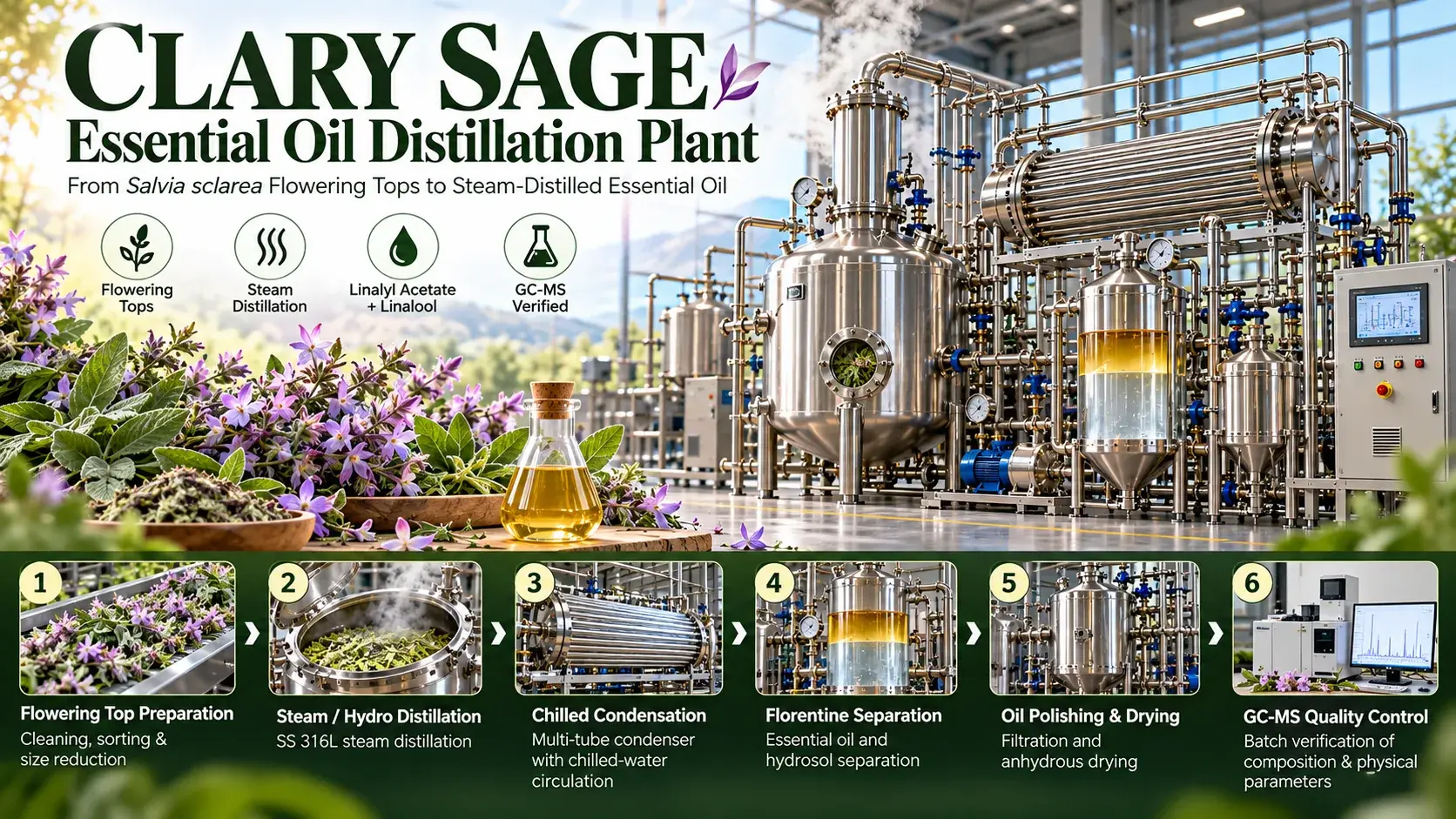
Raw Material Reception & Sorting
Freshly harvested clary sage flowering tops, buds and leaves are received and inspected, since oil composition — particularly the sclareol fraction — is sensitive to harvest stage and freshness.
Charging & Steam Distillation
The prepared flower/leaf charge is loaded into the SS 316L still on a perforated false-bottom or basket system and distilled by direct steam or hydrodistillation, run long enough to draw over both the volatile ester/alcohol fraction and the heavier sclareol-adjacent compounds.
Condensation
Vapours pass through a high-surface-area multi-tube condenser with chilled-water circulation, condensing the volatile oil and aromatic hydrosol together for downstream separation.
Oil–Water Separation
Condensate is separated in a stainless-steel Florentine flask; the clary sage oil is decanted off while the hydrosol is drawn off separately as a co-product.
Polishing & Drying
The crude oil is polish-filtered and dried over anhydrous sodium sulphate (or under vacuum) to remove residual moisture and fine particulate before packing.
Quality Control
Each batch of clary sage oil is verified by GC-MS for linalyl acetate, linalool and sclareol profile, plus physical parameters (specific gravity, refractive index, optical rotation) before release with a certificate of analysis.
Major Plant Equipment
- Flower/leaf reception and sorting area
- Loading conveyor / charge basket system
- SS 316L distillation still (steam/hydrodistillation)
- Steam generator / boiler interface
- Multi-tube shell-and-tube condenser with chilled-water circulation
- Stainless-steel Florentine oil-water separator
- Hydrosol collection and storage tanks
- Polish filtration unit
- Anhydrous drying system (sodium sulphate or vacuum)
- Essential-oil storage and filling tanks
- CIP (clean-in-place) system
- PLC-SCADA control panel, electrical MCC & instrumentation
Plant Output
Applications
- Fine fragrance and perfumery — natural fixative use
- Cosmetic and personal-care formulations
- Nutraceutical and wellness formulations (structural/compositional interest, not a medical claim)
- Aromatherapy applications
- Pharmaceutical standardised ingredient supply
- Natural fixative supply for niche and indie perfumery
- Export to regulated-market ingredient buyers
Key Features
Dual-Fraction Distillation Profile
Distillation timing is set to recover both the volatile linalyl-acetate/linalool ester fraction and the heavier sclareol-adjacent fraction in a single run.
SS 316L Construction
All product-contact surfaces are SS 316L for corrosion resistance and product purity, with CIP capability between batches.
Efficient Condensation
High-surface-area multi-tube condensers with chilled-water circulation maximise oil recovery and minimise losses of volatile top-notes.
Hydrosol Recovery
Integrated Florentine separation allows recovery of clary sage hydrosol as a co-product.
GC-MS Batch Verification
Every batch is verified against linalyl acetate, linalool and sclareol profile before release, supporting consistent fragrance- and cosmetic-industry quality.
Scalable Seasonal Capacity
Plants are configured from pilot to commercial scale with modular expansion to match harvest volume growth.
Frequently Asked Questions
What is a clary sage oil distillation plant?
What makes clary sage oil chemically distinctive?
Is the phytoestrogen-adjacent interest in clary sage a medical claim?
How does clary sage's process differ from peppermint or spearmint distillation?
What plant part is used, and does harvest timing matter?
What production capacities are available for the clary sage plant?
Which industries buy clary sage oil, and does Mechotech provide turnkey installation?
Ready to discuss your project?
Get a free quote and technical consultation from our engineering team.