Roots - Turmeric / Blood Root
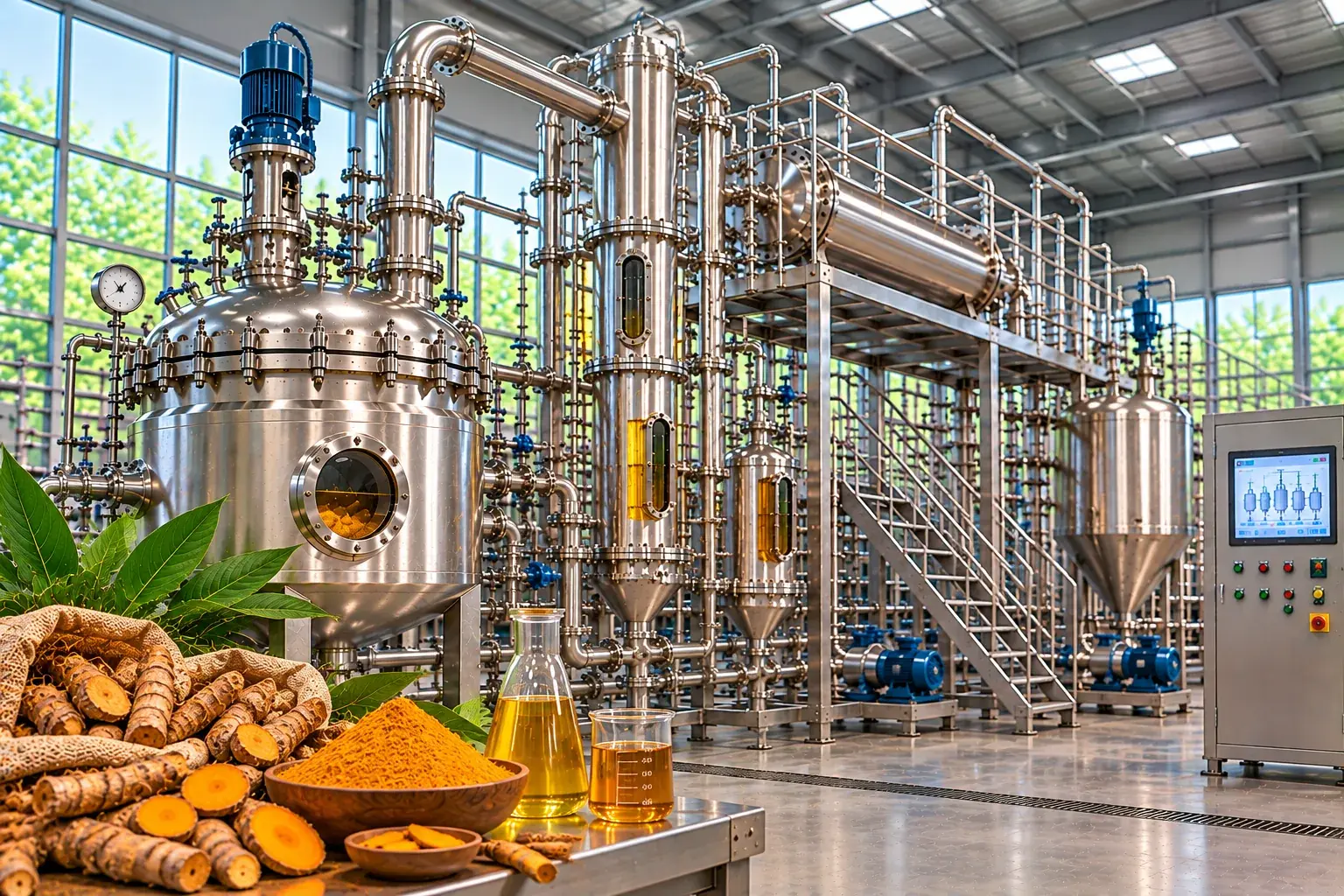
Roots - Turmeric / Blood Root
Mechotech designs and manufactures turnkey natural colour extraction plants for turmeric and bloodroot orange colour. In the Mechotech catalogue, Roots - Turmeric / Blood Root is listed in the Orange Colour group alongside Skins - Brown Onion, Plant - Gaint Coreopsis / BarBerry and Leaves - Eucalyptus. According to Mechotech’s article on orange colour extraction from turmeric and bloodroot, the entry combines two strongly coloured sources: turmeric (Curcuma longa), whose curcuminoids, chiefly curcumin, give a golden-yellow to orange colour, and bloodroot (Sanguinaria canadensis), whose rhizome sap carries the red-orange alkaloid sanguinarine and related benzophenanthridine alkaloids. The article says the two let a producer build an orange by combining curcumin’s golden-orange with the redder alkaloid tone, steered by the ratio, the pH and the extraction solvent. The catalogue entry does not say whether the two are processed together or separately, so that is confirmed with the client.
Mechotech’s Roots - Turmeric / Blood Root plant is configured around the raw material and the target colour extract. It is built in SS 316L with integrated solvent recovery, automation and full documentation, and is delivered as a commissioned turnkey system. The article describes preparation by washing, moderate drying and fine grinding, then three extraction routes of increasing purity: water simmering (simple but lower yield, because curcumin is poorly water-soluble), ethanol or acetone solvent extraction with concentration to oleoresin and higher-curcumin colour (the standard industrial method), and supercritical CO2 extraction. The route, the stabilisation steps and the turmeric-to-bloodroot arrangement for a given project are established during process development and pilot validation.
Technical Specifications
| Product | Roots - Turmeric / Blood Root Natural Colour Extraction Plant |
|---|---|
| Raw Material | Turmeric and bloodroot (catalogue name: Roots - Turmeric / Blood Root) |
| Botanical Name | Curcuma longa (turmeric) and Sanguinaria canadensis (bloodroot), per Mechotech’s article; the product tree names no species |
| Plant Part / Feed Form | Turmeric rhizome (washed, dried at a controlled 50 to 60 degrees Celsius and ground fine, per the article) and bloodroot rhizome (red-orange sap); the catalogue says ‘Roots’, so the exact feed forms are confirmed with the client |
| Colour Group | Orange Colour (see the Orange Colour page) |
| Colour-forming Components | Curcuminoids, chiefly curcumin, for golden-yellow to orange (E100 as a food additive), and sanguinarine with related benzophenanthridine alkaloids for red-orange; both are more soluble in solvents than in water (per the article) |
| Process Category | Natural Colour Extraction Plants |
| Extract Type | Natural colour extract (liquid concentrate or dried powder, per specification) |
| Extraction Method | Water simmering, ethanol or acetone solvent extraction with concentration to oleoresin, or supercritical CO2 extraction (the three routes in the article), in closed jacketed SS 316L vessels; route confirmed during process development |
| Product-contact Material | SS 316L |
| Filtration System | Plate-and-frame filter press with cartridge polish filters |
| Concentration System | Falling-film / vacuum evaporator with solvent recovery where a solvent is used |
| Drying System | Spray or vacuum dryer, where a powder is required |
| Automation | PLC-based |
| Plant Capacity | Configured to requirement |
| Utility Requirements | Steam, chilled/cooling water, compressed air and power (project-specific) |
| Compliance | GMP hygienic design; full documentation for qualification |
| Final Product Form | Natural colour extract (orange colour group) |
Plant Capacities
| Plant Scale | Raw Material Throughput | Typical Use |
|---|---|---|
| Pilot | Configured to your feedstock and trial plan | Product development, parameter validation |
| Semi-Commercial | Configured between pilot and commercial scale | Scale-up trials, contract manufacturing |
| Commercial | Configured to raw-material supply and confirmed buyer volume | Commercial production |
Capacity is configured to raw-material supply, confirmed buyer volume and investment timeline; a pilot plant is recommended to validate parameters before scaling.
Manufacturing Process
Raw Material Preparation
Turmeric rhizomes are washed to remove soil and debris and dried at a controlled 50 to 60 degrees Celsius, because excessive heat degrades curcumin, then crushed and milled to a fine powder so the solvent can reach the pigment; the article notes mature rhizomes harvested eight to ten months after planting give the strongest colour. Bloodroot rhizomes are handled similarly, with care for their potent alkaloids.
Extraction
The prepared material is extracted by the route chosen for the grade: water simmering for basic food and textile use, ethanol or acetone solvent extraction for higher yield, or supercritical CO2 for very high-purity colour with essentially no residual solvent, as the article describes. The route, solvent and temperature are set during process development.
Filtration
The extract is separated from the spent material and clarified through a plate-and-frame filter press and cartridge polish filters.
Concentration & Solvent Recovery
A solvent extract is concentrated by evaporating the solvent to give turmeric oleoresin and, after further purification, higher-curcumin colour, in a falling-film / vacuum evaporator with solvent recovered through the condenser return system.
Standardisation & Stabilisation
The colour is adjusted to the target shade and strength. The article says acidic to neutral pH holds the yellow-orange while alkali turns it red-brown, and that light and heat exposure are minimised because curcumin is light-sensitive; the turmeric-to-bloodroot ratio steers the hue.
Finishing & Quality Control
For food and other demanding uses the article notes the pigment is often microencapsulated with carriers such as maltodextrin or starch to protect the light-sensitive curcumin and improve dispersibility and shelf life. The finished colour is released after assay, residual-solvent, heavy-metal, microbial and moisture testing.
Major Plant Equipment
- Raw material cleaning, authentication and moisture testing
- Drying unit (moderate temperature)
- Mill (fine size reduction)
- Closed jacketed SS 316L extraction vessels
- Solvent storage tanks
- Plate-and-frame filter press
- Cartridge polish filtration
- Falling-film / vacuum evaporator
- Solvent recovery unit and condensers
- Standardisation / blending vessel with pH control
- Microencapsulation or spray dryer (optional, per grade)
- CIP system
- Automation and instrumentation
Plant Output
Applications
- Natural orange colour for food, textile and cosmetic markets (per the article)
- Turmeric oleoresin and purified curcumin colour (per the article)
- Bloodroot red-orange for specialist dyeing (per the article)
- Natural colour and dye ingredient supply
Key Features
SS 316L Construction
Electropolished SS 316L product-contact surfaces with CIP operation between batches.
Two Pigments, One Orange Range
The article combines curcumin’s golden-orange with bloodroot’s redder alkaloid tone, steered by ratio, pH and solvent, so the plant is configured around the shade the client targets.
Route Chosen by Purity
Water, solvent and supercritical CO2 routes of increasing purity are described in the article; the plant is configured to the one that fits the grade.
Light-, Heat- and pH-Aware Handling
The article describes curcumin as sensitive to light, heat and alkaline pH, so processing is held at moderate temperature and low light exposure.
Alkaloid-Aware Handling
The article notes bloodroot alkaloids are bioactive and handled with care; containment and operating procedure are defined with the client.
Scalable Batch Capacity
Plants are configured to requirement from pilot scale upward, with modular expansion.
Frequently Asked Questions
Does Mechotech supply the complete machinery for Roots - Turmeric / Blood Root?
What specification can the Roots - Turmeric / Blood Root plant achieve?
What production capacities are available for the Roots - Turmeric / Blood Root plant?
Which industries use the Roots - Turmeric / Blood Root plant?
Which plants are on this page, and which parts are used?
What compound makes turmeric orange?
What is bloodroot and what colour does it give?
Why use solvent or CO2 rather than water?
How is turmeric orange colour kept stable?
How does this page differ from the other turmeric and orange pages?
Where does this page sit in the Orange Colour range?
Ready to discuss your project?
Get a free quote and technical consultation from our engineering team.