Roots - Turmeric
Roots - Turmeric
Mechotech designs and manufactures turnkey natural colour extraction plants for turmeric. In the Mechotech catalogue, Roots - Turmeric is listed in the Yellow Colour group alongside leaf, saffron, marigold and goldenrod, St. John’s wort, Osage orange, brown onion skin and annatto entries. According to Mechotech’s article on yellow colour extraction from turmeric roots, the raw material is the rhizome of Curcuma longa and the colour comes from the curcuminoids, with curcumin the dominant compound (typically three-quarters or more of the total) beside demethoxycurcumin and bisdemethoxycurcumin. The article stresses that curcumin is fat-soluble and essentially insoluble in water, so colour extraction relies on food-grade solvent rather than water, followed by concentration, crystallisation and standardisation. The catalogue entry says ‘Roots’ while the article takes the rhizome, so the exact feed form is confirmed with the client.
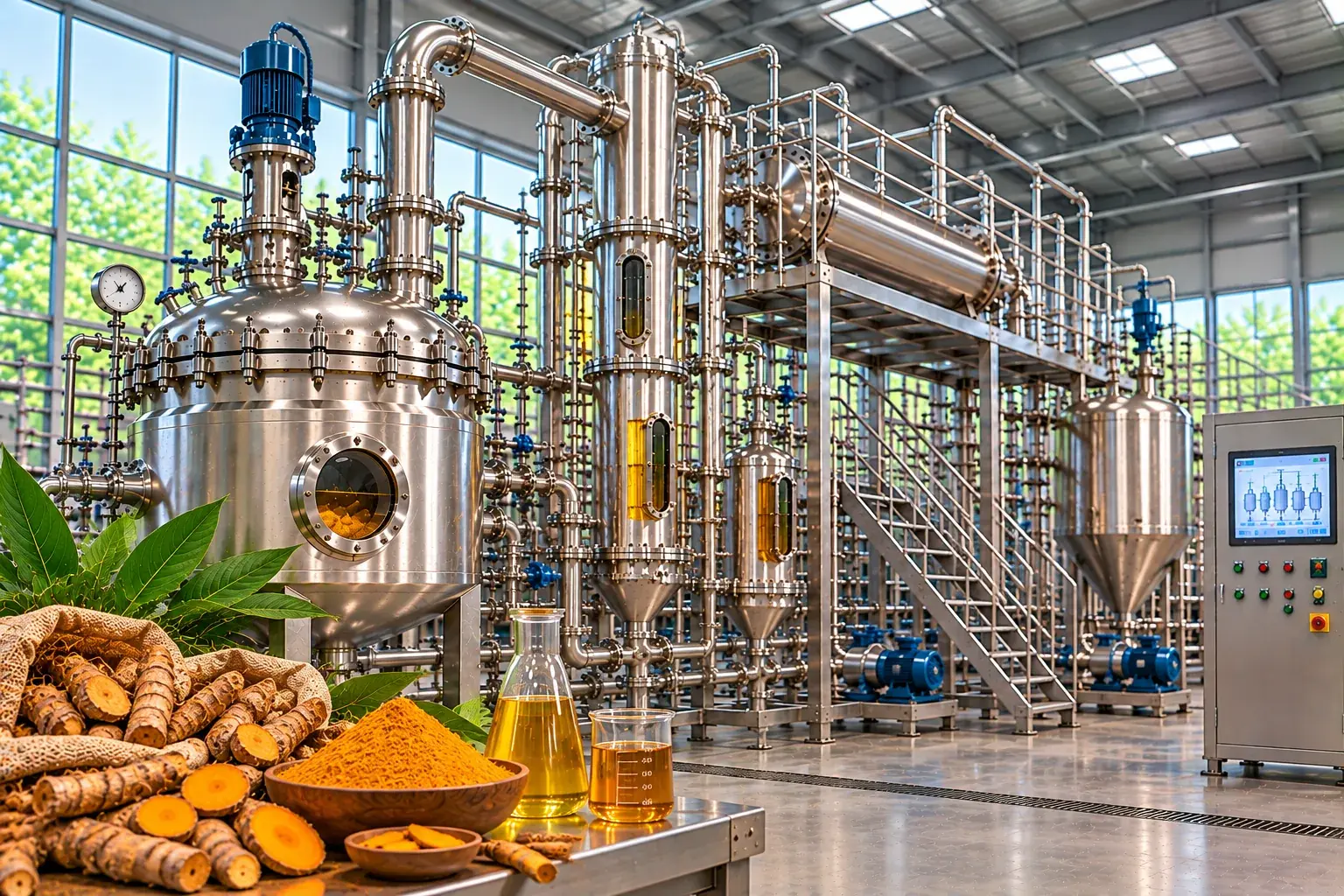
Mechotech’s Roots - Turmeric plant is configured around the raw material and the target colour extract. It is built in SS 316L with integrated solvent recovery, automation and full documentation, and is delivered as a commissioned turnkey system. The article describes a solvent route: dried, cured rhizomes milled to a fine powder, warm multi-stage extraction with ethanol or acetone with agitation, filtration and vacuum concentration with solvent recovery to a dark orange curcumin-rich oleoresin, selective crystallisation to raise curcuminoid content, and standardisation to a declared colour strength, with temperature and light exposure controlled because the pigment is heat- and light-sensitive. The solvent, conditions and grade for a given project are established during process development and pilot validation.
Technical Specifications
| Product | Roots - Turmeric Natural Colour Extraction Plant |
|---|---|
| Raw Material | Turmeric rhizomes (catalogue name: Roots - Turmeric) |
| Botanical Name | Curcuma longa (per Mechotech’s article) |
| Plant Part / Feed Form | Cured, dried rhizome, milled to a fine powder (per the article); the catalogue says ‘Roots’, so the exact feed form is confirmed with the client |
| Colour Group | Yellow Colour (see the Yellow Colour page) |
| Colour-forming Components | Curcuminoids: curcumin (dominant), demethoxycurcumin and bisdemethoxycurcumin; fat-soluble, essentially water-insoluble, pH-responsive and light-sensitive (per the article) |
| Process Category | Natural Colour Extraction Plants |
| Extract Type | Natural colour extract (curcumin-rich oleoresin or crystallised grade, per specification) |
| Extraction Method | Warm, agitated, multi-stage extraction with food-grade ethanol or acetone in closed jacketed SS 316L vessels, with vacuum concentration and solvent recovery, then selective crystallisation (per the article); route confirmed during process development |
| Product-contact Material | SS 316L |
| Filtration System | Plate-and-frame filter press with cartridge polish filters |
| Concentration System | Falling-film / vacuum evaporator with solvent recovery where a solvent is used |
| Drying System | Spray or vacuum dryer, where a powder is required |
| Automation | PLC-based |
| Plant Capacity | Configured to requirement |
| Utility Requirements | Steam, chilled/cooling water, compressed air and power (project-specific) |
| Compliance | GMP hygienic design; full documentation for qualification |
| Final Product Form | Natural colour extract (yellow colour group); curcuminoid-rich colour as oleoresin or crystallised grade, per specification |
Plant Capacities
| Plant Scale | Raw Material Throughput | Typical Use |
|---|---|---|
| Pilot | Configured to your feedstock and trial plan | Product development, parameter validation |
| Semi-Commercial | Configured between pilot and commercial scale | Scale-up trials, contract manufacturing |
| Commercial | Configured to raw-material supply and confirmed buyer volume | Commercial production |
Capacity is configured to raw-material supply, confirmed buyer volume and investment timeline; a pilot plant is recommended to validate parameters before scaling.
Manufacturing Process
Raw Material Preparation
Cured, dried turmeric rhizomes are milled to a fine, uniform powder to maximise the surface exposed to solvent; the article notes that fine particle size markedly increases yield and that the curcuminoid content, which varies by variety and origin, is verified on receipt to protect finished colour strength.
Extraction
The powder is extracted with food-grade ethanol or acetone in closed jacketed SS 316L vessels, warm and with agitation, over several stages so the lipophilic curcuminoids dissolve into a coloured miscella before the spent marc is separated. The article notes that water-based extraction recovers very little because curcumin is water-insoluble; the solvent and temperature are set during process development.
Filtration
The miscella is separated from the spent marc and clarified through a plate-and-frame filter press and cartridge polish filters.
Concentration & Solvent Recovery
The combined miscella is concentrated under vacuum in a falling-film / vacuum evaporator, with the solvent recovered through the condenser return system to control cost and meet residual-solvent limits. This yields the dark orange, curcumin-rich oleoresin described in the article.
Purification & Standardisation
Where a higher grade is required, the concentrate is purified by selective crystallisation to raise curcuminoid content toward food-colour grade, then standardised to a declared colour strength. The article names temperature control and light exclusion as protection for the heat- and light-sensitive pigment.
Finishing & Quality Control
The finished colour is tested for curcuminoid content, residual solvent, heavy metals and microbial quality before release. Because curcumin is water-insoluble, the article notes that food grades are often supplied as oil suspensions or as water-dispersible formats produced by encapsulation; the finishing form is agreed with the client.
Major Plant Equipment
- Raw material cleaning, authentication and moisture testing
- Mill (fine size reduction)
- Closed jacketed SS 316L extraction vessels (multi-stage)
- Solvent storage tanks
- Plate-and-frame filter press
- Cartridge polish filtration
- Falling-film / vacuum evaporator
- Solvent recovery unit and condensers
- Crystallisation vessel (for higher curcuminoid grades)
- Standardisation / blending vessel
- Encapsulation or oil-suspension formulation unit (optional, per grade)
- CIP system
- Automation and instrumentation
Plant Output
Case Study
Curcumin Extraction Plant
See how this plant was engineered and delivered for a real project.
Applications
- Natural yellow food colour (curcumin, E100) for products such as mustard, savoury seasonings, dairy, bakery, confectionery and beverages (per the article)
- Clean-label replacement of synthetic yellows in reformulation (per the article)
- Cosmetic and personal-care colour and antioxidant-character applications (per the article)
- Traditional textile dyeing of cotton and silk in vivid yellows, mostly ceremonial and artisanal use because of modest light-fastness (per the article)
Key Features
SS 316L Construction
Electropolished SS 316L product-contact surfaces with CIP operation between batches.
Solvent Route for a Fat-Soluble Pigment
The plant follows the article’s solvent extraction of curcuminoids, with vacuum concentration and solvent recovery, because curcumin is essentially insoluble in water.
Heat- and Light-Aware Processing
Controlled temperature and light exclusion protect the pigment, which the article describes as sensitive to heat, light and alkaline pH.
Crystallisation to Raise Curcuminoid Content
Selective crystallisation can be added to take the oleoresin toward food-colour grade, with the grade set during process development.
Oil-Suspension or Water-Dispersible Grades
The article notes that encapsulation or oil suspension lets one line supply water-dispersible and oil-soluble colour grades; the grade is agreed with the client.
Scalable Batch Capacity
Plants are configured to requirement from pilot scale upward, with modular expansion.
Frequently Asked Questions
Does Mechotech supply the complete machinery for Roots - Turmeric?
What specification can the Roots - Turmeric plant achieve?
What production capacities are available for the Roots - Turmeric plant?
Which industries use the Roots - Turmeric plant?
Which part of turmeric is processed?
What gives turmeric its yellow colour?
Why is turmeric colour extracted with solvent rather than water?
Can the plant supply water-dispersible colour?
Can turmeric be used as a textile dye?
How does this page differ from the other turmeric pages?
Is there a related Mechotech case study?
Where does this page sit in the Yellow Colour range?
Ready to discuss your project?
Get a free quote and technical consultation from our engineering team.