Flowers - MariGold / Queen Annes Lace / Golden Rod
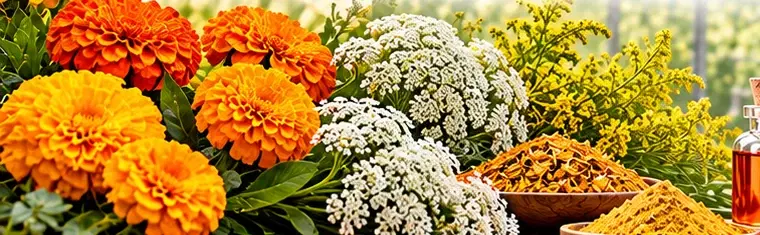
Flowers - MariGold / Queen Annes Lace / Golden Rod
Mechotech designs and manufactures turnkey natural colour extraction plants for marigold, Queen Anne’s lace and goldenrod flowers. In the Mechotech catalogue, Flowers - MariGold / Queen Annes Lace / Golden Rod is listed in the Yellow Colour group alongside Leaves - Bay Leaves / Tea, Stamens - Saffron, Plant - St. John's Wort / Larkspur, Roots - Turmeric, Innerbark or Shavings - Osage Orange, Skins - Brown Onion and Seeds - Annotto. The three flowers carry two different pigment families: marigold’s colour is carried by fat-soluble lutein-type carotenoids, recovered with food-grade solvent, while Queen Anne’s lace and goldenrod owe their yellow to water-soluble flavonoids, recovered by aqueous extraction. The plant is configured per flower and per pigment family.
Mechotech’s Marigold / Queen Anne’s Lace / Goldenrod plant is configured around the raw material and the target colour extract. It is built in SS 316L with integrated solvent recovery, automation and full documentation, and is delivered as a commissioned turnkey system. Because the pigment families differ in solubility, the solvent system and the order of steps are set per flower during process development. Final parameters are established during process development and pilot validation.
Technical Specifications
| Product | Flowers - MariGold / Queen Annes Lace / Golden Rod Natural Colour Extraction Plant |
|---|---|
| Botanical Name | Tagetes erecta (marigold), Daucus carota (Queen Anne’s lace) and Solidago spp. (goldenrod), as described in Mechotech’s colour-extraction article |
| Raw Material | marigold, Queen Anne’s lace and goldenrod flowers |
| Plant Part / Feed Form | Flowers (marigold petals; Queen Anne’s lace flower heads; goldenrod flowering tops — form confirmed with the client) |
| Colour Group | Yellow Colour |
| Pigment Class | Carotenoids (marigold lutein and related xanthophylls) and flavonoids (Queen Anne’s lace, goldenrod) |
| Extract Type | Natural colour extract (liquid concentrate or dried powder, per specification) |
| Extraction Method | Closed jacketed SS 316L extraction with food-grade solvent (alcohol / aqueous), multiple cycles at controlled temperature |
| Product-contact Material | SS 316L |
| Filtration System | Plate-and-frame filter press with cartridge polish filters |
| Concentration System | Falling-film / vacuum evaporator with solvent recovery |
| Drying System | Spray or vacuum dryer |
| Automation | PLC-based |
| Plant Capacity | Configured to requirement |
| Utility Requirements | Steam, chilled/cooling water, compressed air and power (project-specific) |
| Compliance | GMP hygienic design; full documentation for qualification |
| Final Product Form | Natural colour extract (yellow colour group) |
Plant Capacities
| Plant Scale | Raw Material Throughput | Typical Use |
|---|---|---|
| Pilot | Configured to your feedstock and trial plan | Product development, parameter validation |
| Semi-Commercial | Configured between pilot and commercial scale | Scale-up trials, contract manufacturing |
| Commercial | Configured to raw-material supply and confirmed buyer volume | Commercial production |
Capacity is configured to raw-material supply, confirmed buyer volume and investment timeline; a pilot plant is recommended to validate parameters before scaling.
Manufacturing Process
Raw Material Preparation
Flowers are sorted and cleaned of impurities. Marigold petals are dried and, where required, pelletised or milled; Queen Anne’s lace and goldenrod flower heads are cut or milled to a size suited to aqueous extraction.
Extraction
The prepared marigold, Queen Anne’s lace and goldenrod flowers is extracted with food-grade solvent (alcohol / aqueous) in closed jacketed SS 316L extractors at controlled temperature and over multiple cycles to recover the target colour compounds.
Filtration
The extract (miscella) is clarified through a plate-and-frame filter press followed by cartridge polish filters.
Concentration & Solvent Recovery
The miscella is concentrated in a falling-film / vacuum evaporator, with solvent recovered through the condenser return system so that heat exposure of the pigment stays low.
Standardisation
The concentrate is assayed for colour strength and adjusted to the declared target specification before the final finishing step.
Drying & Quality Control
The standardised Flowers - MariGold / Queen Annes Lace / Golden Rod extract is spray- or vacuum-dried where a powder is required, then released after the agreed assay, residual-solvent, heavy-metal, microbial and moisture tests.
Major Plant Equipment
- Raw material cleaning and size-reduction system
- Closed jacketed SS 316L extraction vessels
- Solvent storage tanks
- Plate-and-frame filter press
- Cartridge polish filtration
- Falling-film / vacuum evaporator
- Solvent recovery unit and condensers
- Standardisation / blending vessel
- Spray or vacuum dryer
- CIP system
- Automation and instrumentation
Plant Output
Applications
- Natural colour and dye ingredient supply
- Food and beverage colour applications (subject to approval of the specific colour in each market)
- Cosmetic and personal-care colour applications
- Nutraceutical and Ayurvedic / herbal formulations
- Pharmaceutical standardised ingredient supply
Key Features
SS 316L Construction
Electropolished SS 316L product-contact surfaces with CIP operation between batches.
Closed-Loop Solvent Recovery
Integrated condenser-return recovery reuses solvent between batches and reduces solvent loss.
Two-Pigment-Family Flexibility
The plant can be configured for solvent extraction of carotenoid pigments from marigold and aqueous extraction of flavonoid pigments from Queen Anne’s lace and goldenrod.
Standardised to Specification
In-process and batch-release assay are used to check the finished extract against its declared target specification.
Gentle Concentration
Vacuum concentration keeps heat exposure low for temperature-sensitive colour compounds.
Scalable Batch Capacity
Plants are configured to requirement from pilot scale upward, with modular expansion.
Frequently Asked Questions
Does Mechotech supply the complete machinery for Flowers - MariGold / Queen Annes Lace / Golden Rod?
What specification can the Flowers - MariGold / Queen Annes Lace / Golden Rod plant achieve?
What production capacities are available for the Flowers - MariGold / Queen Annes Lace / Golden Rod plant?
Which raw material is processed in the Flowers - MariGold / Queen Annes Lace / Golden Rod plant?
How does the Flowers - MariGold / Queen Annes Lace / Golden Rod extraction process work?
What pigments do these flowers carry, and does the route differ by flower?
How does this page differ from Mechotech’s other marigold pages?
Which related colour pages does Mechotech list with Flowers - MariGold / Queen Annes Lace / Golden Rod?
Ready to discuss your project?
Get a free quote and technical consultation from our engineering team.